Suspension location for suspension pedestal

  • Thread starter Thread starter Bart van Driessche
  • Start date Start date
  • Tags Tags
    Suspension
Click For Summary

Discussion Overview

The discussion revolves around the design and optimization of a suspension pedestal for applications in boats and truck seats. Participants explore the impact of shock absorber placement and the center of gravity on the system's effectiveness, focusing on theoretical and practical implications for comfort and functionality.

Discussion Character

  • Exploratory
  • Technical explanation
  • Debate/contested
  • Mathematical reasoning

Main Points Raised

  • One participant questions how the location of the shock absorber relative to the rear pivot points affects the system's effectiveness, suggesting that it may influence stress on the pivot points but could be mitigated by proper bushings.
  • Another participant proposes calculating forces on bushings based on distances AB and AC and suggests using contour plots to optimize these distances for suspension performance.
  • A different participant expresses concern that creating a contour plot may exceed the project's scope and seeks a theoretical explanation for optimal positioning of the center of gravity and shock absorber.
  • One participant emphasizes the importance of understanding bushing loads, arguing that high loads necessitate stronger components and increase friction, which could negatively impact performance.
  • Another participant suggests a methodical approach to problem-solving, advocating for calculations and visual representations to clarify the relationship between dimensions and system effectiveness.

Areas of Agreement / Disagreement

Participants exhibit differing views on the best approach to analyze the suspension system, with some advocating for theoretical explanations and others suggesting empirical methods like contour plots. There is no consensus on the optimal positioning of components or the primary factors affecting system effectiveness.

Contextual Notes

Participants note the complexity of the problem and the need to consider multiple variables, including bushing loads and dimensions AB and AC, without reaching a definitive resolution on the best approach or solution.

Bart van Driessche
Messages
3
Reaction score
0
For my thesis at the department of Industrial Design Engineering, I am developing a suspension pedestal. These kind of products are used regularly in boats (link) or truck seats and make use of two diagonal beams and a shock absorber. The vertical excitation can originates from waves or road undulations. A simple FBD can be found below.

I was wondering if the location of the shock absorber, relative to the rear pivot points (A), affects the functioning/effectiveness of the system? If I am correct, placing the shock absorber more forward or backwards only puts more or less stress on the rear pivot points. Yet, by using proper bushings this may not affect the functioning/effectiveness of the system. Assuming the construction is stiff enough to withstand the weight (Fw).

Or, is it better to decrease the distance between the center of gravity (C), in relation to the rear pivot points (A)? E.g. placing the center of gravity at location C'.

Or, e.g., placing the shock absorber more forward at location B', so that the center of gravity (C) is located between point A and B'?
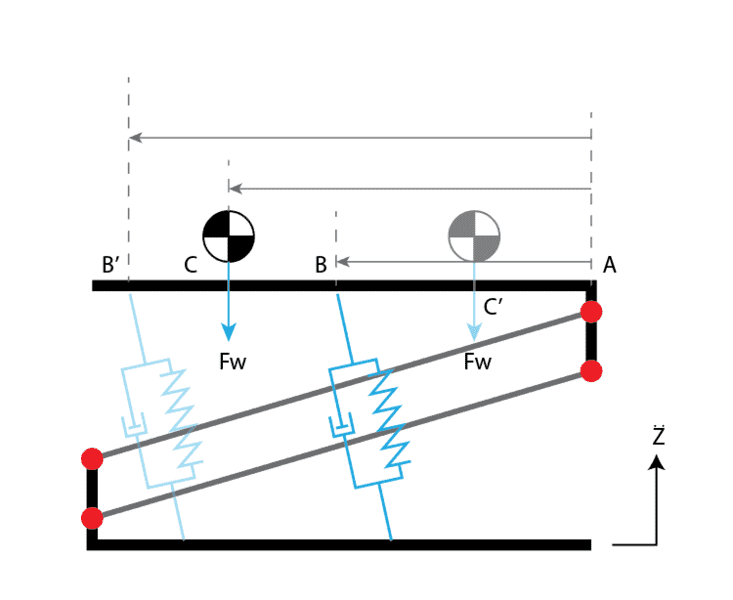
seat pedestal.PNG
 

Attachments

  • seat pedestal.PNG
    seat pedestal.PNG
    11.5 KB · Views: 567
Engineering news on Phys.org
You have two variables: Distance AB, and distance AC. You can calculate the force on the bushings for any distance AB and AC. You also know, or can establish the maximum and minimum distances AB and AC based on the size of a typical seat.

The challenge is find the best combination of AB and AC, and to show that it is the best combination. The tool for doing this is a contour plot. Make, for example, the horizontal axis the distance AB, and the vertical axis distance AC. The bushing force is the plotted variable, with contour lines of constant bushing force.

Such a plot would be a very solid part of a master's thesis, because it naturally leads to a discussion of seat suspension optimization.
 
  • Like
Likes   Reactions: anorlunda and berkeman
Thank you for the reply jrmichler.

Yet, I think making a contour plot exceeds the scope of my project. Is it also possible to explain the best relative position based on basic theory or assumptions? Some one recommended me to place the center of gravity (C) as well as the position of the shock absorber (B) at or close to position A. Though, he didn't explain me why this would be beneficial? What I can image is that if the total length of the whole upper beam is smaller, and therefore the distances AB and AC too, the deviation of this beam due to play at the pivot points at location A is less.
 
A master's degree is an introduction to research degree. This is a simple problem, and one that you can and should solve for yourself. We at PF are more than willing to help you. In this case, help consists of suggesting a path to a solution.

Do the calculations in a spreadsheet. Hand write the results on a hand sketched graph. Hand draw the contour lines. If you are up to speed on free body diagrams, it should take less than three hours. And the resulting plot will fully answer all of your questions, including some that you have not yet thought of.
 
  • Like
Likes   Reactions: berkeman
I appreciate the help and quick answer. Thank you.

But why using the bushing force in the pivot points, as this is not the main parameter that affects the effectiveness of the system, right? Perhaps my topic question was not fully clear. With 'system' I meant the effect of the distances AB and AC on the functionality/effectiveness of the shock absorber. This is the determinative parameter for a comfortable ride. And thus, therefore, a comfortable system as a whole.
 
Complex problems are solved by solving part of the problem, then using the results to solve further, then repeat until the entire problem is solved. In this case, you cannot completely ignore the bushing loads. High bushing loads require strong (heavy) parts, and have high(er) bearing friction. Friction is bad. You also need to fully understand how the loads on the various pieces change with changes in dimensions AB and AC. Start there. Then use what you learned to investigate shock absorber location.

Hint: If you do as I suggested earlier, the answer should be obvious.
 

Similar threads

Replies
11
Views
3K
  • · Replies 4 ·
Replies
4
Views
3K
  • · Replies 1 ·
Replies
1
Views
7K
Replies
36
Views
12K
  • Sticky
  • · Replies 2K ·
60
Replies
2K
Views
869K
  • · Replies 11 ·
Replies
11
Views
3K
  • · Replies 31 ·
2
Replies
31
Views
4K
  • · Replies 6 ·
Replies
6
Views
8K
  • · Replies 4 ·
Replies
4
Views
4K
  • · Replies 31 ·
2
Replies
31
Views
3K