Swinging on a rope minimum horizontal speed

Click For Summary

Homework Help Overview

The problem involves a hiker swinging on a rope across a ravine, with specific measurements given for the length of the rope and the horizontal distance to be covered. The objective is to determine the minimum horizontal speed required for the hiker to successfully swing across and drop at the far edge.

Discussion Character

  • Exploratory, Conceptual clarification, Assumption checking

Approaches and Questions Raised

  • Participants discuss various approaches, including using projectile motion equations and conservation of energy principles. Some suggest rethinking the problem by considering the hiker's motion as a pendulum swing, while others emphasize the importance of drawing a diagram to visualize the situation.

Discussion Status

The discussion is active, with participants offering different perspectives on how to approach the problem. Some guidance has been provided regarding the application of conservation of mechanical energy, and there is an ongoing exploration of the relationships between kinetic and potential energy in the context of the hiker's swing.

Contextual Notes

Participants note that the hiker's situation differs from that of a typical projectile, as she is attached to a rope, which influences the forces acting on her. There is also mention of the need for a proper diagram to clarify the geometric relationships involved in the problem.

fire765
Messages
4
Reaction score
0
A hiker plans to swing on a rope across a ravine in the mountains, as illustrated in the figure, where L = 4.9 m and x = 2.7 m, and to drop when she is just above the far edge. At what minimum horizontal speed should she be moving when she starts to swing(in m/s)?
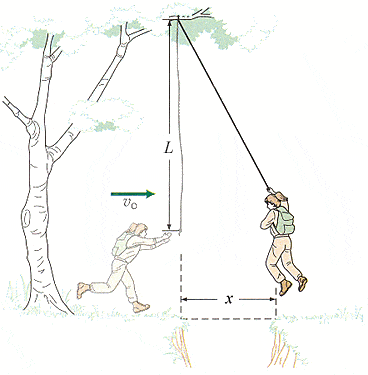

5-32alt.gif


I tried using the equation for range (x=(vo^2sin2(angle))/g but it didnt work, and I am guessing I am on the complete wrong track.
 
Physics news on Phys.org
Why don't you do it the other way round? Suppose the hiker starts from the right at zero speed. Like a pendulum, she has to swing to the left side, and you can find the speed on the left side. Reversing the situation will give you that required speed.

If you don't like this approach, I will of course give you the solution.
 
You can also think about it this way, when the hiker is above the second edge, he has gained potential energy but lost kinetic energy. Equate the two and you get your minimum velocity.
 
fire765 said:
I tried using the equation for range (x=(vo^2sin2(angle))/g but it didnt work, and I am guessing I am on the complete wrong track.
That range equation is for finding the horizontal distance traveled by a projectile--where the only force acting on the object is gravity. In this problem, the hiker is not a projectile--she's hanging on to a rope!

Use conservation of mechanical energy.
 
Draw a proper diagram. The two positions of the rope make up an isosceles triangle. Drop a perpendicular from the right end-point (where she’s holding the rope), to the vertical rope on the left. The length of that perpendicular is x. Let the increase in vertical height from left position to the right position be h. Now you have a right angled triangle relating x, L and h.

The KE at the start on the left is becoming PE on the right, because she has gained a height of h. Now can you say what should have been the initial KE to rise through a height h?
 

Similar threads

  • · Replies 2 ·
Replies
2
Views
7K
Replies
1
Views
2K
  • · Replies 4 ·
Replies
4
Views
2K
  • · Replies 1 ·
Replies
1
Views
3K
  • · Replies 8 ·
Replies
8
Views
7K
  • · Replies 1 ·
Replies
1
Views
4K
  • · Replies 13 ·
Replies
13
Views
7K
  • · Replies 11 ·
Replies
11
Views
5K
Replies
1
Views
4K
Replies
23
Views
2K