Keru
- 20
- 1
Homework Statement
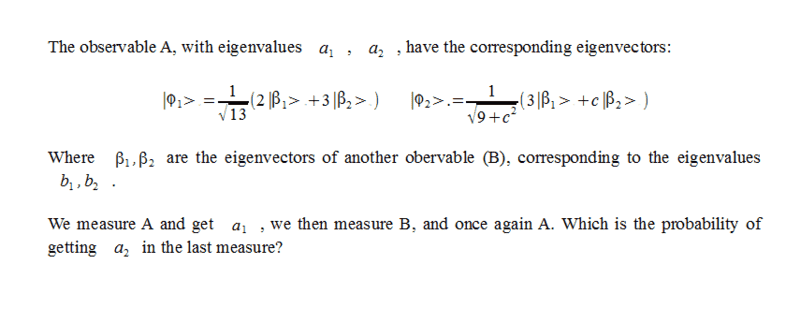
(c is a constant)
The attempt at a solution
-In the first measure we got a1, so the state of the system would be psi1.
-In the second measure, there's no information about what eigenvalue we got. Would the state of the system still be psi1? Psi1 is written in terms of B eigenvectors, and as we don't know which one we measured, the state should be described as a superposition of both vectors, which is precisely psi1. Is that correct?
-In the third measure, i wrote the "betas" in terms of the "psis", so i have something like:
(A and B being constants, not the observables)
psi1 = A beta1 + B beta2 = C psi1 + D psi2 + E psi 1 + F psi2 = G psi1 + H psi 2
Is it H the coefficient that tells me the probabilities of getting the a2 eigenvalue, or did I do something wrong?
(c is a constant)
The attempt at a solution
-In the first measure we got a1, so the state of the system would be psi1.
-In the second measure, there's no information about what eigenvalue we got. Would the state of the system still be psi1? Psi1 is written in terms of B eigenvectors, and as we don't know which one we measured, the state should be described as a superposition of both vectors, which is precisely psi1. Is that correct?
-In the third measure, i wrote the "betas" in terms of the "psis", so i have something like:
(A and B being constants, not the observables)
psi1 = A beta1 + B beta2 = C psi1 + D psi2 + E psi 1 + F psi2 = G psi1 + H psi 2
Is it H the coefficient that tells me the probabilities of getting the a2 eigenvalue, or did I do something wrong?
Attachments

