System of linear equation in term of column vector

Click For Summary

Discussion Overview

The discussion revolves around expressing a system of linear equations in terms of row vectors instead of column vectors. Participants also inquire about the concept of the field of scalars in this context.

Discussion Character

  • Technical explanation
  • Conceptual clarification
  • Debate/contested

Main Points Raised

  • Some participants seek to understand how to convert a system of linear equations from column vector form to row vector form.
  • One participant explains that writing the system in row vectors involves expressing each column as a row, providing examples of both forms.
  • Another participant mentions that unless specified otherwise, the field of scalars is typically assumed to be the field of real numbers, but acknowledges that complex numbers and rational numbers can also be used.
  • A later reply discusses the readability and writing convenience of row versus column vectors, suggesting that horizontal representation may be easier for some contexts.
  • One participant questions whether there is any difference between the two expressions and asks which form is more convenient and why.
  • Another participant elaborates on the distinction between vectors and co-vectors, mentioning the dual space and how it relates to the representation of linear functionals.

Areas of Agreement / Disagreement

Participants express varying opinions on the convenience and readability of row versus column vector representations, indicating that there is no consensus on which is superior. The discussion about the field of scalars also reflects differing perspectives on its definition.

Contextual Notes

Some assumptions about the field of scalars and the definitions of vectors and co-vectors are not fully explored, leaving room for further clarification.

DUET
Messages
55
Reaction score
0
Hello!

The following system of linear equations
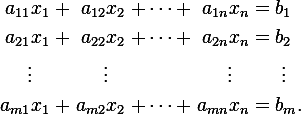
3d924afa5682b1d557305e2ac1f37826.png

has been expressed in term of column vector in the following.
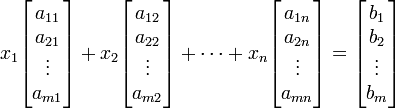
70027b64eee94f04f5b6ffdc37b29fe1.png
.
How can I express the system of linear equations in term of row vector?


In addition, What is the field of scalars? I would request to explain it.

Thanks in advance.
 
Last edited:
Physics news on Phys.org
DUET said:
Hello!

The following system of linear equations
View attachment 61063
has been expressed in term of column vector in the following.
View attachment 61064.
How can I express the system of linear equations in term of row vector?


In addition, What is the field of scalars? I would request to explain it.

Thanks in advance.

Your attachments are too small for me to read.
 
Writing that same system of equations in terms of "row vectors" only means that your write each "column" as a row. For example, your equations, in terms of "column" vectors, are
[tex]x_1\begin{bmatrix}a_{11} \\ a_{21} \\ \cdot\\ \cdot\\ \cdot \\ a_{m1} \end{bmatrix}+ x_2\begin{bmatrix}a_{12} \\ a_{22} \\ \cdot\\ \cdot\\ \cdot \\ a_{m2}\end{bmatrix}+ \cdot\cdot\cdot+ x_n\begin{bmatrix}a_{1n} \\ a_{2n} \\ \cdot\\ \cdot\\ \cdot \\ a_{mn} \end{bmatrix}= \begin{bmatrix}b_1 \\ b_2 \\ \cdot\\ \cdot\\ \cdot \\ b_m \end{bmatrix}[/tex]

Writing it as "rows" instead of "columns" would just be
[tex]x_1\begin{bmatrix}a_{11} & a_{21} & \cdot\cdot\cdot a_{m1} \end{bmatrix}+ x_2\begin{bmatrix}a_{12} & a_{22} & \cdot & \cdot & \cdot a_{m2}\end{bmatrix}+ \cdot\cdot\cdot+ x_n\begin{bmatrix}a_{1n} & a_{2n} & \cdot &\cdot & \cdot a_{mn} \end{bmatrix}= \begin{bmatrix}b_1 & b_2 & \cdot & \cdot & \cdot b_m \end{bmatrix}[/tex]

Unless something is said to the contrary, the "field of scalars" is assumed to be the field of real numbers.

(The field of complex numbers is sometimes used and, less often, the field of rational numbers. But those should be given explicitely.)
 
  • Like
Likes   Reactions: 1 person
HallsofIvy said:
Writing that same system of equations in terms of "row vectors" only means that your write each "column" as a row. For example, your equations, in terms of "column" vectors, are
[tex]x_1\begin{bmatrix}a_{11} \\ a_{21} \\ \cdot\\ \cdot\\ \cdot \\ a_{m1} \end{bmatrix}+ x_2\begin{bmatrix}a_{12} \\ a_{22} \\ \cdot\\ \cdot\\ \cdot \\ a_{m2}\end{bmatrix}+ \cdot\cdot\cdot+ x_n\begin{bmatrix}a_{1n} \\ a_{2n} \\ \cdot\\ \cdot\\ \cdot \\ a_{mn} \end{bmatrix}= \begin{bmatrix}b_1 \\ b_2 \\ \cdot\\ \cdot\\ \cdot \\ b_m \end{bmatrix}[/tex]

Writing it as "rows" instead of "columns" would just be
[tex]x_1\begin{bmatrix}a_{11} & a_{21} & \cdot\cdot\cdot a_{m1} \end{bmatrix}+ x_2\begin{bmatrix}a_{12} & a_{22} & \cdot & \cdot & \cdot a_{m2}\end{bmatrix}+ \cdot\cdot\cdot+ x_n\begin{bmatrix}a_{1n} & a_{2n} & \cdot &\cdot & \cdot a_{mn} \end{bmatrix}= \begin{bmatrix}b_1 & b_2 & \cdot & \cdot & \cdot b_m \end{bmatrix}[/tex]

Unless something is said to the contrary, the "field of scalars" is assumed to be the field of real numbers.

(The field of complex numbers is sometimes used and, less often, the field of rational numbers. But those should be given explicitely.)
Is there any difference between the two expression. If there is no difference then which is more convenient and why?
 
It is entirely a matter of which is easier to read and/or write. Generally, book printers find it easier to write in horizontal lines (in language in which words and sentences are written horizontally!).

(Some authors use "horizontal" and "vertical" placement to distinguish between "vectors" and "co-vectors". Given any vector space, its "dual" is the set of all linear functionals on it- linear functions that map each vector to a number. If V is an n dimensional vector space, its "dual", V*, is also an n dimensional vector space with "sum" defined as (f+ g)(v)= f(v)+ g(v) and "scalar multiplication" by (af)(v)= a(f(v)). It can be shown that, given a basis for V, there is a "natural basis" for V* defined by [itex]f_i(v_j)= 1[/itex] if i= j, 0 other wise. Of course, using the basis for V, we can write any vector as n-numbers. and using that basis for V* we can write any "co-vector" (function in the dual of V) as n-numbers. If we agree to write vectors in V "vertically" and co-vectors in V* horizontally, then we can write f(v) as the matrix product of the "row matrix" representing f and the "column matrix" representing v.)
 
Last edited by a moderator:

Similar threads

  • · Replies 4 ·
Replies
4
Views
3K
  • · Replies 4 ·
Replies
4
Views
3K
  • · Replies 6 ·
Replies
6
Views
4K
  • · Replies 8 ·
Replies
8
Views
3K
  • · Replies 7 ·
Replies
7
Views
3K
  • · Replies 19 ·
Replies
19
Views
4K
  • · Replies 1 ·
Replies
1
Views
4K
Replies
1
Views
4K
  • · Replies 23 ·
Replies
23
Views
2K
  • · Replies 0 ·
Replies
0
Views
9K