T6.1.1 Find the volume of the solid

  • Context: MHB 
  • Thread starter Thread starter karush
  • Start date Start date
  • Tags Tags
    Solid Volume
Click For Summary

Discussion Overview

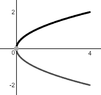
The discussion revolves around finding the volume of a solid defined by cross-sections that are squares, with diagonals extending between the curves defined by the functions \( f_a(x) = -\sqrt{x} \) and \( f_b(x) = \sqrt{x} \). The solid is bounded by the planes perpendicular to the \( x \)-axis at \( x = 0 \) and \( x = 4 \). Participants explore the area of the square cross-sections and the corresponding volume integral.

Discussion Character

  • Mathematical reasoning
  • Technical explanation
  • Exploratory

Main Points Raised

  • Some participants calculate the area of the square cross-section as \( A_{square}(x) = 2x \) based on the diagonal length derived from the Pythagorean theorem.
  • One participant confirms the area calculation and expresses intent to verify the integral setup for volume.
  • Another participant presents the integral \( V = \int_{0}^{4} 2x \, dx \) and computes it, arriving at a volume of 16.
  • There is a reiteration of the volume calculation, emphasizing that the volume of each square is represented by \( 2x \, dx \) and confirming the integral setup.

Areas of Agreement / Disagreement

Participants generally agree on the area of the square cross-section being \( 2x \) and the volume integral setup. However, there is no explicit consensus on the finality of the volume calculation, as it is presented without further verification or challenge.

Contextual Notes

Some assumptions regarding the definitions of the functions and the setup of the integral may not be explicitly stated, and there may be unresolved steps in the integration process.

karush
Gold Member
MHB
Messages
3,240
Reaction score
5
$\tiny{t6.1.1}$
$\text{The solid lies between planes perpendiaular to the}$
$\text{$x$-axis at $x=0$ and $x = 4$.}$
$\text{The cross-scctions perpendicular to the axis on the interval
$0 \le x \le 4$}$
$\text{are squrares whose diagonals run for the parabola $\displaystyle f_a(x)=-\sqrt{x}$
to $\displaystyle f_b(x)=\sqrt{x}$}$
$\text{Find the volume of the solid}$$\textit{the area of the square whose diagonal is from $-\sqrt{x}$ to $-\sqrt{x}$ is}$
\begin{align*}\displaystyle
A_{square}(x)&=[\sqrt{2x}]^2 \\
&=2x
\end{align*}

ok just want to see if the area of the square is ok before
\begin{align*}\displaystyle
I&=\int_{0}^{4} ? \,dx
\end{align*}

View attachment 7421
 

Attachments

  • t6.1.1.PNG
    t6.1.1.PNG
    2 KB · Views: 168
Physics news on Phys.org
karush said:
$\tiny{t6.1.1}$
$\text{The solid lies between planes perpendiaular to the}$
$\text{$x$-axis at $x=0$ and $x = 4$.}$
$\text{The cross-scctions perpendicular to the axis on the interval
$0 \le x \le 4$}$
$\text{are squrares whose diagonals run for the parabola $\displaystyle f_a(x)=-\sqrt{x}$
to $\displaystyle f_b(x)=\sqrt{x}$}$
$\text{Find the volume of the solid}$$\textit{the area of the square whose diagonal is from $-\sqrt{x}$ to $-\sqrt{x}$ is}$
\begin{align*}\displaystyle
A_{square}(x)&=[\sqrt{2x}]^2 \\
&=2x
\end{align*}

ok just want to see if the area of the square is ok before
\begin{align*}\displaystyle
I&=\int_{0}^{4} ? \,dx
\end{align*}

Hi karush,

Yes. Since the length of the diagonal of the square is $2\sqrt{x}$ if we take $y$ as the length of its side, by the Pythagorean theorem we have $y^2 + y^2=\left(2\sqrt{x}\right)^2\Rightarrow y^2=2x$. Therefore the area of the square is $2x$.
 
$\tiny{t6.1.1}$
$\text{The solid lies between planes perpendiaular to the}$
$\text{$x$-axis at $x=0$ and $x = 4$.}$
$\text{The cross-scctions perpendicular to the axis on the interval
$0 \le x \le 4$}$
$\text{are squrares whose diagonals run for the parabola $\displaystyle f_a(x)=-\sqrt{x}$
to $\displaystyle f_b(x)=\sqrt{x}$}$
$\text{Find the volume of the solid}$$\textit{the area of the square whose diagonal is from $-\sqrt{x}$ to $-\sqrt{x}$ is}$
\begin{align*}\displaystyle
A_{square}(x)&=[\sqrt{2x}]^2 \\
&=2x
\end{align*}
$\textit{so the Integral is:}$

$$\begin{align*}\displaystyle
V&=\int_{0}^{4} 2x \, dx\\
&=x^2\biggr|_0^4\\
&=16-0=\color{red}{16}
\end{align*} $$
 
karush said:
$\tiny{t6.1.1}$
$\text{The solid lies between planes perpendiaular to the}$
$\text{$x$-axis at $x=0$ and $x = 4$.}$
$\text{The cross-scctions perpendicular to the axis on the interval
$0 \le x \le 4$}$
$\text{are squrares whose diagonals run for the parabola $\displaystyle f_a(x)=-\sqrt{x}$
to $\displaystyle f_b(x)=\sqrt{x}$}$
$\text{Find the volume of the solid}$$\textit{the area of the square whose diagonal is from $-\sqrt{x}$ to $-\sqrt{x}$ is}$
\begin{align*}\displaystyle
A_{square}(x)&=[\sqrt{2x}]^2 \\
&=2x
\end{align*}
$\textit{so the Integral is:}$

$$\begin{align*}\displaystyle
V&=\int_{0}^{4} 2x \, dx\\
&=x^2\biggr|_0^4\\
&=16-0=\color{red}{16}
\end{align*} $$

Yes, since the volume of each square is given by $2x\,dx$ the volume is given by the integral $\int_0^4 2x\,dx$.
 

Similar threads

  • · Replies 8 ·
Replies
8
Views
2K
Replies
4
Views
2K
  • · Replies 2 ·
Replies
2
Views
2K
  • · Replies 6 ·
Replies
6
Views
2K
  • · Replies 2 ·
Replies
2
Views
2K
  • · Replies 2 ·
Replies
2
Views
2K
  • · Replies 12 ·
Replies
12
Views
3K
  • · Replies 1 ·
Replies
1
Views
1K
  • · Replies 1 ·
Replies
1
Views
1K
  • · Replies 4 ·
Replies
4
Views
2K