Table Functions Explained: Help for Understanding

8 replies · 3K views · last reply
OMGMathPLS
Messages
64
Reaction score
0
I do not get what is going on here. Can someone please explain? This is sohard for me to understand. thank you
View attachment 3546
 
Attachments
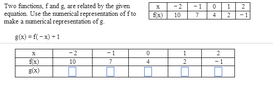
  • Two tables: a table of f(x) with x values -2, -1, 0, 1, 2 and f(x) values 10, 7, 4, 2, -1; and a blank table for g(x) = f(-x) + 1 with the same x values and f(x) row filled in.
    help1.PNG
    3.5 KB · Views: 120
Let's look at the first place where an answer is expected, that is to find $g(-2)$.

We are given the rule:

$$g(x)=f(-x)+1$$

Therefore, we may state:

$$g(-2)=f(-(-2))+1=f(2)+1=-1+1=0$$

Can you try the others in the same way?
 
MarkFL said:
Let's look at the first place where an answer is expected, that is to find $g(-2)$.

We are given the rule:

$$g(x)=f(-x)+1$$

Therefore, we may state:

$$g(-2)=f(-(-2))+1=f(2)+1=-1+1=0$$

Can you try the others in the same way?

Ok so we're including the - we are plugging it in with the negative.
That makes more sense.
 
OMGMathPLS said:
Ok so we're including the - we are plugging it in with the negative.
That makes more sense.

Yes, the rule:

$$g(x)=f(-x)+1$$

tells us to take the input to $g$, change its sign or negate it, and input it to $f$, and then add 1 to that output, and this is the output of $g$. :D
 
Let's look at the next one...what did you do to get 0?
 
MarkFL said:
Let's look at the next one...what did you do to get 0?

I'm not sure why we are putting it into the (x) first and then = f(x) if we're trying to find g(x).

Because all we are using from the table is the x so why are we do we even need the f(x)?
 
OMGMathPLS said:
I'm not sure why we are putting it into the (x) first and then = f(x) if we're trying to find g(x).

In order to find $g(x)$, we need to use the given rule:

$$g(x)=f(-x)+1$$

So, we do the following:

1.) Negate the input to $g$.

2.) Pass this negated input to $f$.

3.) Add 1 to the value obtained from $f$.

4.) This is the value of $g$.

So, for the second one, we find:

1.) $$-(-1)=1$$

2.) $$f(1)=2$$

3.) $$2+1=3$$

4.) $$g(-1)=3$$

Or, as I did the first one:

$$g(-1)=f(-(-1))+1=f(1)+1=2+1=3$$ :D
 
MarkFL said:
In order to find $g(x)$, we need to use the given rule:

$$g(x)=f(-x)+1$$

So, we do the following:

1.) Negate the input to $g$.

2.) Pass this negated input to $f$.

3.) Add 1 to the value obtained from $f$.

4.) This is the value of $g$.

So, for the second one, we find:

1.) $$-(-1)=1$$

2.) $$f(1)=2$$

3.) $$2+1=3$$

4.) $$g(-1)=3$$

Or, as I did the first one:

$$g(-1)=f(-(-1))+1=f(1)+1=2+1=3$$ :D

Thank you