Math Amateur
Gold Member
MHB
- 3,920
- 48
I am reading Andrew McInerney's book: First Steps in Differential Geometry: Riemannian, Contact, Symplectic ...
I am currently focussed on Chapter 3: Advanced Calculus ... and in particular I am studying Section 3.3 Geometric Sets and Subspaces of T_p ( \mathbb{R}^n ) ...
I need help with a basic aspect of Definition 3.3.5 ...
Definition 3.3.5 reads as follows:
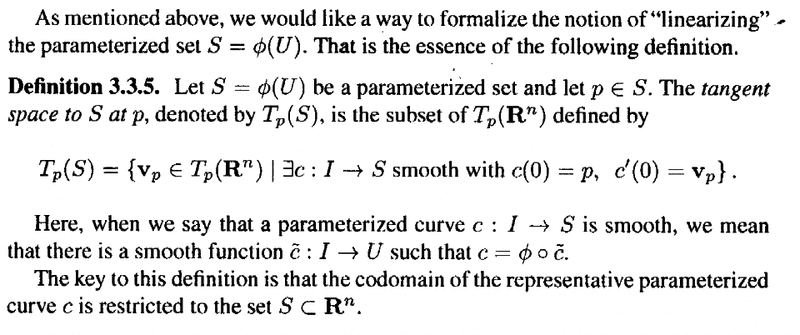 In the above definition we find the following:
" ... ... Here, when we say that a parametrized curve c \ : \ I \longrightarrow S is smooth, we mean that there is a smooth function \tilde{c} \ : \ I \longrightarrow U such that c = \phi \circ \tilde{c} ... ... "
My question is as follows:
Why do we need to bother defining \tilde{c} ... the codomain of c is defined as S ... so we surely only need to stipulate that c is continuously differentiable or C^1 ... that is the usual definition of 'smooth' so why isn't this enough ...
... ... so, my question is then, why do we bother defining \tilde{c} and then go on to consider the composite function c = \phi \circ \tilde{c} ... ?Hope someone can help ...
Peter===========================================================
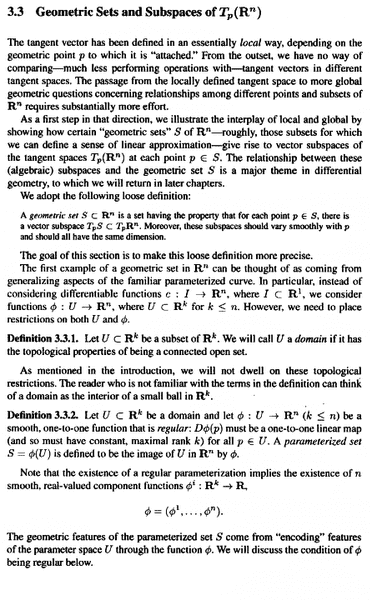
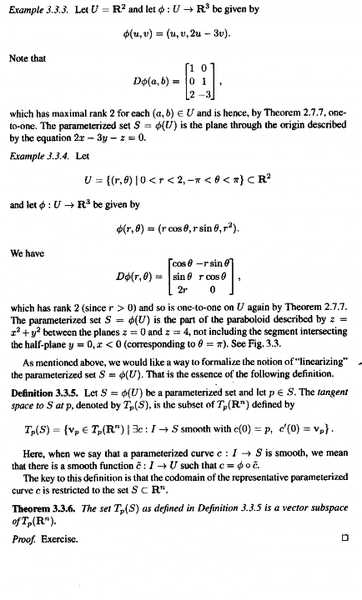
To give the context for McInerney's approach to this definition I am providing the introduction to Section 3.3 as follows:
I am currently focussed on Chapter 3: Advanced Calculus ... and in particular I am studying Section 3.3 Geometric Sets and Subspaces of T_p ( \mathbb{R}^n ) ...
I need help with a basic aspect of Definition 3.3.5 ...
Definition 3.3.5 reads as follows:
" ... ... Here, when we say that a parametrized curve c \ : \ I \longrightarrow S is smooth, we mean that there is a smooth function \tilde{c} \ : \ I \longrightarrow U such that c = \phi \circ \tilde{c} ... ... "
My question is as follows:
Why do we need to bother defining \tilde{c} ... the codomain of c is defined as S ... so we surely only need to stipulate that c is continuously differentiable or C^1 ... that is the usual definition of 'smooth' so why isn't this enough ...
... ... so, my question is then, why do we bother defining \tilde{c} and then go on to consider the composite function c = \phi \circ \tilde{c} ... ?Hope someone can help ...
Peter===========================================================
To give the context for McInerney's approach to this definition I am providing the introduction to Section 3.3 as follows:


