Geometric Sets and Tangent Subspaces - McInnerney, Example 3

Click For Summary

Discussion Overview

The discussion revolves around the concepts of geometric sets and tangent spaces as presented in Andrew McInerney's book, particularly focusing on Example 3.3.7 from Chapter 3. Participants explore the definitions and properties of the set S and its tangent space T_p(S) in the context of differential geometry.

Discussion Character

  • Technical explanation
  • Conceptual clarification
  • Debate/contested

Main Points Raised

  • One participant questions whether the equation 2x - 3y - z = 0 fully describes the set S, suggesting that not all points in S may satisfy this equation if they are not in the range of the mapping c.
  • Another participant asserts that all points in S do satisfy the equation, indicating a belief that a specific point p = (x_0, y_0, z_0) must satisfy 2x_0 - 3y_0 - z_0 = 0.
  • There is a discussion about the nature of vectors in the tangent space T_p(S), with one participant suggesting that vectors satisfying the equation must lie in S, while another clarifies that tangent vectors contain both location and direction information, distinguishing them from points in S.
  • Participants explore the representation of elements in T_p(S) as 6-vectors, discussing how the components relate to location and direction, and how this affects their interpretation in relation to the set S.
  • One participant seeks recommendations for books that provide a simpler approach to tangent spaces with worked examples.

Areas of Agreement / Disagreement

Participants express differing views on whether all points in S satisfy the equation 2x - 3y - z = 0, and there is contention regarding the relationship between tangent vectors and points in S. The discussion remains unresolved with multiple competing interpretations of the concepts involved.

Contextual Notes

Participants highlight the distinction between points and vectors, noting that while both can lie in the same geometric plane, they represent different mathematical objects with different properties. The discussion also touches on the implications of the plane S passing through the origin for the properties of the tangent space.

Who May Find This Useful

This discussion may be useful for students and practitioners of differential geometry, particularly those interested in the concepts of tangent spaces and geometric sets, as well as those seeking resources for further study in these areas.

Math Amateur
Gold Member
MHB
Messages
3,920
Reaction score
48
I am reading Andrew McInerney's book: First Steps in Differential Geometry: Riemannian, Contact, Symplectic ...

I am currently focussed on Chapter 3: Advanced Calculus ... and in particular I am studying Section 3.3 Geometric Sets and Subspaces of T_p ( \mathbb{R}^n ) ...

I need help with a basic aspect of Example 3.3.7 ...

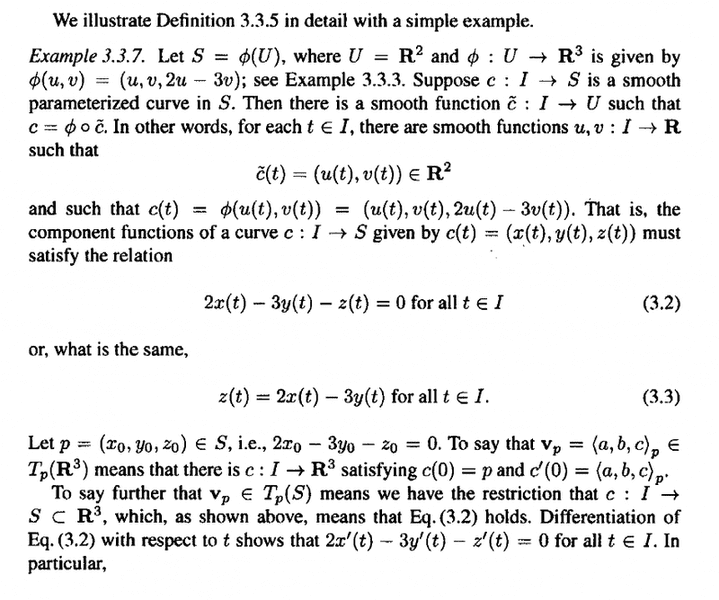
Example 3.3.7 reads as follows:
?temp_hash=0b3a241837e88ef8f6527ecc2b6304a4.png

?temp_hash=0b3a241837e88ef8f6527ecc2b6304a4.png

Question 1

In the above text we read:

" ... ... Let p = ( x_0, y_0, z_0 ) \in S i.e. 2 x_0 - 3 y_0 - z_0 = 0. ... ... "... BUT ... as I read the example ... ... we have that 2 x_0 - 3 y_0 - z_0 = 0 is the equation of c(t) at ( x_0, y_0, z_0 ) ... AND ... again as I see it ... this is not all of S as c maps I into S ... thus a general point p = ( x_0, y_0, z_0 ) \in S may not satisfy the equation as it may not be in the range of c ...Can some please clarify my issue with the example... ? (I hope I have made my question clear ..)===========================================================

*** EDIT ***

After some reflection I now feel that all points in S = \phi (U) = ( u, v, 2u - 3v ) satisfy the equation 2x - 3y - z = 0 ... so a particular point p = ( x_0, y_0, z_0) obviously satisfies 2x_0 - 3y_0 - z_0 = 0 ... is that right ... ?

Please let me know if my edit is correct ...
==========================================================


Question 2


In the above text we read:

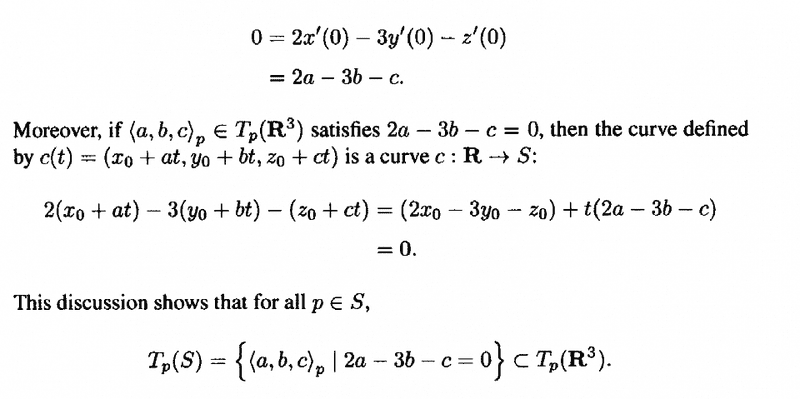
" ... ... This discussion shows that for all p \in S,

T_p (S) = \{ (a, b, c)_p \ \ | \ \ 2a - 3b - c = 0 \} \subset T_p ( \mathbb{R}^3 )

... ... ... ... "Now, it seems that vectors at p = (x_0, y_0, z_0) that have components a, b, c respectively which obey the equation, 2a - 3b - c =0 are (I think?) in S ... ... so this would mean that T_p(S) is a subset of S ... Is that correct ...?Question 3

Does anyone know of any books with a simple approach to tangent spaces replete with a number of worked/computational exercises ...?
Hope someone can help with the above questions ...

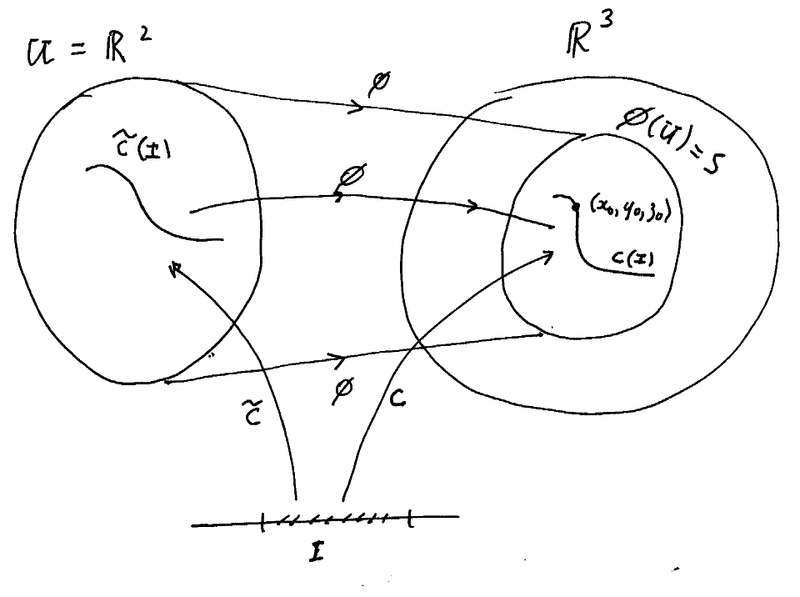
PeterI have made a simple diagram of my understanding of the mappings involved ... as follows ... ...
?temp_hash=0b3a241837e88ef8f6527ecc2b6304a4.png
Is the above diagram a correct representation of the mappings involved?
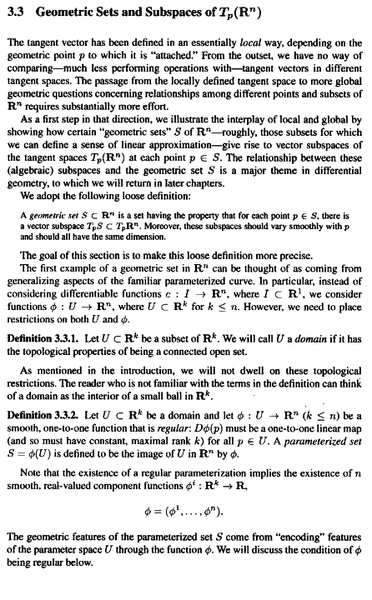
To help to give some of the context and some explanation of the theory and notation relevant to the above I am providing McInerney's introduction to Section 3.3 as follows:
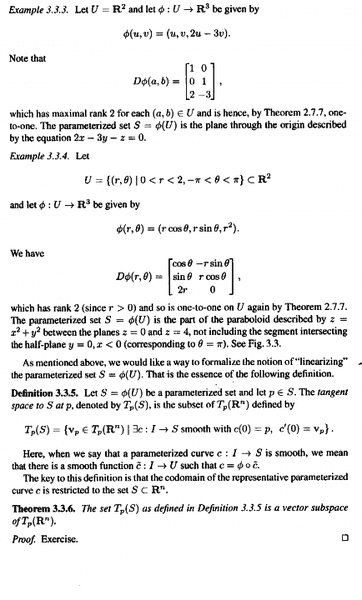
?temp_hash=0b3a241837e88ef8f6527ecc2b6304a4.png

?temp_hash=0b3a241837e88ef8f6527ecc2b6304a4.png
 

Attachments

  • McInerney - 1 - Example 3.3.7 - Section 2.6  - PART 1 - Page 81     .png
    McInerney - 1 - Example 3.3.7 - Section 2.6 - PART 1 - Page 81 .png
    56.3 KB · Views: 869
  • McInerney - 2 - Example 3.3.7 - Section 2.6  - PART 2 - Page 82     .png
    McInerney - 2 - Example 3.3.7 - Section 2.6 - PART 2 - Page 82 .png
    60.2 KB · Views: 811
  • Peter - Figure 1 - McInerney - Example 3.3.7.png
    Peter - Figure 1 - McInerney - Example 3.3.7.png
    81.5 KB · Views: 775
  • McInerney - 1 - Section 3.3  - PART 1 - Page 79   .png
    McInerney - 1 - Section 3.3 - PART 1 - Page 79 .png
    45.5 KB · Views: 730
  • McInerney - 2 - Section 3.3  - PART 2 - Page 80   .png
    McInerney - 2 - Section 3.3 - PART 2 - Page 80 .png
    28.6 KB · Views: 695
Last edited:
Physics news on Phys.org
Math Amateur said:
*** EDIT ***

After some reflection I now feel that all points in S = \phi (U) = ( u, v, 2u - 3v ) satisfy the equation 2x - 3y - z = 0 ... so a particular point p = ( x_0, y_0, z_0) obviously satisfies 2x_0 - 3y_0 - z_0 = 0 ... is that right ... ?

Please let me know if my edit is correct ..
Yes, it is correct.
Question 2

In the above text we read:

" ... ... This discussion shows that for all p \in S,

T_p (S) = \{ (a, b, c)_p \ \ | \ \ 2a - 3b - c = 0 \} \subset T_p ( \mathbb{R}^3 )

... ... ... ... "Now, it seems that vectors at p = (x_0, y_0, z_0) that have components a, b, c respectively which obey the equation, 2a - 3b - c =0 are (I think?) in S ... ... so this would mean that T_p(S) is a subset of S ... Is that correct ...?
No. A vector in the tangent space ##T_pS## is not in the space ##S## itself, because the former holds both location and direction information, whereas the latter holds only location information. It's like the difference between 'going through Paris in a Northerly direction at 50 km/h' and just 'Paris'.

You can think of the former as a vector of six components, with the first three giving location and the second three giving velocity (direction and magnitude), and the latter as a vector of only three components, giving just location.
 
  • Like
Likes   Reactions: Math Amateur
Thanks for the help Andrew ... but just a clarification ...

We know that S = \phi (U) = (u, v, 2u - 3v)

So points in S satisfy 2x - 3y - z... this is the equation that vectors in T_P (S) must satisfy ... so surely all the points of the vector < a, b, c >_p lie in S ...

I understand that the points of S do not have a direction and that points are conceptually different from vectors in that vectors have magnitude and direction and points do not ... but can't we say that the points of the vector < a, b, c >_p lie in S ... ?

Peter
 
Math Amateur said:
2x - 3y - z =0... this is the equation that vectors in T_P (S) must satisfy
Remember that the vector in ##T_pS## is a 6-tuple ##<a,b,c,x,y,z>## (a '6-vector') with the first three components indicating mag and direction and the second three indicating location. What we can say in this case, and only because the plane ##S## passes through the origin, is that both ##<x,y,z>## and ##<a,b,c>##, regarded as '3-vectors', must satisfy the equation. So you can think of each of those two as being in ##S##, but neither is the 6-vector, because each contains only half of the information content of the 6-vector.

An element of ##T_pS## is a 6-vector, which in this case we can think of two 3-vectors, while an element of ##S## is just a 3-vector.

Note also that while ##<x,y,z>## and ##<a,b,c>##, interpreted as points in Euclidean 3-space, lie in the same plane S, they do not necessarily point in the same direction. Consider the vector ##<-2,3,-13>_{<3,2,0>}## which is the vector at point ##<3,2,0>## pointing in direction ##<-2,3,-13>##, and has 6-tuple representation ##<-2,3,-13,3,2,0>##. The direction in which the 3-vector is pointing is (if I've done my calcs right) perpendicular to the location 3-vector whose tail is at the origin and head is at ##<3,2,0>##. But both 3-vectors lie in the plane ##S##.

Another way to visualize vectors in ##T_pS## is as signposts showing the direction and distance to another city. Consider a signpost in Glasgow pointing along a Roman road ('cos they're straight) to Edinburgh that says 'Edinburgh 100km'. The direction of the signpost and the distance 100km is the ##<a,b,c>## info of the 6-vector. The location of the signpost (eg its latitude and longitude) is the ##<x,y,z>## info of the 6-vector.
 
  • Like
Likes   Reactions: Math Amateur
andrewkirk said:
Remember that the vector in ##T_pS## is a 6-tuple ##<a,b,c,x,y,z>## (a '6-vector') with the first three components indicating mag and direction and the second three indicating location. What we can say in this case, and only because the plane ##S## passes through the origin, is that both ##<x,y,z>## and ##<a,b,c>##, regarded as '3-vectors', must satisfy the equation. So you can think of each of those two as being in ##S##, but neither is the 6-vector, because each contains only half of the information content of the 6-vector.

An element of ##T_pS## is a 6-vector, which in this case we can think of two 3-vectors, while an element of ##S## is just a 3-vector.

Note also that while ##<x,y,z>## and ##<a,b,c>##, interpreted as points in Euclidean 3-space, lie in the same plane S, they do not necessarily point in the same direction. Consider the vector ##<-2,3,-13>_{<3,2,0>}## which is the vector at point ##<3,2,0>## pointing in direction ##<-2,3,-13>##, and has 6-tuple representation ##<-2,3,-13,3,2,0>##. The direction in which the 3-vector is pointing is (if I've done my calcs right) perpendicular to the location 3-vector whose tail is at the origin and head is at ##<3,2,0>##. But both 3-vectors lie in the plane ##S##.

Another way to visualize vectors in ##T_pS## is as signposts showing the direction and distance to another city. Consider a signpost in Glasgow pointing along a Roman road ('cos they're straight) to Edinburgh that says 'Edinburgh 100km'. The direction of the signpost and the distance 100km is the ##<a,b,c>## info of the 6-vector. The location of the signpost (eg its latitude and longitude) is the ##<x,y,z>## info of the 6-vector.
Thanks for the help, Andrew ... appreciate it

Still reflecting on what you have said ...

Do you know a good and preferably basic reference that treats tangent spaces at undergrad level ... and has some worked examples ,,,

Peter
 

Similar threads

  • · Replies 5 ·
Replies
5
Views
2K
  • · Replies 4 ·
Replies
4
Views
3K
  • · Replies 1 ·
Replies
1
Views
2K
  • · Replies 10 ·
Replies
10
Views
3K
Replies
7
Views
2K
Replies
8
Views
4K
  • · Replies 1 ·
Replies
1
Views
2K
  • · Replies 4 ·
Replies
4
Views
3K
  • · Replies 3 ·
Replies
3
Views
2K
  • · Replies 2 ·
Replies
2
Views
2K