Why Does Tax-Deferred Compounding Offer a Financial Edge Over Annual Taxation?

  • Context: Undergrad 
  • Thread starter Thread starter BWV
  • Start date Start date
Click For Summary
SUMMARY

Tax-deferred compounding provides a significant financial advantage over annual taxation due to the ability to grow capital without immediate tax deductions. The mathematical representation shows that a portfolio taxed annually grows at (1+R(1-T))^n, while a tax-deferred portfolio grows at ((1+R)^n - (1+R)^nT + T). For a 12% return and a 24% tax rate, the divergence in growth becomes pronounced over time, illustrating the benefits of deferring taxes. The key takeaway is that deferring taxes allows for greater capital accumulation, leading to enhanced long-term growth.

PREREQUISITES
  • Understanding of compound interest and growth rates
  • Familiarity with tax implications on investment returns
  • Basic knowledge of Jensen's inequality
  • Ability to interpret mathematical expressions and binomial coefficients
NEXT STEPS
  • Research the implications of tax-deferred accounts like 401(k)s and IRAs
  • Learn about the mathematical principles behind Jensen's inequality
  • Explore the effects of different tax rates on investment growth
  • Study advanced compounding techniques and their applications in financial planning
USEFUL FOR

Investors, financial planners, tax advisors, and anyone interested in optimizing investment growth through tax strategies.

BWV
Messages
1,638
Reaction score
1,992
Trying to get some better mathematical insight on why tax-deferred compounding of an investment has an advantage over annual taxation
so R=return, T=tax rate and n=time (years)
If the full return is taxed every year, a portfolio grows at:

(1+R(1-T))n

if the portfolio is only taxed at the end of the multi-year period, the value is:

((1+R)n-1)(1-T) +1 or, alternatively (1+R)n-(1+R)nT+T

For T >0 and R >0, and n > 1 the statement below is true, but not sure how I would prove it - Jenson's inequality perhaps?

(1+R(1-T))n < (1+R)n-(1+R)nT+T

If you plot the growth of the two portfolios, for 12% return and 24% tax rate, the values diverge dramatically:
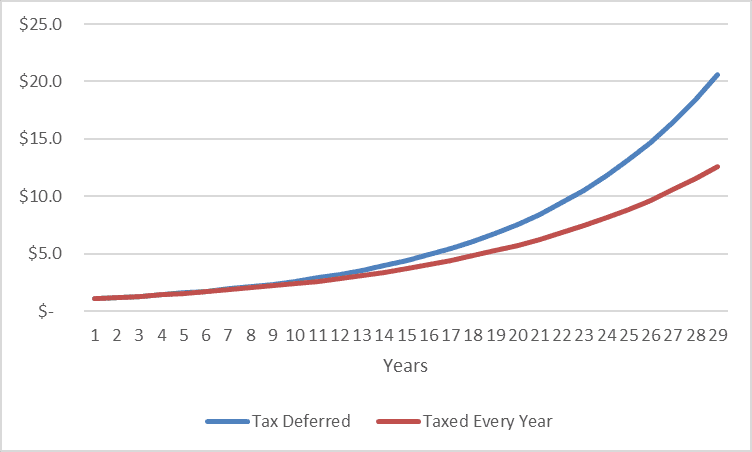
1645200359280.png


The y/y change on the 'Taxed every year' is simply (1+R(1-T)), however the 'Taxed Deferred' y/y change begins at (1+R(1-T)) but converges over time to (1+R) (at about 50 years in this example), - would like to understand this - taking derivatives with respect to n does not help much as you just get a log(1+r)(1+r)^n terms for both functions.
 

Attachments

  • 1645198740326.png
    1645198740326.png
    6 KB · Views: 153
Physics news on Phys.org
If 0 &lt; T &lt; 1 then (1 - T)^n &lt; (1-T) and hence <br /> \begin{split}<br /> (1 + R(1-T))^n &amp;= \sum_{k=0}^n \binom{n}{k} R^k(1-T)^k \\<br /> &amp;\leq \sum_{k=0}^n \binom{n}{k} R^k(1-T) \\<br /> &amp;= (1+R)^n(1-T) \\<br /> &amp;&lt; (1+ R)^n(1-T) + T.\end{split} I asume for y/y you want <br /> \frac{(1+R)^{n+1}(1-T)+T}{(1+R)^n(1-T) + T}<br /> = (1 + R) \frac{(1-T) + T(1+R)^{-n-1}}{(1-T)+T(1+R)^{-n}}. As n \to \infty the right hand side tends to (1 + R)\dfrac{1-T}{1-T} = 1 + R.
 
  • Like
Likes   Reactions: BWV
pasmith said:
I asume for y/y you want <br /> \frac{(1+R)^{n+1}(1-T)+T}{(1+R)^n(1-T) + T}<br /> = (1 + R) \frac{(1-T) + T(1+R)^{-n-1}}{(1-T)+T(1+R)^{-n}}. As n \to \infty the right hand side tends to (1 + R)\dfrac{1-T}{1-T} = 1 + R.
Thanks, that's perfect never fails that my bad algebra rather than my bad calculus is the impediment- although the T is just adjusting for the principal not being taxed, so the logic of that being the key issue is counterintuitive to me. But, it makes sense - if the whole amount, rather than just the gains were taxed (like in a 401K contribution) it would be

(1+R)n-(1+R)nT , or more simply (1+R)n(1-T)
then if you compared it to a situation where $1 was taxed up front then on the gains every year after
(1-T) (1+R(1-T))n
then it is very simply (1+R)n vs (1+R(1-T))n

Dumb question, how did you get the
\frac {T(1+R)^{-n-1}}{T(1+R)^{-n}}. term?
 
Another more basic math question - how do you get the binomial term here:

pasmith said:
If 0 &lt; T &lt; 1 then (1 - T)^n &lt; (1-T) and hence <br /> \begin{split}<br /> (1 + R(1-T))^n &amp;= \sum_{k=0}^n \binom{n}{k} R^k(1-T)^k \\<br /> &amp;\leq \sum_{k=0}^n \binom{n}{k} R^k(1-T) \\<br /> &amp;= (1+R)^n(1-T) \\<br /> &amp;&lt; (1+ R)^n(1-T) + T.\end{split}
 
BWV said:
Trying to get some better mathematical insight on why tax-deferred compounding of an investment has an advantage over annual taxation
so R=return, T=tax rate and n=time (years)
If the full return is taxed every year, a portfolio grows at:

(1+R(1-T))n

if the portfolio is only taxed at the end of the multi-year period, the value is:

((1+R)n-1)(1-T) +1 or, alternatively (1+R)n-(1+R)nT+T
The simple answer is that whoever takes the tax at the end of each year gets the subsequent growth on that tax. If you don't pay tax, you get subsequent growth on that extra capital (albeit the growth is eventually taxed). But, if you pay the tax, the capital is gone. After the first year we have:

a) Capital ##1 + R - RT##

or

b) Capital ##1 + R##

In a) you have less capital to grow and the IRS gets the growth on that RT they took at the end of year one. Whereas in b), the IRS eventually takes the tax on the extra RT, but only after you've benefited from the growth on it in subsequent years (even though you pay tax on that growth, it's generally better to pay tax on growth that not to have the capital to grow in the first place).

The numbers for ##n = 2## are easy to see:

a) ##B_1 = (1 + R - RT)^2 = 1 + 2R + R^2 -2RT + R^2T^2 - 2R^2T##

b) ##B_2 = 1 + \big [(1 + R)^2 - 1 \big ](1 - T) = 1 + (2R + R^2)(1-T) = 1 + 2R + R^2 -2RT - R^2T##

Hence ##B_1 = B_2 + R^2T^2 - R^2T = B_2 - R^2T(1 - T) = B_2 - (RT)(R)(1-T)##

And we see that ##B_2 > B_1## by precisely the taxed growth on the extra capital at the end of the first year (##RT##). In other words, you get the growth on the tax you didn't pay at the end of year one and only have to pay the tax on that growth. In case a) you don't get that growth at all.

For ##n > 2## it's the same story of getting the growth (albeit taxed) on all the tax you didn't pay in the earlier years.
 
  • Like
Likes   Reactions: BWV

Similar threads

  • · Replies 6 ·
Replies
6
Views
1K
  • · Replies 8 ·
Replies
8
Views
3K
  • · Replies 16 ·
Replies
16
Views
5K
  • · Replies 1 ·
Replies
1
Views
3K
  • · Replies 26 ·
Replies
26
Views
2K
  • · Replies 9 ·
Replies
9
Views
3K
  • · Replies 1 ·
Replies
1
Views
2K
  • · Replies 175 ·
6
Replies
175
Views
27K
Replies
8
Views
3K
  • · Replies 1 ·
Replies
1
Views
2K