Taylor's question at Yahoo Answers regarding celestial mechanics

MarkFL
Gold Member
MHB
Messages
13,284
Reaction score
12
Here is the question:

The moon is a sphere with radius of 959 km.?


Determine an equation for the ellipse if the distance of the satellite from the surface of the moon varies from 357 km to 710 km.

I have posted a link there to this topic so the OP can see my work.
 
Physics news on Phys.org
Hello Taylor,

We know the center of the moon must be one of the foci of the ellipse. I would choose to orient the coordinate system so that this focus is at the origin, and the apogee is on the positive $x$ axis and the perigee is on the negative $x$-axis.

The center of the ellipse is therefore at the point:

$$(c,0)=\left(\sqrt{a^2-b^2},0 \right)$$

The major axis, will then be given by:

$$2a=357+2\cdot959+710=2985$$

$$a=\frac{2985}{2}$$

We also must have:

$$a-c=959+357=1316$$

Hence:

$$c=\frac{353}{2}$$

$$b^2=\left(\frac{2985}{2} \right)^2-\left(\frac{353}{2} \right)^2=2196404$$

And so the equation describing the orbit of the satellite is:

$$\frac{\left(x-\frac{353}{2} \right)^2}{\left(\frac{2985}{2} \right)^2}+\frac{y^2}{2196404}=1$$

Simplify a bit:

$$\frac{(2x-353)^2}{8910225}+\frac{y^2}{2196404}=1$$

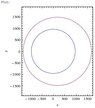
Here is a plot of the moon and the orbit of the satellite:

View attachment 1507
 

Attachments

  • taylor.jpg
    taylor.jpg
    10.9 KB · Views: 108

Similar threads

  • · Replies 1 ·
Replies
1
Views
4K
Replies
1
Views
2K
  • · Replies 1 ·
Replies
1
Views
2K
Replies
1
Views
2K
  • · Replies 1 ·
Replies
1
Views
2K
Replies
2
Views
2K
  • · Replies 1 ·
Replies
1
Views
2K
  • · Replies 1 ·
Replies
1
Views
2K
  • · Replies 1 ·
Replies
1
Views
2K
  • · Replies 1 ·
Replies
1
Views
2K