Tension at an angle from hanging mass

Click For Summary
SUMMARY

The discussion focuses on calculating the tension in a cable supporting a hanging mass, specifically addressing the equilibrium of forces acting on the mass. The tension (T) is suggested to be 800N, using an acceleration due to gravity of 10 m/s². Participants emphasize the importance of drawing a free body diagram to visualize the forces, including tension, weight, and the force exerted by the bar. The equilibrium condition requires that the sum of horizontal and vertical forces equals zero, guiding the determination of the direction of the bar's force.

PREREQUISITES
  • Understanding of Newton's Second Law (F=ma)
  • Knowledge of free body diagrams
  • Concept of equilibrium in physics
  • Basic principles of tension in cables
NEXT STEPS
  • Study the concept of equilibrium in static systems
  • Learn how to draw and analyze free body diagrams
  • Explore the effects of angles on tension in cables
  • Investigate real-world applications of tension in engineering
USEFUL FOR

Students preparing for physics exams, educators teaching mechanics, and anyone interested in understanding the principles of tension and equilibrium in physical systems.

austindubose
Messages
17
Reaction score
0
I apologize for my multiple recent posts, but I'm having pre-exam stress, so even the simplest things seem nearly impossible. Haha..
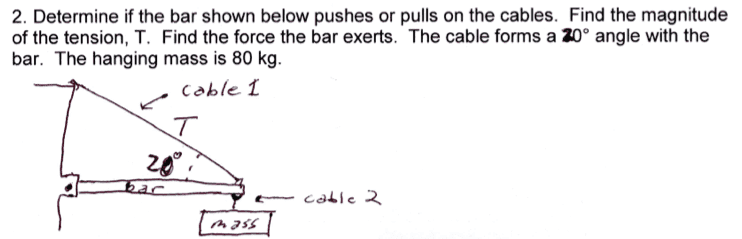
Homework Statement


2pycaqg.png

Note that connection point between the bar and the cable is not a pulley.


Homework Equations


F=ma


The Attempt at a Solution


The problem seems to be pretty straightforward, but would T=800N? (We use 10 m/s2 for acceleration due to gravity.) And also, what would clue me into whether the bar pushes or pulls on the ropes?

Thanks!
 
Physics news on Phys.org
Draw a free body diagram of the hanging mass. You should have the tension, weight, and force the bar exerts. Split the tension into horizontal and vertical components.

The mass is in equilibrium so the left/right and up/down forces must be equal that should clue you in as to what direction the bar force is exerting.

It should be pretty straight forward to solve for tension now also.
 
Sorry for the late reply, but would this be the correct way to approach this?
oidwtj.jpg
 

Similar threads

  • · Replies 38 ·
2
Replies
38
Views
5K
  • · Replies 3 ·
Replies
3
Views
2K
  • · Replies 19 ·
Replies
19
Views
2K
Replies
5
Views
8K
  • · Replies 5 ·
Replies
5
Views
3K
  • · Replies 3 ·
Replies
3
Views
14K
  • · Replies 6 ·
Replies
6
Views
7K
  • · Replies 7 ·
Replies
7
Views
4K
  • · Replies 4 ·
Replies
4
Views
4K
  • · Replies 6 ·
Replies
6
Views
8K