Tension in string pulling two carts

Click For Summary
SUMMARY

The discussion centers on the dynamics of a tractor pulling two carts, focusing on the tension in the connecting cables and the application of free body diagrams (FBDs). Participants clarify that the mass used in calculations should be the mass of the cart being analyzed, and emphasize that tensions in the system are not equal due to the mass of the tractor and the acceleration involved. Key equations discussed include T = 820t - m*0.7805t, where T represents tension, and the importance of considering friction and mass in the analysis of forces acting on the carts.

PREREQUISITES
  • Understanding of Newton's second law (F = m*a)
  • Familiarity with free body diagrams (FBDs)
  • Basic knowledge of tension in pulley systems
  • Concept of mass and acceleration in dynamic systems
NEXT STEPS
  • Study the application of free body diagrams in multi-body systems
  • Learn about tension forces in non-pulley systems
  • Explore the effects of friction on tension and acceleration
  • Investigate the dynamics of connected masses in linear motion
USEFUL FOR

Physics students, mechanical engineers, and anyone interested in understanding the dynamics of systems involving multiple masses and forces.

annamal
Messages
393
Reaction score
33
Homework Statement
Figure attached shows a baggage tractor pulling luggage carts from an airplane. The tractor has mass 650.0 kg, while cart A has mass 250.0 kg and cart B has mass 150.0 kg. The driving force (820t) acting for a brief period of time accelerates the system from rest and acts for 3.00 s. Acceleration is 0.7805t. a) What is the horizontal force acting on the connecting cable between cart A and B at this instant? Assume friction is negligible.
Relevant Equations
F - T = m*a
820t - T = m*0.7805t
T = 820t - m*0.7805t
What would I use as mass? Mass of cart A, or mass of cart A and tractor?
F - T = m*a
820t - T = m*0.7805t
T = 820t - m*0.7805t
I am confused what I would use as mass? Mass of cart A, or mass of cart A and tractor?
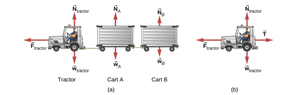
 

Attachments

  • Screen Shot 2022-03-23 at 6.57.50 PM.png
    Screen Shot 2022-03-23 at 6.57.50 PM.png
    16 KB · Views: 247
Physics news on Phys.org
As with any such question involving interacting masses that can move somewhat independently, draw a separate FBD for each mass. Each FBD should only show forces and accelerations directly related to the mass in question.
 
haruspex said:
As with any such question involving interacting masses that can move somewhat independently, draw a separate FBD for each mass. Each FBD should only show forces and accelerations directly related to the mass in question.
cart A's formula: -T + T -Ff = m*a?
 
Why have you assumed the two tensions are the same?
 
Mister T said:
Why have you assumed the two tensions are the same?
In a pulley system, the tensions are the same, why aren't they the same for this tractor pulling carts?
 
annamal said:
In a pulley system, the tensions are the same, why aren't they the same for this tractor pulling carts?
Because of the mass in between. We can only assume tensions are the same both sides of a pulley when there is no friction at the axle and either:
- it is a constant velocity arrangement (maybe static), or
- the pulley has negligible mass

The same applies for linear motion of a body between two strings. In the present case, there is no friction, but the body has mass and is accelerating.

Also, what is Ff in your equation? There is no mention of friction.
 
Last edited:
haruspex said:
Because of the mass in between. We can only assume tensions are the same both sides of a pulley when there is no friction at the axle and either:
- it is a static arrangement, or
- the pulley has negligible mass

Also, what is Ff in your equation? There is no mention of friction.
I think it is negligible
 
annamal said:
I think it is negligible
"a) What is the horizontal force acting on the connecting cable between cart A and B at this instant? Assume friction is negligible."

What instant is the problem referring to?
Should we assume it is at the end of the 3 seconds period?

Because the cables linking the three rolling masses do not stretch, the given acceleration is the same for each of those masses.
Cart B can't "see" what forces are beyond the A-B cable; therefore, you can simplify the solution by drawing a free body diagram for B that stops at that cable midpoint.
 
annamal said:
In a pulley system, the tensions are the same, why aren't they the same for this tractor pulling carts?
If the pulley has mass, the tensions are not the same. Likewise, for the cart attached to the tractor. Once you master this line of reasoning, it's valuable to think about what happens when the cables are not massless.
 
  • Like
Likes   Reactions: Lnewqban
  • #10
Mister T said:
If the pulley has mass, and is accelerating, the tensions are not the same.
 
  • #11
Ok, well I solved it until
T = 820t - m*0.7805t. I am just confused which mass I put for m. Mass of cart A or mass of cart A and tractor.
 
  • #12
annamal said:
Ok, well I solved it until
T = 820t - m*0.7805t. I am just confused which mass I put for m. Mass of cart A or mass of cart A and tractor.
That's because you are not using free body diagrams. The diagram will show the forces acting on the object. The vector sum of those forces equals the mass of that object times the acceleration.
 
  • #13
Mister T said:
That's because you are not using free body diagrams. The diagram will show the forces acting on the object. The vector sum of those forces equals the mass of that object times the acceleration.
Free body digram for A:
T2 (tension from string tractor to cart A) <--- A ---> T (tension on string from A to B)
T2 = 820t - m (mass of tractor)*0.7805t
T2 - T = m*a --> T = T2 - m*a = 820t - mT (mass of tractor)*0.7805t = mA (mass of cartA)*0.7805t
Is this correct? I am assuming the tractor and carts are accelerating at the same rate?
 
  • #14
annamal said:
Free body digram for A:
T2 (tension from string tractor to cart A) <--- A ---> T (tension on string from A to B)
T2 - T = m*a
Since this follows from a free body diagram of A, then ##m## is the mass of A.
 
  • Like
Likes   Reactions: Lnewqban

Similar threads

  • · Replies 14 ·
Replies
14
Views
1K
  • · Replies 12 ·
Replies
12
Views
1K
  • · Replies 32 ·
2
Replies
32
Views
1K
  • · Replies 7 ·
Replies
7
Views
4K
  • · Replies 1 ·
Replies
1
Views
2K
Replies
44
Views
3K
  • · Replies 21 ·
Replies
21
Views
4K
Replies
18
Views
3K
  • · Replies 12 ·
Replies
12
Views
1K
  • · Replies 24 ·
Replies
24
Views
4K