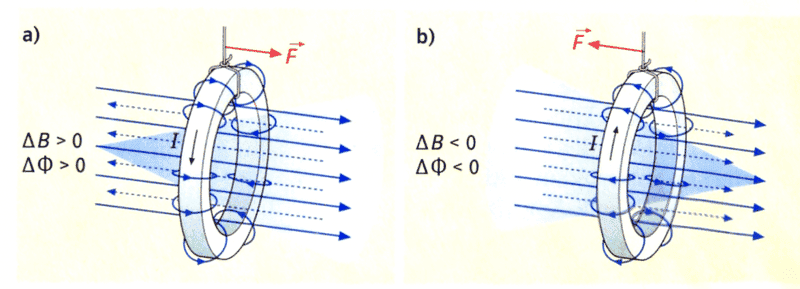
Textbook picture: Is direction of this eddy current wrong?

Click For Summary
SUMMARY

The discussion centers on the inaccuracies in a high school textbook regarding the direction of eddy currents as described by Lenz's law. Participants agree that the induced current direction is incorrectly depicted in both scenarios presented in the textbook. Additionally, there are concerns about the representation of magnetic flux in a single loop conductor and the convention of current flow, particularly the use of electron flow versus conventional current. The conversation highlights the potential confusion this may cause for students transitioning to university-level physics.

PREREQUISITES
  • Understanding of Lenz's Law and its application to eddy currents.
  • Familiarity with magnetic flux concepts in electrical circuits.
  • Knowledge of current flow conventions, including conventional current and electron flow.
  • Basic principles of electromagnetism as outlined in Maxwell's equations.
NEXT STEPS
  • Research the implications of Lenz's Law in practical applications, such as induction heating.
  • Study the differences between conventional current and electron flow in electrical circuits.
  • Examine advanced textbooks on electromagnetism to compare current flow conventions.
  • Explore the impact of educational materials on student understanding of physics concepts.
USEFUL FOR

Physics educators, high school students transitioning to university-level physics, and anyone interested in the nuances of electrical current conventions and their implications in learning.
greypilgrim
Messages
581
Reaction score
44
Hi.

This is from a high school textbook, in a chapter about eddy currents and Lenz's law. In a), a magnetic field is turned on, in b) it's turned off, which both induces a current in a suspended aluminium ring:
SCAN0010.png


I think the direction of the current is wrong in both pictures. Any opinions?
 
Physics news on Phys.org
Agree with you. Flux (broken lines) due to induced current (if circuit were complete) is in right direction in both cases, but induced current is in wrong direction in both cases.

Other minor nitpicks: (1) Since the conductor is a single loop, not a solenoid, the flux due to the induced current won't be parallel to axis throughout the cross-section, (2) I'd have thought also that the flux lines tightly wrapped around the conductor ought to be broken rather than full, but maybe I'm being stupid here.

Pity, because the artwork is so beautiful.
 
Does the author state the I ( cuurent ) protocol. Perhaps it refers to electron flow.
 
256bits said:
Does the author state the I ( cuurent ) protocol. Perhaps it refers to electron flow.
I've been using this book for almost two years now and only realized now that they indeed indicate the flow of negative charges, i.e. electrons. They don't write the ##I## arrow often, in the DC chapter they write only + and - poles which make it clear (obviously this is not possible for induced currents), which is why it probably took me so long.

I think I see this convention in an increasing number of "modern" school textbooks, probably to make it easier for students to use their mental picture of moving electrons. But are there major university level textbooks or publications that do this as well? None that I know of and I highly doubt there are, since this would mean redefining current density as well and therefore introducing minuses in the fourth Maxwell equation and the continuity equation, which would just look weird.

So the confusion will start at the latest when those students enter university and probably much earlier when they try and find explanations or exercises on the internet where the other convention is used. I don't think those "modern" textbooks are doing the students much favor...
 
  • Like
Likes Thomas Tucker
greypilgrim said:
I don't think those "modern" textbooks are doing the students much favor...

Agree entirely. In my experience students learning electricity for the first time quickly get used to electrons moving in the opposite direction to the conventional current in metals. It's only a minor and temporary nuisance.
 

Similar threads

  • · Replies 2 ·
Replies
2
Views
2K
  • · Replies 18 ·
Replies
18
Views
3K
  • · Replies 3 ·
Replies
3
Views
2K
  • · Replies 6 ·
Replies
6
Views
2K
  • · Replies 3 ·
Replies
3
Views
3K
Replies
4
Views
1K
  • · Replies 1 ·
Replies
1
Views
1K
Replies
1
Views
1K
  • · Replies 9 ·
Replies
9
Views
2K
  • · Replies 9 ·
Replies
9
Views
3K