The convergence of a numerical series

Join the discussion
Ask a follow-up here, or get your own question answered by working scientists, mathematicians and engineers — people, not an autocomplete.
Real named experts · corrections over time · the nuance an AI answer skips
5 replies · 2K views
Amaelle
Messages
318
Reaction score
55
Homework Statement
Look at the image
Relevant Equations
Absolute convergence.
Greetings
here is the exercice
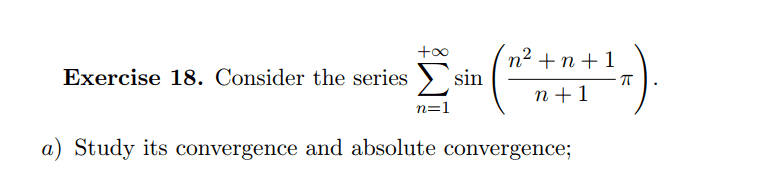
1629802637709.png

My solution was
as n^2+n+1/(n+1) tends asymptotically to n then the entire stuffs inside the sinus function tends to npi which make it asymptotically equal to sin(npi) which is equal to 0 and consequently the sequence is Absolutely convergent

Here is the solution of the book
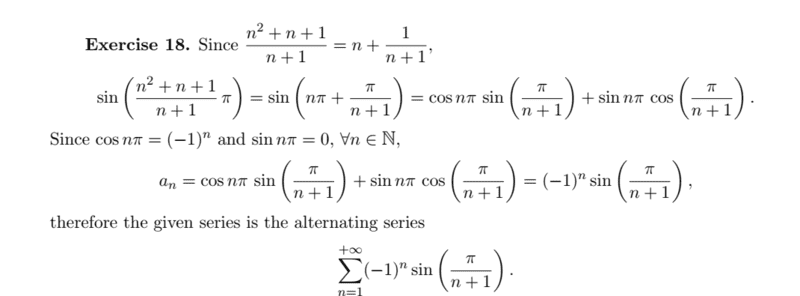
1629802909490.png

1629802963524.png


I do unsderstand it very well but I need to know where my logics has failed me in my attempt
thank you!
 
Physics news on Phys.org
To say that the terms are asymptotically equal to something does not say enough. It doesn't say how fast it approaches that limit. For instance, ##\sum{1/n}## doesn't converge even though ##1/n## approaches 0 asymptotically.
 
Reply
  • Like
Likes   Reactions: Amaelle and Orodruin
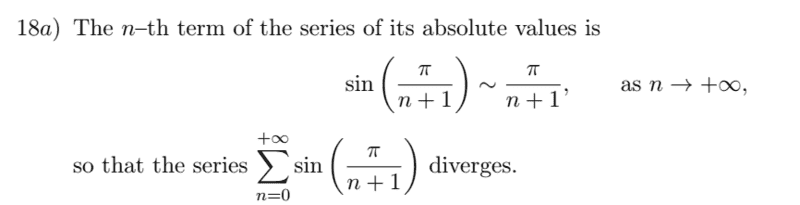
You can make the non-convergence rigorous by using the inequality [tex] \sin x > \frac{2}{\pi} x, \qquad 0 < x < \frac\pi 2.[/tex] Then [tex]\sum_{n=0}^N \sin\left(\frac{\pi}{n+1}\right) > \sin\left(\frac{\pi}1\right) + \sum_{n=1}^N \frac{2}{n+1} = 2\sum_{n=2}^{N+1} \frac 1n[/tex] which diverges.
 
Reply
  • Like
Likes   Reactions: Amaelle
Amaelle said:
Homework Statement:: Look at the image
Relevant Equations:: Absolute convergence.

My solution was
as n^2+n+1/(n+1)
You need more parentheses here. Taken literally, the above means
##n^2 + n + \frac 1{n + 1}##, which you surely didn't intend.
If you don't use Tex, it should be written as (n^2 + n + 1)/(n + 1).
 
Reply
  • Like
Likes   Reactions: Amaelle
FactChecker said:
To say that the terms are asymptotically equal to something does not say enough. It doesn't say how fast it approaches that limit. For instance, ##\sum{1/n}## doesn't converge even though ##1/n## approaches 0 asymptotically.

I wanted to say as
sin[pi*((n^2+n+1)/(n+1)]≈sin[pi*((n^2)/(n)]≈sin[pi(n)] and we know the serie ∑sin[pi(n)] converges SO IS MY SERIE
 
Once again, your "##\approx##" is not enough. It depends on how fast the terms on the left come close to the terms on the right. Consider ##1/n \approx 0## as ##n## gets large. But ##\sum{0}## converges while ##\sum{1/n}## diverges to ##+\infty##.
 
Reply
  • Like
Likes   Reactions: Mark44