Undergrad The fastest route between two points

  • Thread starter Thread starter ddddd28
  • Start date Start date
  • Tags Tags
    Points
Click For Summary
Traveling from point A to point B involves navigating a border where different velocities apply, complicating the fastest route determination. If velocity v1 before the border is greater than v2 after it, a longer initial route may be beneficial to offset time lost in the slower section. The challenge lies in finding the optimal border crossing point, which requires minimizing the overall travel time rather than just the distance. This problem is akin to classic calculus scenarios, such as minimizing time for light passing through different media or navigating across a river. The discussion highlights the need for a general solution that accounts for varying speeds and distances.
ddddd28
Messages
73
Reaction score
4
Hello,
Consider the next scenario:
I wish to travel from point a to point b as fast as possible. Between the points there is a border. In the region from a to the border, I can move only with velocity v1, and after the border, I am allowed to move only with velocity v2. All the additional details are given in the sketch:
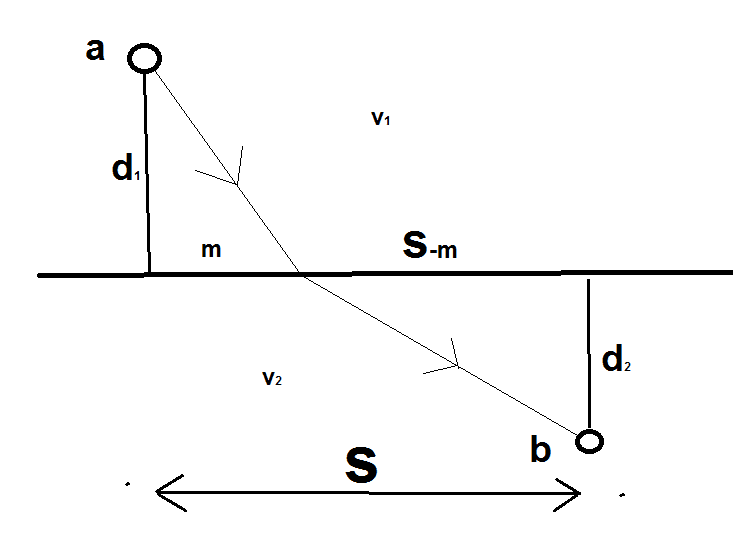
1564235532763.png

As it turns out, the problem is not as easy as it appears to be because it is not clear where I should pass the border. If v1 is bigger than v2 then I should consider taking a longer route in the first section to compensate on the time spent in the second section. However, a longer route in the first section adds up to the overall distance.
My attempt to solve it was to express the overall duration of the route as a function of m and minimize it. To my dismay, I ended up with a fourth-degree equation that didn't want to crack...
 
Mathematics news on Phys.org
ddddd28 said:
Hello,
Consider the next scenario:
I wish to travel from point a to point b as fast as possible. Between the points there is a border. In the region from a to the border, I can move only with velocity v1, and after the border, I am allowed to move only with velocity v2. All the additional details are given in the sketch:
View attachment 247182
As it turns out, the problem is not as easy as it appears to be because it is not clear where I should pass the border. If v1 is bigger than v2 then I should consider taking a longer route in the first section to compensate on the time spent in the second section. However, a longer route in the first section adds up to the overall distance.
My attempt to solve it was to express the overall duration of the route as a function of m and minimize it. To my dismay, I ended up with a fourth-degree equation that didn't want to crack...
No replies as yet so I will ask a question.
There will be different answers on this depending on which v is faster and by how much. Have you given all the details on this?
Some trig scenarios in there to play with.
I'm not a maths guy but I like the subject. @fresh_42 and @Mark44 will probably have 2 or 3 steps to solve!
 
ddddd28 said:
If v1 is bigger than v2 then I should consider taking a longer route in the first section to compensate on the time spent in the second section.
I don't get at all why that should be an issue. The solution needs to be general and has to encompass both situations automatically. I agree that it's a nasty problem but not because you can't decide in advance which path should be longer. That's what you are supposed to be SOLVING for, really.
 
This is a standard problem in calculus textbooks, where the goal is to minimize the time rather than the distance covered. Typical problems include scenarios in which you need to get to a point on the other side of a river, and your velocity while swimming or boating is different from your velocity on foot, as well as finding the path of least time for light passing through two different media.
 
  • Like
Likes pinball1970, SSequence, fresh_42 and 1 other person
I get : m = v1 √(d1^2+m^2) / ( v2 √(d2^2+(S-m)^2) + v1 √(d1^2 + m^2) )
 
Mark44 said:
Typical problems include scenarios in which you need to get to a point on the other side of a river, and your velocity while swimming or boating is different from your velocity on foot, as well as finding the path of least time for light passing through two different media.
Yes, refraction and the principle of least time was the first thing that came to my mind (since the kind of diagram, as in OP, is often associated with it).
 
Here is a little puzzle from the book 100 Geometric Games by Pierre Berloquin. The side of a small square is one meter long and the side of a larger square one and a half meters long. One vertex of the large square is at the center of the small square. The side of the large square cuts two sides of the small square into one- third parts and two-thirds parts. What is the area where the squares overlap?

Similar threads

Replies
0
Views
2K
  • · Replies 10 ·
Replies
10
Views
2K
Replies
14
Views
836
  • · Replies 2 ·
Replies
2
Views
3K
  • · Replies 8 ·
Replies
8
Views
686
Replies
2
Views
2K
  • · Replies 12 ·
Replies
12
Views
7K
  • · Replies 7 ·
Replies
7
Views
2K
  • · Replies 12 ·
Replies
12
Views
3K
  • · Replies 17 ·
Replies
17
Views
3K