The Klein-Gordon equation with a potential

  • Context: Graduate 
  • Thread starter Thread starter Sekonda
  • Start date Start date
  • Tags Tags
    Klein-gordon Potential
Click For Summary

Discussion Overview

The discussion revolves around the Klein-Gordon equation modified by a potential term, specifically of the form \(\delta V= \lambda \Psi^{*}\Psi\). Participants explore the implications of this potential in the context of quantum field theory, particularly regarding self-interactions and the interpretation of coupling constants.

Discussion Character

  • Exploratory
  • Technical explanation
  • Debate/contested
  • Mathematical reasoning

Main Points Raised

  • Some participants question the nature of the term \(\delta V= \lambda \Psi^{*}\Psi\) as a potential, suggesting it may represent a non-linear interaction rather than a traditional potential.
  • There is a discussion about the meaning of the coupling constant \(\lambda\), with some suggesting it represents the strength of self-interactions in the field.
  • One participant points out that the term \(\lambda \Psi^{*}\Psi\) can be interpreted as a self-interaction, where both \(\Psi\) and \(\Psi^{*}\) refer to the same spacetime point.
  • Another participant provides an example of how perturbative expansions around small \(\lambda\) can be performed, although the absence of a source term \(J\) in the current context is noted as a point of confusion.
  • Some participants express uncertainty about how the term leads to interactions, contrasting it with more familiar forms of interaction terms in quantum electrodynamics (QED).
  • There are multiple interpretations of the interaction term, with some suggesting it should be expressed differently to align with known forms of self-interaction in quantum field theory.

Areas of Agreement / Disagreement

Participants do not reach a consensus on the interpretation of the potential term or its implications for self-interactions. Multiple competing views and interpretations remain, particularly regarding the nature of the coupling constant and the form of the interaction term.

Contextual Notes

Some participants note limitations in their understanding of the relationship between the potential term and the Lagrangian formulation, as well as the absence of a source term in the current discussion.

Sekonda
Messages
201
Reaction score
0
Hello,

My question concerns the Klein-Gordon Equation under some potential of the form (and refers to a higgs-like interaction, i assume as that's what we're researching):

[tex]\delta V= \lambda \Psi^{*}\Psi[/tex]

For substitution into the Klein-Gordon equation:

[tex](\frac{\partial^2 }{\partial t^2}-\bigtriangledown ^2+m^2)\Psi=\lambda \Psi^{*}\Psi[/tex]

This is all in reference to the feynman diagram of:
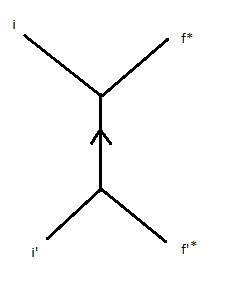
feynman.png


The internal line is supposed to represent some scalar mediator, and we also assume the [tex]\Psi[/tex] are 'free' states. Also there are [tex]\lambda[/tex] factors at the vertices of the feynman diagram, I believe this to be just some scaling factor of the perturbation - however I'm not sure. Also from what I've wrote the Psi's in the potential may have subscripts i' and f' but I'm not really sure why this is (they may supposed to be i and f?)

I don't understand much of this - beginning with my main issue of the form of the perturbation being what seems to be a probability density? Also I'm not really sure what interaction is exactly happening in this feyman diagram.

If what I have wrote is nonsensical, please tell me why so and I'll see if I can clear anything up. Any explanations will be appreciated!

Thanks guys,
SK.
 
Physics news on Phys.org
My professor has told me that the use of the Psi's in the potential is 'not really a 'potential' but a non-linear term we add to the wave equation that induces self interactions of the wave'

Does anybody know why self-interactions are caused by terms like ψ*ψ?

Thanks
 
How [tex]\delta V= \lambda \Psi^{*}\Psi[/tex] is an interaction term and what is that λ.I can not see any kind of interaction associated with this term.
 
lambda is a coupling constant. perturbative expansions are taken around lambda small. As to why certain terms intuitively lead to vertices, and the powers of fields directly correspond to the number of legs entering the vertices, I would love to know. You can find many derivations starting from a scalar action that work out the perturbative expansions in [itex]\lambda[/itex] and [itex]J[/itex] for some source. But as far as why nonlinearity equates to interaction I'm still not sure. If you look through some of the past threads here I can guaranteed the question has been answered though, it just might be buried somewhere deep.
 
Thanks guys for the information, I'll have a look around.

Lambda is the coupling constant - is this basically the coupling of the particle to the field? What does it mean?

Thanks
 
Look at Leonard Susskind QFT courses in YouTube. That is explained in the first or the second course (each one have 10 lectures) in a very intuitive manner.
More or less, the idea is that ψ, [itex]\phi[/itex] or A are creation / destruction operators so if you write, for example, ψ(x)*ψ(x)*[itex]\phi[/itex](x) you are saying that you are creating 2 ψ particles and 1 [itex]\phi[/itex] in position x from nothing (or destructing 1 and creating 2, or creating 1 and destructing 2 and so on).
So, in that way one can interpret that, for example in the 2 desctruction-1 creation example, a ψ particle interacts with a [itex]\phi[/itex] particle, it sort of eats it and as a result we have a ψ particle. All this being said in a veeeeryyyy intuitive way.

Hope it helps
 
Thank you for the suggestion of the youtube videos, I can tell this will help me understand this whole subject a lot better. Though there are quite a few so I better get watching and making notes!

Thanks again the_pulp!
 
I still don't get it,if λ is a coupling constant then where is the coupling term.I mean let's take qed for example in which coupling term is of form jμAμ,where jμ is current associated with particles and Aμ which represents potentials.only this term corresponds to interaction in qed.but I can not see anything similar with the given interaction because to me it does not seem any interaction.
 
It's coupling to itself. here are some example couplings: [itex](\lambda / 4!) \phi^4[/itex] is common example. Also [itex](\lambda /4!)(\phi \phi^{\dagger})^2[/itex] is another example where there are anti-particles, the phi and phi dagger.
 
  • #10
yes,it is a kind of self interaction.I was just not thinking that both ψ* and ψ should be associated to same spacetime point to cause interaction.It was generating the anharmonic term which gives interaction
 
  • #11
jfy4 what do you mean when you say we take perbutative expansions around λ?

Thanks!
 
  • #12
I mean, starting with the partition function, one can expand the exponential of the potential term in a series expansion in [itex]\lambda[/itex] (the coupling constant, there's nothing special about the letter lambda). Then, in nice cases you can write the poential as variations in a source [itex]J[/itex], [itex]V(\delta / \delta J)[/itex]. One can solve the free field partition function in terms of the propagator and sources, and then pull down green's functions with the variations in [itex]J[/itex]. These will be related to whatever order you decide to take the series expansion to in [itex]\lambda[/itex].
 
  • #13
jfy4 said:
I mean, starting with the partition function, one can expand the exponential of the potential term in a series expansion in [itex]\lambda[/itex] (the coupling constant, there's nothing special about the letter lambda). Then, in nice cases you can write the poential as variations in a source [itex]J[/itex], [itex]V(\delta / \delta J)[/itex]. One can solve the free field partition function in terms of the propagator and sources, and then pull down green's functions with the variations in [itex]J[/itex]. These will be related to whatever order you decide to take the series expansion to in [itex]\lambda[/itex].

But there is no source term J here which has really caused me trouble something like J∅,in qed jμ is generally ieψ*γ0γμψ but here there is no such thing.
 
  • #14
for the complex klein gordon equation you can write one as [itex]J^{\dagger}\phi + J\phi^{\dagger}[/itex] and for the real one you can write [itex]J\phi[/itex]. You can set [itex]J[/itex] equal to zero when you are done with the perterbative expansion.
 
  • #15
There is no necessity of it,one can directly go on with iL(lagrangian) and put the planewave form and separate all the unnecessary terms(factors taken care by external line etc.) to get the vertex factor.one can put the interaction term equal to delta function and go to momentum space to find the propagator.But so far there is no internal line corresponding to ay virtual quanta as is drawn because there is no source term and it's interaction with any field.
 
  • #16
The r.h.s. of KGE should read:
[tex] \frac{\lambda}{2} \left(\Psi^{\ast} \, \Psi \right) \Psi[/tex]
for a self-interaction of the type the Higgs boson has:
[tex] \mathcal{L}_{\mathrm{int}} = -\frac{\lambda}{2! 2!} \, \left( \Psi^{\ast} \, \Psi \right)^2[/tex]
 
  • #17
Dickfore said:
The r.h.s. of KGE should read:
[tex] \frac{\lambda}{2} \left(\Psi^{\ast} \, \Psi \right) \Psi[/tex]
for a self-interaction of the type the Higgs boson has:
[tex] \mathcal{L}_{\mathrm{int}} = -\frac{\lambda}{2! 2!} \, \left( \Psi^{\ast} \, \Psi \right)^2[/tex]

Second one makes sense,first one does not.
 
  • #18
andrien said:
Second one makes sense,first one does not.

The KGE is the Euler-Lagrange eqn. for the action defined as [itex]S = \int{d^d x \, \mathcal{L}}[/itex], where the Lagrangian (density) is:
[tex] \mathcal{L} = \mathcal{L_0} + \mathcal{L}_{\mathrm{int}}[/tex]
Here [itex]\mathcal{L_0} = \partial^{\mu} \Psi^{\ast} \, \partial_{\mu} \Psi - m^2 \Psi^{\ast} \, \Psi[/itex] is the Lagrangian for the free complex scalar field. Varying w.r.t. [itex]\Psi^{\ast}[/itex], one obtains:
[tex] \frac{\delta S}{\delta \Psi^{\ast}(x)} = -\left\lbrace \partial^2 + m^2 \right\rbrace \Psi(x) - \frac{\lambda}{2! 2!} 2 (\Psi^{\ast} \Psi) \, \Psi[/tex]
Equate this variation to zero and you get:
[tex] \left\lbrace \partial^2 + m^2 \right\rbrace \Psi = - \frac{\lambda}{2} (\Psi^{\ast} \Psi) \, \Psi[/tex]
Apart from a wrong sign, the r.h.s. has the form I gave in my previous post.
 
  • #19
I thought your first term also some sort of a lagrangian which is not possible.
 
  • #20
andrien said:
I thought your first term also some sort of a lagrangian which is not possible.

How can a Lagrangian term be present in a Klein-Gordon equation?!
 
  • #21
Yes you are right with the correct potential form, though I assumed it was in relation to the Higgs boson as this is what the topic is on though I'm guessing a potential of this form is just an example to familiarise ourselves.
 
  • #22
Dickfore said:
How can a Lagrangian term be present in a Klein-Gordon equation?!
I did not read it rather just see.
 
  • #23
Hey I think the form of the potential was supposed to be this:

[tex]\lambda\Psi_{f'}^{*} \Psi_{i'}[/tex]

such that:

[tex](\frac{\partial^2 }{\partial t^2}-\bigtriangledown^2+m^2)\Psi=\lambda\Psi_{f'}^{*} \Psi_{i'}[/tex]

Is this right?
 
  • #24
For a complex scalar field theory you want a partition function of the form
[tex] Z = \int D\phi \exp \left[ i \int d^4 x \frac{1}{2} \{ \partial \phi \partial \phi^{\dagger} + m^2 \phi \phi^{\dagger} \} + V(\lambda , \phi, \phi^{\dagger}) + J^{\dagger}\phi + J\phi^{\dagger} \right][/tex]
you can then assume weak coupling and expand the potential order by order in lambda, and replace the moment integrals with variations with respect to J, [itex]\delta / \delta J[/itex], like
[tex] \int dx \, x^2 e^{-\alpha x} = \frac{\partial^2}{\partial \alpha^2} \int dx \, e^{-\alpha x}[/tex]
doing this, along with a regularization procedure, you can make all the connected green's functions and feynman diagrams.
 
  • #25
Hmm I don't understand most of that - though it does sound like the route we are taking. Does the equation I just posted make sense at all though? Are you implying that it is and it's a complex scalar field?

I haven't actually had any substantial teaching of quantum field theory, we're supposed to be taking a simplified route so forgive me for not understanding most of the terms you speak of (i.e. the partition function - I've heard of that but not applied to this!)

Thanks!
 
  • #26
something doesn't seem right... If I understand you correctly you are writing
[tex] V(\Psi, \Psi^{\dagger}) = \lambda \Psi \Psi^{\dagger}[/tex]
then the lagrangian would be
[tex] \mathcal{L} = \frac{1}{2}\partial \Psi^{\dagger} \partial \Psi + \frac{1}{2}m^2 \Psi^{\dagger}\Psi - \lambda \Psi^{\dagger} \Psi[/tex]
If you solve Lagrange's equations for [itex]\Psi[/itex] or [itex]\Psi^{\dagger}[/itex] you will not get what you have posted. If you want to get a vertex with three lines the potential needs to be cubic in field quantities. but with a complex field it will be asymmetrical too since you will write down a term like [itex]\Psi\Psi^{\dagger}\Psi[/itex] which is uneven in the two fields. For real fields it would be like [itex]\phi^{3}/3![/itex].
 
  • #27
Well it probably isn't right knowing me, my professor said we model the perturbation as the interaction between some 2 scalar particles which is of the form of some coupling strength lambda and the product of the complex conjugated final state wavefunction of particle 2 and the initial state wavefunction of particle 2...

I shall send him an email tomorrow and ask!
I apologise if I'm not coherent/making sense.

Thanks,
Tom
 
  • #28
please report back! :) I want to know too.
 
  • #29
haha will do!
 
  • #30
I think that interaction term posted by dickfore is the right one,it seems that in post #27 that is what is being said.
 

Similar threads

  • · Replies 3 ·
Replies
3
Views
1K
  • · Replies 3 ·
Replies
3
Views
1K
  • · Replies 1 ·
Replies
1
Views
2K
  • · Replies 9 ·
Replies
9
Views
2K
  • · Replies 2 ·
Replies
2
Views
2K
  • · Replies 45 ·
2
Replies
45
Views
5K
  • · Replies 24 ·
Replies
24
Views
3K
  • · Replies 6 ·
Replies
6
Views
2K
  • · Replies 1 ·
Replies
1
Views
1K
  • · Replies 5 ·
Replies
5
Views
2K