The Mandelbrot Set has a third dimension: the Bifurcation Diagram

Click For Summary
SUMMARY

The discussion centers on the relationship between the Mandelbrot Set and the Bifurcation Diagram, highlighting their visualization connections. Participants express fascination with the dimensional aspects of these mathematical constructs and reference James Gleick's influential book, "Chaos: Making a New Science," which has significantly impacted their understanding of fractals. The conversation also touches on the accuracy of educational YouTube channels like Veritaseum and SmarterEveryDay, which provide reliable scientific content. Additionally, there is a call for further exploration of the less-studied areas of fractal geometry, particularly regarding the implications of cross-sections through the Mandelbrot Set.

PREREQUISITES
  • Understanding of fractal geometry concepts
  • Familiarity with the Mandelbrot Set and its properties
  • Knowledge of bifurcation theory
  • Basic skills in 3D rendering techniques
NEXT STEPS
  • Research the mathematical implications of cross-sections through the Mandelbrot Set
  • Explore advanced topics in bifurcation theory and its applications
  • Investigate the latest developments in fractal geometry and related visualizations
  • Read James Gleick's "Chaos: Making a New Science" and its second edition for historical context
USEFUL FOR

Mathematicians, physicists, computer graphics artists, and anyone interested in the advanced study of fractals and their applications in science and art.

DaveC426913
Gold Member
2025 Award
Messages
24,250
Reaction score
8,368
This is wild.
I was always fascinated with the Mandelbrot set, as well as the bifurcation diagram. I had no idea the Mandelbrot diagram was a different visualization of the bifurcation diagram.
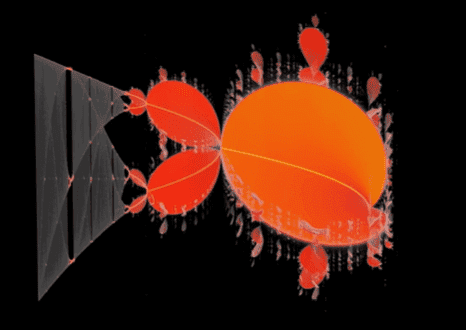
mandelbrot bifurcation.png


Question: is this video accurate? I always question the veracity of YouTube science videos.
 
  • Like
Likes   Reactions: anorlunda
Mathematics news on Phys.org
I think you can trust certain channels to be accurate Like veritaseum, smartereveryday, 3brown1blue, numberphile and others related to them. They do their homework and they create great content.

Veritaseum lists numerous papers as well in the description of the Video that you can check. Some though are behind paywalls.

i too was fascinated by this dimensional connection.
 
Did you catch the plug in the video for James Gleick's book ?https://en.wikipedia.org/wiki/Chaos:_Making_a_New_Science

When I read that book 32 years ago, it made such an impression, that I bought several copies to give to my friends. I just learned that it won a Pulitzer Prize. It was very good.
 
  • Like
Likes   Reactions: Klystron
anorlunda said:
Did you catch the plug in the video for James Gleick's book ?
Name sounds familiar. His books were probably what I was reading back then.
 
anorlunda said:
Did you catch the plug in the video for James Gleick's book ?https://en.wikipedia.org/wiki/Chaos:_Making_a_New_Science

When I read that book 32 years ago, it made such an impression, that I bought several copies to give to my friends. I just learned that it won a Pulitzer Prize. It was very good.
I used to carry a soft-back copy of James Gleick's "Chaos" gifted by my father in my car to read in off moments. "Chaos" led me to study fractal dimensions and axiomatic set theory at university.

Also enjoyed Gleick's science articles in the New York Times and Washington Post over the years. "Newton" struck me as the definitive modern biography of Isaac Newton with interesting comparisons of early and modern mathematical notations and Newton's productive work while escaping the plague. I wrote a book review on "Time Travel: a History", I think at the public library website. Gleick's biography of Richard Feynman "Genius" is on my reading list.

Apologies for not watching the videos. Guess I prefer reading books and PF. :cool:
 
Last edited:
  • Like
Likes   Reactions: anorlunda
Klystron said:
Apologies for not watching the videos. Guess I prefer reading books and PF. :cool:
Well yes - and now I want to read the books!

I assume the science has progressed in the 3 decades since Gleick's book.
Any recos on this specific relationship (Mandelbrot and bifurcation) - as opposed to more general books on fractals?
 
I had a hard time sleeping last night. My mind sparkled with thoughts like a field of fireflies on a hot evening.

In the latter half, the narrator says something to the effect of "the bifurcation diagram only exists in the real number plane of the Mandelbrot graph, since we only measure real things with it." But he also says the other buds off the main body have their own bifurcations.

So, presumably, you could take a slice along any line through the Mandelbrot'plane and view its cross section.
And presumably, we would see distorted renderings of the BD.

What would the cross-section look like if, instead of slicing exactly along the x-axis, we sliced thorugh and angle of .01 degrees? Now it would miss the miniature artifacts far in the negative x range and plow right into emptiness (at least for a while. The Mandelbrot set is one single entity - all black areas are connected). Would the BD sort of bottom out at zero as it crossed these deserts of ... non-Mandelbrotliness?

Is there meaning to such a slice?

As we swept out the slice, clockwise from x=0 through x=-y and on through x>infinity, presumably we would see a moving, transforming BB that would, every once in a while return to pseudo-normalcy as we reached one of the larger offset buds.
 
Last edited:
DaveC426913 said:
I assume the science has progressed in the 3 decades since Gleick's book.
There is a 2nd edition to the book. Amazon says the 2nd edition already sold more than 1 million copies.
 
DaveC426913 said:
I had a hard time sleeping last night. My mind sparkled with thoughts like a field of fireflies on a hot evening.

In the latter half, the narrator says something to the effect of "the bifurcation diagram only exists in the real number plane of the Mandelbrot graph, since we only measure real things with it." But he also says the other buds off the main body have their own bifurcations.

So, presumably, you could take a slice along any line through the Mandelbrot'plane and view its cross section.
And presumably, we would see distorted renderings of the BD.

What would the cross-section look like if, instead of slicing exactly along the x-axis, we sliced thorugh and angle of .01 degrees? Now it would miss the miniature artifacts far in the negative x range and plow right into emptiness (at least for a while. The Mandelbrot set is one single entity - all black areas are connected). Would the BD sort of bottom out at zero as it crossed these deserts of ... non-Mandelbrotliness?

Is there meaning to such a slice?

As we swept out the slice, clockwise from x=0 through x=-y and on through x>infinity, presumably we would see a moving, transforming BB that would, every once in a while return to pseudo-normalcy as we reached one of the larger offset buds.
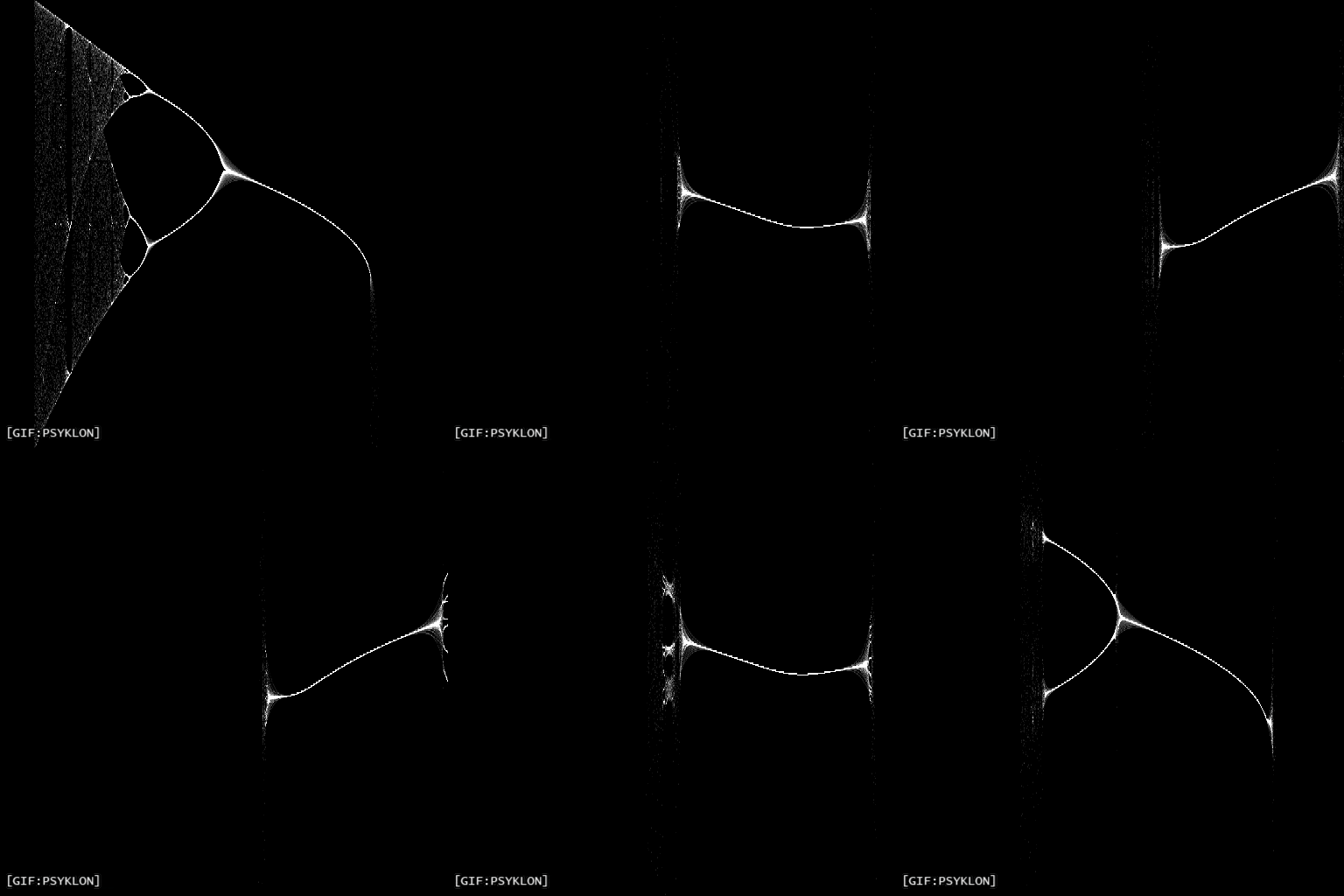
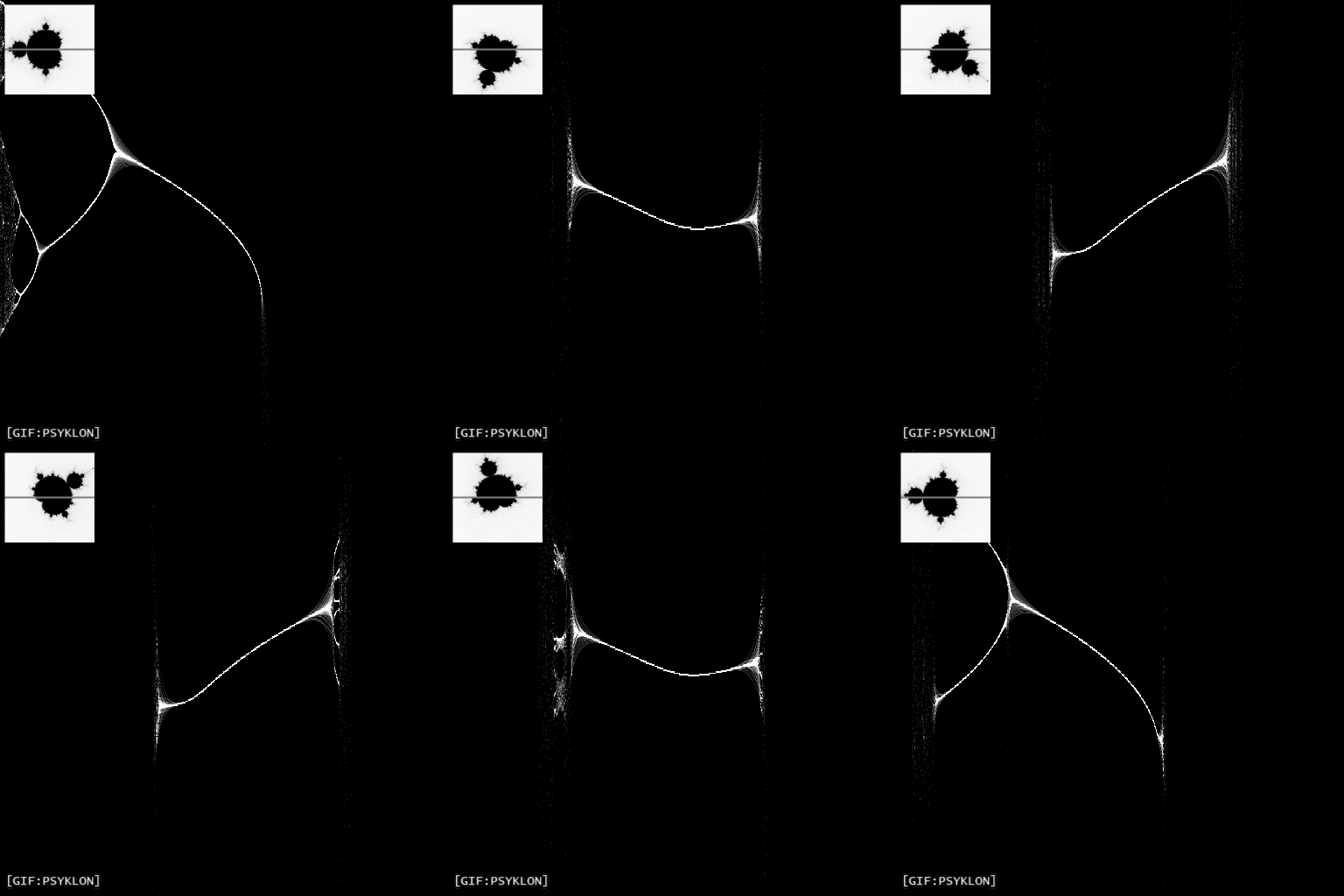
Just out of curiosity, I rendered an image showing the cross sections of the rotating object, but I can't found any interesting areas besides the one at the axis:
giphy.gif

Altrough, on the 3D render I can see that the smaller bulbs also have a similar behaviour:
giphy.gif

I'm sure that these smaller "bifurcation diagrams" are shifted from the centrel point, and it also might be that these are not perfectly straight, so it would be very hard to coherently render a cross-section of these. Maybe I'll try it sooner or later.
 
  • Wow
  • Like
Likes   Reactions: BvU and Klystron
  • #10
DaveC426913 said:
What would the cross-section look like if, instead of slicing exactly along the x-axis, we sliced thorugh and angle of .01 degrees? Now it would miss the miniature artifacts far in the negative x range and plow right into emptiness (at least for a while. The Mandelbrot set is one single entity - all black areas are connected). Would the BD sort of bottom out at zero as it crossed these deserts of ... non-Mandelbrotliness?

Is there meaning to such a slice?
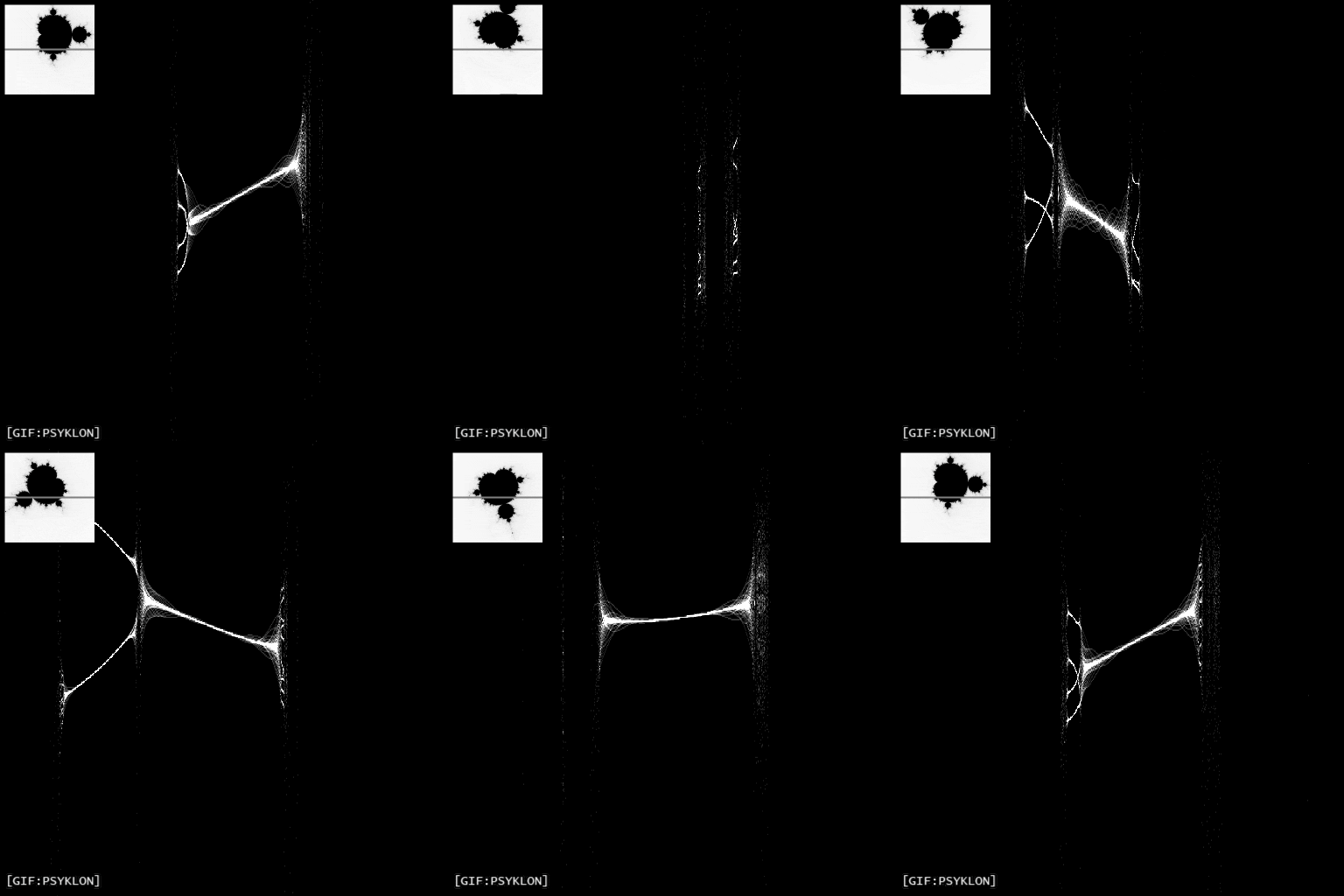
Based on my experiments, I can confirm many that many of your assumptions was right. Of course, bifurcation only exists inside the Mandelbrot set, other areas will be empty. For the meaning part, I think yes, we can make use of this visualization to tell us that to what period, and exactly between which numbers any given point of the mandelbrot is attracted to (if any). I did two more renders showing how this can be utilized:
giphy.gif

giphy.gif


Anyway, does anybody know why this area of fractal geometry is not well studied? It seems like everybody was amazed when it was first shown that the bifurcation diagram exists inside the Mandelbrot set, but it also looks like the story ended here... Mandelbulbs and other 3D variants emerged, and still in massive use, but in my opinion there's still many hidden and unexplored areas of the original equation as well.
 
  • Like
Likes   Reactions: BvU and Klystron

Similar threads

  • · Replies 15 ·
Replies
15
Views
3K
  • · Replies 4 ·
Replies
4
Views
2K
  • · Replies 5 ·
Replies
5
Views
2K
  • · Replies 47 ·
2
Replies
47
Views
6K
  • · Replies 14 ·
Replies
14
Views
4K
  • · Replies 30 ·
2
Replies
30
Views
6K
  • · Replies 16 ·
Replies
16
Views
2K
  • · Replies 2 ·
Replies
2
Views
2K
  • · Replies 14 ·
Replies
14
Views
2K
  • · Replies 8 ·
Replies
8
Views
2K