The Mystery of the Couple's Children: Eye Color Edition

Click For Summary

Discussion Overview

The discussion centers around the genetics of eye color, specifically questioning the likelihood of a couple with green and hazel eyes having children with blue and brown eyes. Participants explore the complexities of eye color inheritance and the potential for environmental factors to influence eye color changes.

Discussion Character

  • Exploratory
  • Technical explanation
  • Debate/contested

Main Points Raised

  • Some participants propose that if both parents have hazel eyes, their children would likely also have hazel eyes, with a small chance of blue eyes.
  • Others suggest that if one parent has green eyes and the other has hazel eyes, the children could inherit green, hazel, or possibly blue eyes.
  • A participant notes that the only way to explain the children's eye colors as shown in the picture might be if one parent has brown eyes, although this raises questions about the shade of brown inherited.
  • Another participant highlights that eye color inheritance is complex and not strictly determined by dominant and recessive traits, indicating that almost any combination of parental eye colors can result in various eye colors in children.
  • Environmental factors are mentioned as influencing eye color changes over time, suggesting that eye color is not fixed and can be altered by external conditions.

Areas of Agreement / Disagreement

Participants express differing views on the inheritance of eye color, with no consensus reached on the likelihood of the children's eye colors given the parents' eye colors. The discussion remains unresolved regarding the specific genetic mechanisms at play.

Contextual Notes

Limitations include the complexity of genetic inheritance patterns and the influence of environmental factors on eye color, which are not fully understood or agreed upon by participants.
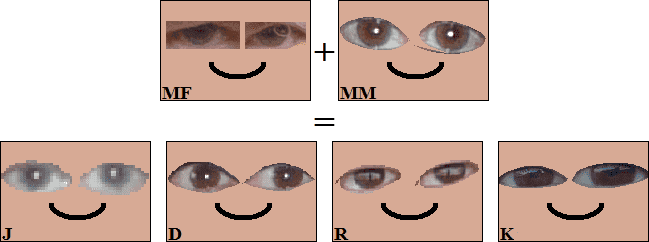
Berserker
Messages
2
Reaction score
0
Hello,

In the picture above a couple are shown with their children. Or are they actually their children? Is it possible for them, having green (?) and hazel (?) eyes, to get 1 child with blue eyes and 3 children with brown eyes?

5ntlS0h.png
 
Biology news on Phys.org
Berserker said:
Hello,

In the picture above a couple are shown with their children. Or are they actually their children? Is it possible for them, having green (?) and hazel (?) eyes, to get 1 child with blue eyes and 3 children with brown eyes?

5ntlS0h.png
Welcome to the PF.

Is this question for schoolwork? If so, it needs to be posted in the Homework Help section of the PF, and you need to show your attempt at answering the question before we can offer tutorial help. :smile:
 
berkeman said:
Welcome to the PF.

Is this question for schoolwork? If so, it needs to be posted in the Homework Help section of the PF, and you need to show your attempt at answering the question before we can offer tutorial help. :smile:
Hello berkeman,

It's not homework. But I recognize I should've provided with my own attempt at solving it.

While using the pipette tool in MS Paint on the eyes of the parent marked as MF I find a mixture between gold and green, there's also some brown and even a little grey. In the other parent's eyes, marked as MM, I find reddish brown, dark gold and quite some blue and grey at the edges. My conclusion is that the eyes of the parent marked as MF classifies as either green or hazel eyes, and the eyes of the parent marked as MM classifies as hazel or amber.

My take on it is that if both parents have hazel eyes then their children would also have hazel eyes or perhaps with a small possibility of blue eyes. Also, if one parent has green eyes and the other has hazel eyes then they'd have children with green eyes, hazel eyes or again with a small possibility of blue eyes. Except from mutations, the only possibility I can think of for the outcome as shown in the picture would be if one of the parents is actually classified as having brown eyes. But then again, the children should have inherited the same shade of brown as that parent and not a much darker version of it.

Am I missing something basic or substantial? All help is welcome and appreciated.

Thanks
 
Berserker said:
Hello berkeman,

It's not homework. But I recognize I should've provided with my own attempt at solving it.

While using the pipette tool in MS Paint on the eyes of the parent marked as MF I find a mixture between gold and green, there's also some brown and even a little grey. In the other parent's eyes, marked as MM, I find reddish brown, dark gold and quite some blue and grey at the edges. My conclusion is that the eyes of the parent marked as MF classifies as either green or hazel eyes, and the eyes of the parent marked as MM classifies as hazel or amber.

My take on it is that if both parents have hazel eyes then their children would also have hazel eyes or perhaps with a small possibility of blue eyes. Also, if one parent has green eyes and the other has hazel eyes then they'd have children with green eyes, hazel eyes or again with a small possibility of blue eyes. Except from mutations, the only possibility I can think of for the outcome as shown in the picture would be if one of the parents is actually classified as having brown eyes. But then again, the children should have inherited the same shade of brown as that parent and not a much darker version of it.

Am I missing something basic or substantial? All help is welcome and appreciated.

Thanks

My eyes were hazel. Over the years they turned blue.
 
This has a great explanation of your issue. https://en.wikipedia.org/wiki/Eye_color

1. Almost any combination of eye color in parents can have biological children with almost any eye color. It is very complex, not just blue (recessive) and brown dominant.

2. Hazel and other colors are caused by scattering of light in the stroma of the iris. It is a layer in fibrous tissue in the iris of the eye.

3. Changes to fibers in the stroma from environmental factors can and do alter eye color. For example: Medications like Travatan (for glaucoma) interact with the stroma the stroma. People with hazel or purple eyes using that med often wind up with darker colored eyes . I do not know if the changes are reversible.

This means that hazel and some other colors are not fixed for life. Environmental factors are also responsible for changes in the stroma.

So the answer to your question is: this is a biochemical/anatomical phenomenon. Analyzing the reflected wavelengths of light may be fun but probably not informative at all. People's eyes (anybody on the blue/gray/hazel, etc. side of things) can and do change color. They can also have kids with dark eyes -> not extremely likely but possible.
 
  • Like
Likes   Reactions: berkeman

Similar threads

Replies
2
Views
5K
  • · Replies 16 ·
Replies
16
Views
142K
Replies
8
Views
5K
  • · Replies 1 ·
Replies
1
Views
3K
  • · Replies 1 ·
Replies
1
Views
3K
  • · Replies 1 ·
Replies
1
Views
4K
  • · Replies 40 ·
2
Replies
40
Views
4K
  • · Replies 7 ·
Replies
7
Views
5K
Replies
0
Views
1K