Two Particles Connected by Massless Rod: Dynamics Analysis

Click For Summary
SUMMARY

The discussion focuses on the dynamics of two point-like particles of mass m connected by a massless rod, and the effects of a collision with a particle of mass M. After the collision, the center of mass velocity is determined to be 𝑉𝑐𝑚 = 𝑀(𝑣0+𝑣)/2𝑚. The participants analyze angular momentum conservation, concluding that the total angular momentum before and after the collision must be calculated using the formula 𝐿 = 𝑟 × 𝑝. The final angular velocity of the two m-particles is established as 𝜔 = 𝑀(𝑣0+𝑣)/𝑚𝐿, confirming the counterclockwise rotation post-collision.

PREREQUISITES
  • Understanding of linear momentum conservation principles
  • Familiarity with angular momentum concepts and calculations
  • Knowledge of center of mass calculations
  • Basic mechanics involving collisions and rotational dynamics
NEXT STEPS
  • Study the conservation of momentum in elastic and inelastic collisions
  • Learn about angular momentum conservation in multi-body systems
  • Explore the calculation of center of mass for composite systems
  • Investigate the dynamics of rigid body rotation and angular velocity
USEFUL FOR

Students and professionals in physics, particularly those focusing on mechanics, collision dynamics, and rotational motion analysis.

Booze
Messages
2
Reaction score
0
New user is reminded to show their work on schoolwork problems at PF
Homework Statement
The particle of mass M collapses with the body of two point-like particles of mass m.
Relevant Equations
Help needed
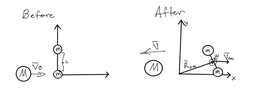
Two point-like particles of mass m. The particles are rigidly connected to each other with a mass-less rod of length L. The particles are initially at rest in such a way that one particle is at the origin and the other is at the point (0, L). A point-like particle of mass M collides with a particle located at the origin with a speed 𝑣⃗0.

a) After the collision, a particle of mass M bounces straight back to its direction of entry. Show that two m-the center of mass of the body formed by the particle must then move so that 𝑉𝑐𝑚 = 𝑀(𝑣0+𝑣)/2𝑚 .
b) Determine the orbital angular momentum 𝐿⃗⃗ 𝑡𝑟𝑎𝑛𝑠 and the rotation rate 𝐿⃗⃗ 𝑟𝑜𝑡 of the given
using quantities (relative to the origin) before and after the collision. What can you say about the total angular momentum value?
c) Show that after the collision, the body of two m-particles rotates counterclockwise with angular velocity 𝜔 = 𝑀(𝑣0+𝑣)/𝑚𝐿.
 

Attachments

  • wt.PNG
    wt.PNG
    5.3 KB · Views: 129
Physics news on Phys.org
Hello @Booze ,

:welcome: ##\qquad ## !​

Please read the PF homework guidelines. We can only help if you post your attempt at solution.

What have you learned so far that can help you solve this one ?

Oh, and "Help needed" is NOT a relevant equation. :wink:

##\ ##
 
  • Like
Likes phinds and topsquark
in question a) I don't get where does come from M(v0+v)!
i did the law of conservation of momentum before=after. i got that 2m is equel M, but i think it is wrong!
in b) i assumed before collision that Lrot is 0 and Ltrans= r(M) x p(M). and after collision i was thinking that Ltrans=r'(M) x p(M) + Rcm x p(body)=r'(M) x M*v0 +Rcm x Vcm*2m= Rcm*Vcm*2m - r'(M)*M*v=...=LM(v0+v)/m-r'(M)Mv
Vcm u know from a) and i calculate Rcm=mL/2m
i got c) right w=Vcm/Rcm= answer
 
Last edited:
Booze said:
in question a) I don't get where does come from M(v0+v)!
i did the law of conservation of momentum before=after. i got that 2m is equel M, but i think it is wrong!
in b) i assumed before collision that Lrot is 0 and Ltrans= r(M) x p(M). and after collision i was thinking that Ltrans=r'(M) x p(M) + Rcm x p(body)=r'(M) x M*v0 +Rcm x Vcm*2m= Rcm*Vcm*2m - r'(M)*M*v=...=LM(v0+v)/m-r'(M)Mv
Vcm u know from a) and i calculate Rcm=mL/2m
i got c) right w=Vcm/Rcm= answer
Please show how you got your result in part (a), specifically how you applied linear momentum conservation. In part (b) you need to consider angular momentum conservation. What is the total angular momentum about the origin before the collision? Hint: ##\mathbf{L}=\mathbf{r}\times\mathbf{p}##. Part (c) will sort itself out after you have obtained correct answers for parts (a) and (b).
 
Last edited:
Booze said:
I don't get where does come from M(v0+v)!
Neither do I unless you are told that M bounces back with speed v (i.e. a velocity -v). Did you leave that out or is it missing from the original?
 
haruspex said:
Neither do I unless you are told that M bounces back with speed v (i.e. a velocity -v). Did you leave that out or is it missing from the original?
I had the same question about the meaning of v. Then I saw in the figure posted in #1 that M is shown bouncing back with speed v.
 

Similar threads

  • · Replies 71 ·
3
Replies
71
Views
3K
Replies
335
Views
16K
  • · Replies 13 ·
Replies
13
Views
2K
  • · Replies 11 ·
Replies
11
Views
3K
Replies
10
Views
2K
Replies
21
Views
2K
  • · Replies 12 ·
Replies
12
Views
2K
  • · Replies 18 ·
Replies
18
Views
3K
  • · Replies 9 ·
Replies
9
Views
2K
