The Peak Day of a Very Active Atlantic Hurricane Season

  • Thread starter Thread starter .Scott
  • Start date Start date
  • Tags Tags
    Hurricane Peak
Click For Summary

Discussion Overview

The discussion revolves around the activity of the Atlantic hurricane season, particularly focusing on the implications of using Greek letters for naming storms and the potential for retirement of those names. Participants explore the historical context, naming conventions, and the unusual occurrence of multiple storms simultaneously.

Discussion Character

  • Exploratory
  • Debate/contested
  • Technical explanation

Main Points Raised

  • Some participants note the unprecedented activity in the Atlantic hurricane season, referencing multiple disturbances and storms occurring simultaneously.
  • There is a discussion about the retirement of storm names, with some participants stating that Greek letter storms cannot be retired due to the lack of alternative names.
  • Others propose that the naming system could be amended to include names from various alphabets or mythologies, though this would require changes to existing protocols.
  • A participant cites the World Meteorological Organization's (WMO) guidelines on name retirement, mentioning that Greek-lettered storms are not specifically addressed in their documentation.
  • Some express the belief that it is only a matter of time before a Greek letter storm is retired, while others remain skeptical about the practicality of such a change.
  • There is mention of the historical context of storm names that have been retired due to their impact, with examples provided from past seasons.
  • One participant highlights the significant number of tropical disturbances currently active, emphasizing the ongoing nature of the hurricane season.

Areas of Agreement / Disagreement

Participants express a range of views regarding the retirement of Greek letter storm names, with no consensus reached on whether such names can or should be retired. The discussion remains unresolved on the implications of using Greek letters for storm naming.

Contextual Notes

There are limitations in the discussion regarding the assumptions about the naming conventions and the specific criteria for retirement of storm names, which are not fully explored. The implications of the WMO's guidelines on Greek-lettered storms remain unclear.
.Scott
Science Advisor
Homework Helper
Messages
3,937
Reaction score
1,969
TL;DR
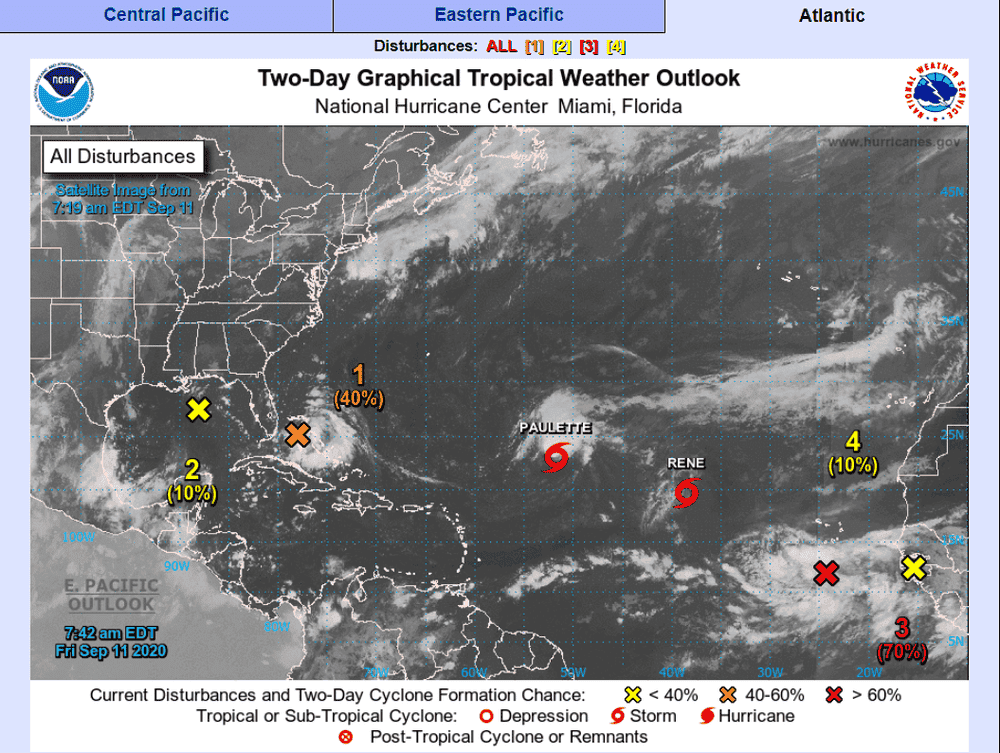
NOAA Screen shot shows widespread activity
I just took a peek at the NOAA Hurricane site: NOAA Atlantic Hurricane Site

It's pretty crowded out there: 4 disturbances and 2 tropical storms.
I have never seen so much activity. Here is a screen shot (from 9/11/2020):
Atlantic_Hurricanes.png
If there are more storms (and this is just the middle of the season), they will be: Sally, Teddy, Vicky, Winfred, Alpha, Beta, Gamma, ...

If we make it to Zeta, it will match the 2005 season.
When a hurricane causes exceptional damage, its name is retired.
That has never happened to a Greek letter storm.
 
Last edited:
  • Informative
Likes   Reactions: jim mcnamara and berkeman
Earth sciences news on Phys.org
Yikes! I’ve never seen the bigger picture map like that.

I remember a NOVA show on a plane disaster that mentioned how the pilot attempted to fly around one massive storm only to run into a secondary storm behind it instead of turning back. It never occurred to me at the time that two storm systems could be in such proximity as is shown in your snapshot.
 
.Scott said:
If we make it to Zeta, it will match the 2005 season.
When a hurricane causes exceptional damage, its name is retired.
That has never happened to a Greek letter storm.
The greek storms cannot be retired, as there are no other names to replace them.

Thus you might have exceptional storms in consecutive years with the same name.
 
There are many alphabets around the world to choose from or you could start naming storms using the greek gods, norse gods... but I guess they would have to amend their naming system to allow it.
 
Halc said:
The greek storms cannot be retired, as there are no other names to replace them.

Thus you might have exceptional storms in consecutive years with the same name.

Per the World Meteorological Organization:
The only time that there is a change in the list is if a storm is so deadly or costly that the future use of its name on a different storm would be inappropriate for reasons of sensitivity. If that occurs, then at an annual meeting by the WMO Tropical Cyclone Committees (called primarily to discuss many other issues) the offending name is stricken from the list and another name is selected to replace it. Infamous storm names such as Mangkhut (Philippines, 2018), Irma and Maria (Caribbean, 2017), Haiyan (Philippines, 2013), Sandy (USA, 2012), Katrina (USA, 2005), Mitch (Honduras, 1998) and Tracy (Darwin, 1974) are examples for this.

I don't see any exemption for lettered storms ... however ...

The WMO website makes no mention of Greek-lettered storms at all.
And from the description, "meteorologist" only assigned the WMO the very narrow task of maintaining the six-year list of available storm names. So, if a Greek letter ever makes an infamous name for itself, it would seem that "meteorologists" will have to address that when it happens.

So far, lettered Atlantic storms have only occurred in 2005 - and none have ever qualified for retirement. But the 2005 season certainly demonstrated that it was possible. The storm just before Hurricane Alpha (October 22, 2005) was Wilma (October 15, 2005) and not only was "Wilma" retired, it remains the most intense Atlantic storm ever recorded (882 mbar).

Two retired names share Alpha's October 22nd birthday: Sandy (2012) and Mitch (1998). And there are seven that have occurred later in the season: Hattie (1961), Lenny (1999), Michelle (2001), Noel (2007), Paloma (2008), Tomas (2010), and Otto (2016).
 
I think its just a matter of time before a lettered storm is retired.

Lets just hope it isn't ##\Omega##
 
  • Wow
Likes   Reactions: berkeman
From Wikipedia (https://en.m.wikipedia.org/wiki/2005_Atlantic_hurricane_season):
During the conference, there was considerable discussion on the usage of the Greek alphabet and if those names could be retired if one proved to be particularly damaging or deadly.[167] The committee decided that the usage of the Greek alphabet had a major important political, economic and social impact globally, which might not have happened if a secondary or circular list of names had been used.[167] As a result, the committee decided that the Greek alphabet would be used again if the traditional naming list was exhausted, and that it was not practical to retire a Greek letter. Storms named with Greek letters that would otherwise be eligible for retirement would appear in the retired name list, but have a notation affixed with the circumstances.[167]
 
  • Like
Likes   Reactions: .Scott
The mid-Atlantic has become a storm factory. We're up to seven tropical disturbances: 4 named storms, 1 developing depression, and 2 others - all at the same time.
Atlantic_Hurricanes_20200914.png
 

Similar threads

Replies
6
Views
3K