The picture of the Comoving coordinate

  • Context: Undergrad 
  • Thread starter Thread starter Arman777
  • Start date Start date
  • Tags Tags
    Coordinate Picture
Click For Summary

Discussion Overview

The discussion revolves around understanding the comoving coordinates in the context of cosmological metrics, particularly focusing on the geometric interpretation of the coordinates ##\sigma## and ##\chi## in a 2-sphere and 3-sphere framework. Participants explore the implications of the scale factor and the relationships between different coordinate systems.

Discussion Character

  • Exploratory
  • Technical explanation
  • Conceptual clarification
  • Debate/contested

Main Points Raised

  • One participant presents the metric for a flat 3D Euclidean space and transitions to a 2-sphere metric, introducing comoving coordinates and the scale factor.
  • Another participant suggests that ##\chi## can be visualized as an angular coordinate, drawing parallels to the angular coordinates on a 2-sphere.
  • There is a discussion about the relationship between ##\sigma## and ##\chi##, with some participants proposing that ##\sigma## represents a radial direction while ##\chi## may represent an angle.
  • Confusion arises regarding the use of the scale factor in the equations, with participants questioning its relevance to the coordinate transformations being discussed.
  • Some participants express uncertainty about the geometric interpretation of ##\chi## and its relationship to ##\sigma##, with suggestions that ##\sigma## might represent a ratio of radial distance.

Areas of Agreement / Disagreement

Participants do not reach a consensus on the geometric interpretation of ##\chi## and its relationship to ##\sigma##. There are multiple competing views regarding the role of the scale factor and the nature of the coordinates in the metric.

Contextual Notes

Limitations include potential misunderstandings of the coordinate transformations and the implications of the scale factor on the metric. The discussion reflects varying interpretations of the geometric relationships involved.

Arman777
Insights Author
Gold Member
Messages
2,163
Reaction score
191
I am trying to understand the picture of the metric in terms of the comoving coordinates but it become really confusing for me beacuse every book uses different notation for the same things.

So Let's suppose we have a flat 3D Euclidian Space, we can write the metric as,

$$dl^2 = dx^2 + dy^2 + dz^2$$ in polar form

$$dl^2 = dR^2 + R^2d\theta^2 + R^2sin(\theta)^2d\phi^2$$

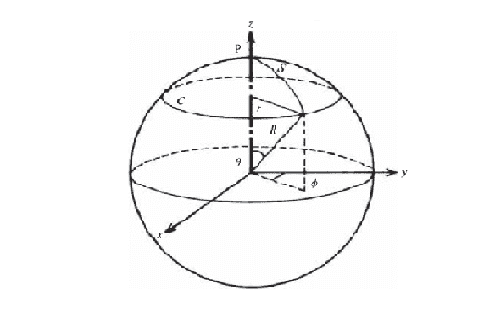
Lets talk about a 2-sphere such that its radius is ##R## is constant. Then the above equation becomes

$$dl^2 = R^2d\theta^2 + R^2sin(\theta)^2d\phi^2$$

Here ##R## is the radial coordinate such that
1589222114650.png


At this point if we assume that the universe is expanding we can no longer claim ##dR = 0##. So let me set comoving coordinate ##\sigma## such that

$$R(t) = a(t)\sigma$$

so we can write,

$$dl^2 = a(t)^2[d\sigma^2 + \sigma^2d\theta^2 + \sigma^2sin(\theta)^2d\phi^2]$$

But this is for the flat case. In general its written as

$$dl^2 = a(t)^2[\frac{d\sigma^2}{1-k\sigma^2} + \sigma^2d\theta^2 + \sigma^2sin(\theta)^2d\phi^2]$$

There is also another comoving coordinate that we use and its generally called ##\chi##. We can transform ##\chi## to ##\sigma## via

##d\chi = \frac{d\sigma}{\sqrt{1-\sigma^2}}##

And we write

$$dl^2 = a(t)^2[d\chi^2 + S_k(\chi)^2dk[d\theta^2 + sin(\theta)^2d\phi^2]]$$

Now I get confused at this point. For ##k=1## above integral becomes,

$$\chi = arcsin(\sigma)$$ or

$$\sigma = sin(\chi)$$

I am troubling to understand this geometrically.

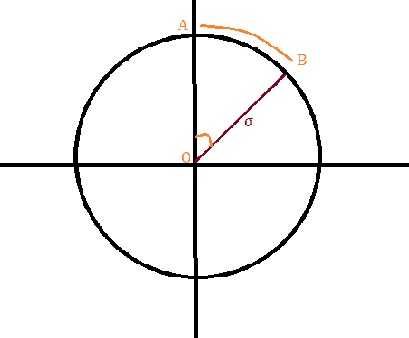
It seems that ##\chi## is some sort of an angle. We are certain that ##\sigma## is in radial direction. So what is the ##\chi## in a geometrical sense

is it the ##|AB| = \chi## arclength. Or is it some sort of an angle such that ##\angle AOB = \chi## ?

Or is the re-scaled version of the ##\sigma## ?
1589223331605.png


So my questions are

1)Does my equations make sense

2) If they are, where is the ##\chi## in this picture.
 
Last edited:
Space news on Phys.org
Arman777 said:
It seems that ##\chi## is some sort of an angle.

Yes. If you want to visualize this in terms of the 2-sphere, suppose the spatial origin is at the North Pole; then ##\theta## in the usual angular coordinates (which runs from ##\theta = 0## at the North Pole to ##\theta = \pi## at the South Pole) is the analogue of ##\chi## in the 3-sphere version, and ##\phi## in the usual angular coordinates is the analogue of the 2-sphere coordinates ##\theta## and ##\phi## in the 3-sphere version. In other words, ##\chi## is an angular coordinate in the radial direction (just as, if you are standing at the North Pole on a 2-sphere, ##\theta## is an angular coordinate in your "radial" direction, the direction that points away from you).

To see the correspondence with the "scale factor" version on the 2-sphere, define a coordinate ##\sigma## such that ##2 \pi R \sigma## is the circumference of a line of latitude at radial coordinate ##\sigma##. Then we can see that ##\sigma = \sin \theta##.

Now take the 2-sphere metric in angular coordinates, ##ds^2 = R^2 \left( d\theta^2 + \sin^2 \theta d \phi^2 \right)##, and transform it from coordinates ##(\theta, \phi)## to coordinates ##(\sigma, \phi)##. We have ##d \sigma = \cos \theta d \theta##, so ##d\theta^2 = d\sigma^2 / \cos^2 \theta = d\sigma^2 / (1 - \sigma^2)##, and we obtain...

$$
ds^2 = R^2 \left( \frac{d\sigma^2}{1 - \sigma^2} + \sigma^2 d\phi^2 \right)
$$

...which should look familiar.
 
I kind of understand but still a bit lost. So, I guess this is the correct picture ?

1589236190805.png

But by doing this we cannot write $R(t) = a(t)\sigma## ?

PeterDonis said:
To see the correspondence with the "scale factor" version on the 2-sphere,
but you never used the scale factor in your equations..?
 
Arman777 said:
I guess this is the correct picture ?

No. In your picture, we would just have ##\sigma = R \chi##. That's not the equation I used (go back and check--note I used ##\theta## instead of ##\chi## for the angle you labeled as ##\chi##).

Arman777 said:
you never used the scale factor in your equations..?

No, because your question actually has nothing whatever to do with the scale factor. It's just about different coordinate charts that can be used on a spacelike 3-surface. The changing scale factor can simply multiply the entire metric of the spacelike 3-surface, exactly as you do in post #1 of this thread, without affecting the form of that metric at all.
 
PeterDonis said:
No. In your picture, we would just have ##\sigma = R \chi##. That's not the equation I used (go back and check--note I used ##\theta## instead of ##\chi## for the angle you labeled as ##\chi##).
No, because your question actually has nothing whatever to do with the scale factor. It's just about different coordinate charts that can be used on a spacelike 3-surface. The changing scale factor can simply multiply the entire metric of the spacelike 3-surface, exactly as you do in post #1 of this thread, without affecting the form of that metric at all.
I see it now but Its hard to picture the ##\sigma## then. It becomes some kind of a ratio.. ? ##\sigma = \rho / R##

1589285935160.png

PeterDonis said:
is the analogue of ##\chi## in the 3-sphere version,
If we were talking about 3-sphere the ##\chi## would be normal radial coordinate. Maybe if you could recommend a book I can read about these things ?
 
Arman777 said:
It becomes some kind of a ratio.. ? \sigma=ρ/R

Yes, in other words, ##\sin \chi##, or, with my labeling of the angle (I called ##\theta## what you are calling ##\chi## in the picture), ##\sigma = \sin \theta##, the formula I wrote earlier.

Arman777 said:
If we were talking about 3-sphere the ##\chi## would be normal radial coordinate.

Yes, a radial angle. Which, if you're standing at the North Pole, point A in your picture, is exactly what ##\chi## is in your picture: the angle in the radial direction (the direction away from the North Pole, along a line of longitude), as opposed to the angle in the tangential direction (around a line of latitude). On a 3-sphere, you simply have two tangential angles instead of one.
 
  • Like
Likes   Reactions: Arman777

Similar threads

  • · Replies 6 ·
Replies
6
Views
2K
  • · Replies 4 ·
Replies
4
Views
3K
  • · Replies 8 ·
Replies
8
Views
3K
  • · Replies 1 ·
Replies
1
Views
2K
  • · Replies 1 ·
Replies
1
Views
2K
Replies
1
Views
399
  • · Replies 8 ·
Replies
8
Views
2K
  • · Replies 0 ·
Replies
0
Views
2K
  • · Replies 9 ·
Replies
9
Views
4K
  • · Replies 4 ·
Replies
4
Views
2K