The Pressure-Entropy Relationship for a Photon Gas

Join the discussion
Registration is free. Ask a follow-up in this thread, or start your own.
3 replies · 4K views
Bookworm092
Messages
2
Reaction score
2
Homework Statement
Given the internal energy U of a photon gas, one can take its partial derivative with respect to volume V to get the pressure P (or rather its negative). But if U is calculated by integrating Planck's distribution (see attached), then the result will not be one third of U/V, a result from kinetic theory. Please explain what has gone wrong.
Relevant Equations
See attached.
This is from Problem 7.45 of Thermal Physics by Daniel Schroeder.
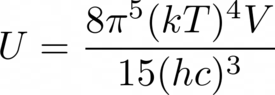
 

Attachments

  • Stefan-Boltzmann law.png
    Stefan-Boltzmann law.png
    4.9 KB · Views: 416
Reply
  • Like
Likes   Reactions: Delta2
Physics news on Phys.org
Bookworm092 said:
Homework Statement:: Given the internal energy U of a photon gas, one can take its partial derivative with respect to volume V to get the pressure P (or rather its negative).
When taking a partial derivative, you need to specify what other variables are kept constant.

From the first law ##dU = TdS - PdV##, you can see that ##-P = \large \left( \frac{\partial U}{\partial V}\right)_S \;##.
 
Reply
  • Like
Likes   Reactions: Bookworm092, vanhees71 and Delta2
TSny said:
When taking a partial derivative, you need to specify what other variables are kept constant.

From the first law ##dU = TdS - PdV##, you can see that ##-P = \large \left( \frac{\partial U}{\partial V}\right)_S \;##.
Thank you for your response. I managed to crack the problem. Both ##S## and ##N## are to be kept constant. But since ##T## is not constant, I can make use of another equation to express T in terms of something else. I had already derived an expression for ##S##. The answer comes out as expected from kinetic theory.
 
Reply
  • Like
Likes   Reactions: TSny
You cannot keep ##N## constant and varying ##T##. Since "photon number" is not a conserved quantity there's no chemical potential either (despite the fact that photons are massless bosons, so that even if you could introduce a chemical potential it must be ##0## anyway).

We have given
$$U=\sigma T^4 V.$$
The "natural independent variables" for ##U## are, however ##S## and ##V## and
$$\mathrm{d}U = T \mathrm{d} S-p \mathrm{d} V.$$
From this you have
$$(\partial_S U)_V=T=\left (\frac{U}{\sigma V} \right)^{1/4}.$$
This you can integrate (using Nernst's Law that at ##T=0##, where ##U=0## also ##S=0##) to
$$U^{3/4}=\frac{3}{4} (\sigma V)^{-1/4} S \qquad (*)$$
or
$$U=\left (\frac{3}{4} \right)^{4/3} (\sigma V)^{-1/3} S^{4/3},$$
from which
$$p=-(\partial_V U)_S=\frac{U}{3 V}.$$
From (*) you also get the more convenient formula
$$S=\frac{4}{3} \sigma V T^3=\frac{4 U}{3T}.$$
 
Reply
  • Like
Likes   Reactions: hutchphd and TSny