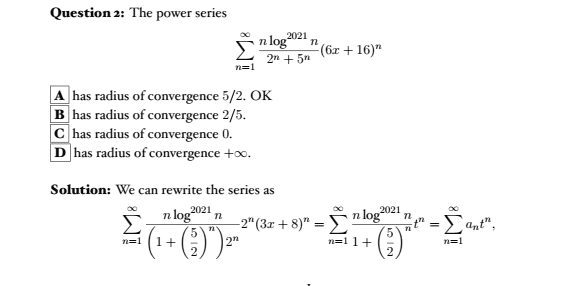
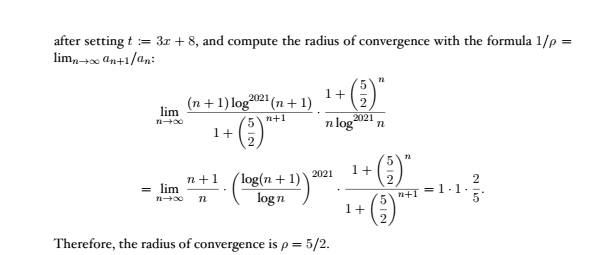
Homework Help Overview
The discussion revolves around determining the radius of convergence for a power series, specifically examining the implications of different factorization choices in the series' terms. Participants are analyzing the effects of using different bases in the denominator and how these choices influence the convergence criteria.
Discussion Character
- Exploratory, Assumption checking, Mathematical reasoning
Approaches and Questions Raised
- Participants are exploring various approaches to factorizing the series, questioning the validity of omitting certain terms, and discussing the implications of asymptotic approximations. There are inquiries about the correct formulation of the general term and the application of the Ratio Test.
Discussion Status
The discussion is active, with participants providing feedback on each other's reasoning and calculations. Some guidance has been offered regarding the importance of including all relevant terms in the Ratio Test, and there is an ongoing examination of how to properly define the radius of convergence in relation to the variable transformations used.
Contextual Notes
Participants are navigating potential misunderstandings related to the definitions of terms and the application of convergence tests. There is a mention of a specific exercise that may have implications for the interpretation of results, and some participants express concerns about the clarity of the book's explanations.