The role of permanent magnets coupled with solenoids

Click For Summary
SUMMARY

The discussion centers on the interaction between permanent magnets and solenoids in the context of electromagnetically exciting steel guitar strings, particularly in devices like the Ebow. It is established that the strength of the permanent magnet significantly influences the excitation force applied to the string, enhancing coupling efficiency. The permanent magnet creates a static magnetic field that interacts with the fluctuating magnetic field generated by the solenoid, allowing for effective string excitation. Testing with varying strengths of permanent magnets confirms their critical role in the performance of these electromagnetic systems.

PREREQUISITES
  • Understanding of electromagnetic principles, specifically solenoid operation.
  • Familiarity with the function of permanent magnets in magnetic fields.
  • Knowledge of electromagnetic feedback loops in musical applications.
  • Basic concepts of signal generation and waveform manipulation.
NEXT STEPS
  • Research the principles of electromagnetic coupling in solenoids.
  • Explore the impact of permanent magnet strength on solenoid performance.
  • Investigate the use of piezo transducers in string excitation applications.
  • Learn about waveform rectification techniques for solenoid energization.
USEFUL FOR

Musicians, audio engineers, and electrical engineers interested in the design and optimization of electromagnetic devices for string instruments, particularly those exploring innovative excitation methods.

parsec
Messages
112
Reaction score
1
I have been experimenting with solenoids used to excite steel guitar strings electromagnetically. These can be found in a variety of infinite "sustainer" products such as the ebow. They generally consist of a pickup, an amplifier and a solenoid which form a simple electromagnetic feedback loop.

The excited solenoid is wound around an iron core with a permanent magnet adjacent to its base. The strength of the permanent magnet affects the excitation strength, but I don't understand why this is.

I can understand why this is the case in a conventional loudspeaker;
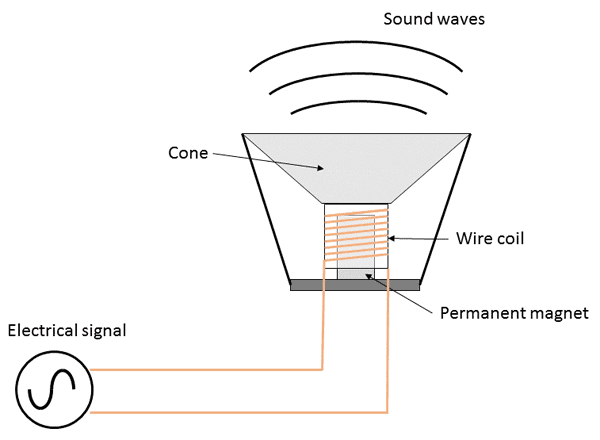
speaker-diagram.png


The permanent magnet creates a static magnetic field which the coil can then push against. The stronger the static magnetic field, the greater the (fluctuating) force on the coil.

Conversely, with the sustainer exciter, the magnet applies a static magnetic field, and the solenoid current applies a fluctuating magnetic field.

Why does the static magnetic field affect the efficacy of the alternating current and fluctuating magnetic field in the solenoid? Somehow it seems to increase its coupling efficiency. Is it because the permanent magnet effectively magnetises the string, allowing the solenoid field to apply more force to it?
 

Attachments

  • speaker-diagram.png
    speaker-diagram.png
    11.8 KB · Views: 1,196
Engineering news on Phys.org
parsec said:
Conversely, with the sustainer exciter, the magnet applies a static magnetic field, and the solenoid current applies a fluctuating magnetic field.

Why does the static magnetic field affect the efficacy of the alternating current and fluctuating magnetic field in the solenoid? Somehow it seems to increase its coupling efficiency. Is it because the permanent magnet effectively magnetises the string, allowing the solenoid field to apply more force to it?

I'm no Guitar-Zan, can't even operate one..

but here's my guess-

You could excite the string without a permanent magnetized core, as you suspect
so it's not about efficacy
it's about giving the Ebow a "Go" signal.

With the permanent magnetized core ,
motion of the string will produce a small voltage in the coil telling the Ebow a string has been plucked and it can take over now..

His patent is at USPTO.gov , you can read it for free.
 

Attachments

  • upload_2018-7-3_12-39-0.png
    upload_2018-7-3_12-39-0.png
    33.5 KB · Views: 565
I have specifically tested an excited with and without a permanent magnet (and with permanent magnets of varying strength) and they strongly influence the force applied to the string. It doesn't seem to have much to do with the transduced signal feeding the amplifier, as the same behavior occurs when a signal generator is used.
 
Just curious, have piezo transducers been tried for that application?
 
I think they have for transducers but not so much for exciters, since they would only be able to excite the string through a weak vibrational/sound coupling.
 
Without the permanent magnet you get frequency doubling when driving the string. Both the positive and negative parts of the current waveform thru the solenoid will attract the string. When the string is magnetized with the permanent magnet, it is attracted or repelled by the solenoid depending on the signal polarity, reproducing the electrical waveform as vibration.

Cheers,
Tom
 
  • Like
Likes   Reactions: jim hardy
This makes a lot of sense. Thanks. I am visualising it as a DC magnetic bias that the permanent magnet applies, around which the solenoid current causes the field to oscillate. I guess the effect is the same as the string being magnetised so that the solenoid's magnetic polarity both attracts and repels it.

If the excitation waveform is rectified such that the solenoid is only energised when the string is on its way down (such that it is only attracted but never repelled), should this mitigate the effect of the permanent magnet? I will have to test this.
 
parsec said:
I will have to test this.
Be sure to let us know what you discover.
 

Similar threads

  • · Replies 1 ·
Replies
1
Views
1K
  • · Replies 7 ·
Replies
7
Views
3K
  • · Replies 14 ·
Replies
14
Views
6K
Replies
1
Views
2K
  • · Replies 6 ·
Replies
6
Views
2K
Replies
4
Views
4K
  • · Replies 16 ·
Replies
16
Views
3K
  • · Replies 6 ·
Replies
6
Views
3K
  • · Replies 8 ·
Replies
8
Views
4K
Replies
2
Views
9K