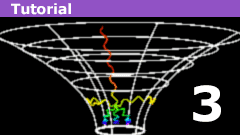
Expanding on this, one may make an analogy between this family of sphere evolutions and the exterior of spherical body. Such exterior region can be covered by families of world lines, each such family being a sphere of observers leaving the surface, reaching a maximum, and then returning (no requirement that they they be inertial). They can be set up so their maxima are all at constant T in some chart, and they don't cross, thus forming a valid congruence filling the entire exterior spacetime of the body. An observation is that this shows that the exterior of a spherical body, taken as a manifold by itself, has topology S2xR2.
However, there are some key differences from the KS congruence I described. The ordinary body congruence would have spheres evolving from minimum to maximum arbitrarily close to the minimum. There would be no notion of a minimum maxima that is larger by a finite amount than the minimum. Nor would there be a duplicate exterior corresponding to negative X in the KS case. This exterior would be analogous to one KS exterior quadrant, with the SC radius standing in for the body surface.
What GR tells us is that this construction (for the exterior of a body) cannot be shrunken down smoothly to represent a point body. It has a minumum size below which we (if we preserve vacuum and spherical symmetry) we must change the geometry, in the way mandated by the KS interior region(s).