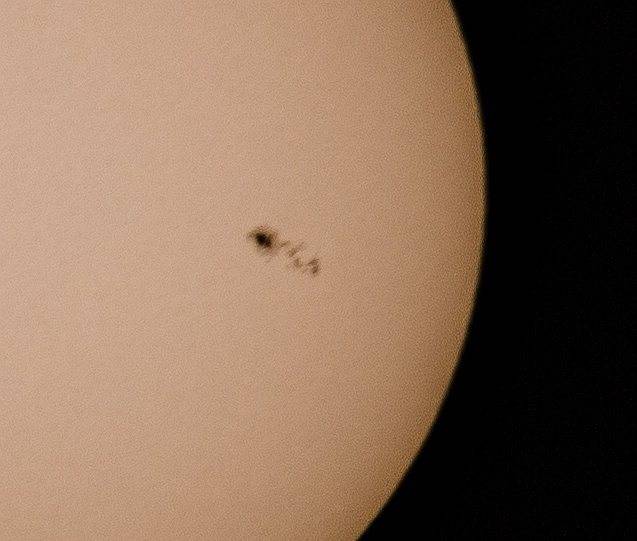
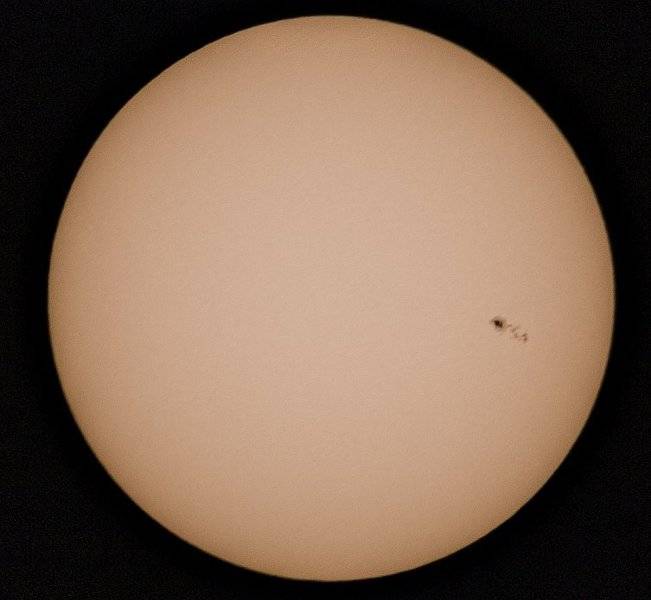
The Sun today - 9 July 2017 - nice spot group

Click For Summary

Discussion Overview

The discussion revolves around the observation of sunspot group AR2665, noted for being the largest spot group in some time. Participants share their experiences, observations, and challenges related to photographing and viewing the sunspot, as well as discussing its potential activity, such as solar flares. The conversation includes both technical aspects of solar observation and personal anecdotes about the difficulties of focusing on sunspots.

Discussion Character

  • Exploratory
  • Technical explanation
  • Conceptual clarification
  • Debate/contested
  • Experimental/applied

Main Points Raised

  • Some participants note that the largest spot in the group is comparable in size to Jupiter.
  • There are mentions of difficulties in achieving sharp manual focus due to eyesight issues and atmospheric conditions.
  • One participant inquires about the potential for solar flares from the sunspot, referencing a previous M 1.2 flare.
  • Technical discussions arise regarding the settings of cameras and lenses used for solar photography, including concerns about diffraction and exposure times.
  • Participants share links to live updates and articles related to solar activity and sunspots.
  • There are varying reports on the visibility of the sunspot, with some claiming it can be seen with the naked eye using solar glasses, while others express skepticism about this claim.
  • One participant expresses frustration over the diminishing visibility of the sunspot, describing it as reduced to a small dot.
  • Discussions include comparisons of different observational equipment, such as binoculars and telescopes, and the challenges associated with using them.

Areas of Agreement / Disagreement

Participants express a mix of agreement and disagreement regarding the visibility and significance of the sunspot. While some find it noteworthy, others consider it less interesting as it diminishes in size. There is no consensus on the best methods for observing or photographing the sunspot, nor on its current activity level.

Contextual Notes

Some participants mention the influence of atmospheric conditions on visibility and focus, as well as the limitations of their equipment. There are unresolved questions about the sunspot's activity and the specifics of solar flare occurrences.

Who May Find This Useful

Astronomy enthusiasts, amateur astrophotographers, and individuals interested in solar activity may find this discussion relevant.

davenn
Science Advisor
Gold Member
Messages
9,715
Reaction score
11,761
AR2665 ... largest spot group for some time
Canon 6D, 800mm, f11, 125th, ISO100 ( the 800mm is a 100-400mm L lens with a x2 teleconverter)
With my eyesight going downhill, I have really been struggling of late to be able to get sharp manual focus
1f641.png


IMG_0914sm.jpg


IMG_0914-2sm.jpg
Dave
 
  • Like
Likes   Reactions: russ_watters, DennisN, Andy Resnick and 6 others
Astronomy news on Phys.org
Wow! If it's there tomorrow (I assume) I'll try to look at it myself. ...
 
  • Like
Likes   Reactions: davenn
the largest spot in that group is about the size of Jupiter
 
  • Like
Likes   Reactions: Stavros Kiri
davenn said:
the largest spot in that group is about the size of Jupiter
Amazing! I also magnified your second image on my screen and it looks like a mole on a human skin! :nb)
 
  • Like
Likes   Reactions: davenn
Stavros Kiri said:
Amazing! I also magnified your second image on my screen and it looks like a mole on a human skin! :nb)

yes it does
 
I got swamped these days and didn't get the chance to see it. But I'm still happy with your pictures. Any idea if it produced solar flares this time? (there was a high chance, I think)

As far as I know region 2665 is still active today wed July 12, 2017. I may still get a chance to see it. I think it's worth it!

Here is a 'live update' etc. ... :
https://www.spaceweatherlive.com/en/solar-activity/sunspot-regions
 
  • Like
Likes   Reactions: davenn
Stavros Kiri said:
Any idea if it produced solar flares this time? (there was a high chance, I think)

a M 1.2 a couple of days ago
 
  • Like
Likes   Reactions: Stavros Kiri
davenn said:
a M 1.2 a couple of days ago
Ok thanks!
 
davenn said:
AR2665 ... largest spot group for some time
Canon 6D, 800mm, f11, 125th, ISO100 ( the 800mm is a 100-400mm L lens with a x2 teleconverter)
With my eyesight going downhill, I have really been struggling of late to be able to get sharp manual focus

3 straight days of 100% overcast skies here...

I empathize with the difficulty of manual focusing- but that may not be the problem here. Was your lens set to 400/11, meaning the final configuration was 800/22? That tiny f/# is sufficient to make diffraction noticeable. And, based on my experience in (now) swampy Cleveland, 1/125s exposure time can still allow seeing effects to occur if the atmosphere is especially active.
 
  • Like
Likes   Reactions: davenn and Stavros Kiri
  • #11
Andy Resnick said:
Was your lens set to 400/11, meaning the final configuration was 800/22?

400 @f5.6 = 800 @ f11 :smile:
 
  • Like
Likes   Reactions: Andy Resnick
  • #12
  • Like
Likes   Reactions: Stavros Kiri
  • #13
Awesome pix! It's been a down year for sunspots.
davenn said:
With my eyesight going downhill, I have really been struggling of late to be able to get sharp manual focus
The trouble with sunspots is that they aren't sharply focused objects, which makes them hard to focus on.
 
  • Like
Likes   Reactions: davenn and Stavros Kiri
  • #14
It's even visible with naked eye, solar glasses of course ! Just got the chance to see it ...
 
  • Like
Likes   Reactions: davenn
  • #15
russ_watters said:
Awesome pix! It's been a down year for sunspots.

The trouble with sunspots is that they aren't sharply focused objects, which makes them hard to focus on.

thanks Russ I appreciate your comments :smile: ... yes, the sun is heading deeper into solar minimum.

well ... to an extent, yes ... tho I am seeing others do sharper images than me with just single exposure photos ( not stacked)
so the 3 main variables are ...
1) ... I'm seriously struggling focussing on the finer details ... be it photography, reading, my electronics at work
2) ... the quality of my solar filter compared to what others are using ( my camera and lens is top end stuff)
3) ... stable/unstable atmosphere

here's a random one pulled off a facebook astro forum ...

19990182_1289252017850610_4185664567419624235_n.jpg
Rex I. De SilvaSingle Frame Astrophotography

My image of sunspot AR2665 captured 11th July. Coolpix L27 point & shoot digital camera and vintage Asahi Pentax 40mm spyglass with AstroSolar filter. Edited with ACDSee 15.

really crisp

I could show ones worse than mine, but I won't :biggrin:
mine isn't bad, I just feel that I could do a lot betterDave
 
  • Like
Likes   Reactions: 1oldman2 and Stavros Kiri
  • #17
Stavros Kiri said:
It's even visible with naked eye, solar glasses of course ! Just got the chance to see it ...
"Naked eye"?
Are you some kind of human-falcon hybrid?
My camera could just barely make it out.
2017.07.14.sun.spot.fuji.camera.76x.zoom.png

Just above the "1" in "16:23"
36x optical zoom

It may be a speck of dust on the lens, but I don't care. I'm calling it a sunspot.
 
  • Like
Likes   Reactions: davenn and 1oldman2
  • #18
OmCheeto said:
"Naked eye"?
Are you some kind of human-falcon hybrid?
My camera could just barely make it out.View attachment 207182
Just above the "1" in "16:23"
36x optical zoom

It may be a speck of dust on the lens, but I don't care. I'm calling it a sunspot.
You're late! I think it's winding down now:
https://www.spaceweatherlive.com/en/solar-activity/sunspot-regions

When I saw it it was still about the size of Jupiter (I caught it on the verge ...). So no need to have a falcon eye. It was expected (to be visible by "naked eye").

If I can still see it today (meaning tomorrow July 15) (with just the solar glasses) I'll probably change my profile name ... to "falcon" ...:biggrin:
 
  • #19
Stavros Kiri said:
If I can still see it today (meaning tomorrow July 15) (with just the solar glasses) I'll probably change my profile name ... to "falcon" ...:biggrin:

Just did! Just a tiny tiny dot though, only because I knew where to look. [Still keeping my profile name though!]
With binos and telescope it was still clear of course, but I'm not too much into cameras (other than cell phones) ...
It will be setting towards the non-visible side soon anyway (couple of days, I assume), so anyone wanting to test their eye vision and/or their instruments must act fast (i.e. now) ...
 
  • #20
Stavros Kiri said:
Just did! Just a tiny tiny dot though, only because I knew where to look. [Still keeping my profile name though!]
With binos and telescope it was still clear of course, but I'm not too much into cameras (other than cell phones) ...
It will be setting towards the non-visible side soon anyway (couple of days, I assume), so anyone wanting to test their eye vision and/or their instruments must act fast (i.e. now) ...
I tried it with binoculars(7x50) yesterday, and couldn't hold them steady enough.
I may try it today with my new/old 3" reflecting telescope. But I haven't figured out how to capture images through it yet.
And it's been reduced from an interesting "spot" and "trailing" stuff combination, from when @davenn first posted, to merely a single spot.
Which is not really that interesting.
As my sister posted regarding my image on Facebook yesterday; "I think it's an 'ant' on the lens"
:oldgrumpy:
 
  • Like
Likes   Reactions: Stavros Kiri
  • #21
OmCheeto said:
I tried it with binoculars(7x50) yesterday, and couldn't hold them steady enough.
I may try it today with my new/old 3" reflecting telescope. But I haven't figured out how to capture images through it yet.
And it's been reduced from an interesting "spot" and "trailing" stuff combination, from when @davenn first posted, to merely a single spot.
Which is not really that interesting.
As my sister posted regarding my image on Facebook yesterday; "I think it's an 'ant' on the lens"
:oldgrumpy:
I agree, it's just a small common spot by now, barely intetesting, except for visibility tests. Binoculars have that stability problem. I use 12×30 (handy and small, I carry them with me, especially when I'm travelling, good for fast observations - but you'll be surprised, I can even see the horse head nebula with those, saturn's ring(s), double stars etc.). With 7×50 that kind of spots don't look interesting at all, neither (almost) with the 12×30. Telescopes, even small ones, are better and much more stable of course.
 
  • #22
OmCheeto said:
And it's been reduced from an interesting "spot" and "trailing" stuff combination, from when @davenn first posted, to merely a single spot.
Which is not really that interesting.

Stavros Kiri said:
I agree, it's just a small common spot by now, barely intetesting, except for visibility tests.
ye but it still had a sting in it's tail ! ... produced a M2.4 flare a couple of days ago 14th July and those effects have just hit Earth over the last 3 hours
the prelude to more aurora activity :smile:Dave
 
  • Like
Likes   Reactions: OmCheeto and Stavros Kiri
  • #23
davenn said:
ye but it still had a sting in it's tail ! ... produced a M2.4 flare a couple of days ago 14th July and those effects have just hit Earth over the last 3 hours
the prelude to more aurora activity :smile:Dave
So it did it again! didn't it? ...
https://www.spaceweatherlive.com/en/news/view/286/20170714-eruptive-m24-solar-flare

"G1 - Minor geomagnetic storm expected
The observed Kp index is 4+ but the predicted K-indice of 5- indicates that stronger geomagnetic conditions might occur at this moment.
"

"Current data suggest that it is not possible to see aurora now at middle latitudes"

For higher latitudes high 75% chance of severe aurora activity, at the moment.

Predicted Kp index max 6, for all latitudes.

For aurora and Kp index forecast:
https://www.spaceweatherlive.com/en/auroral-activity/aurora-forecast

Note: Even several doctors, neurologists etc. follow up with such sites, as the Kp index seems to also play a role in affecting at least some neural phenomena.
 
  • Like
Likes   Reactions: davenn
  • #24
davenn said:
ye but it still had a sting in it's tail ! ...
...
Dave
I saw that! With my new/old telescope.

Yesterday, while putting together the solar filter, I had to stop and laugh, as it reminded me of that old saying; "All I Really Need to Know I Learned in Kindergarten".
1. Black craft paper
2. cardboard
3. tape
4. scissors
5. crayon
6. ruler​

2017.07.15.saw.a.sunspot.through.a.telescope.png

Originally a "tracking" telescope: Bushnell North Star, 76mm, reflector, model 78-8831.
Currently a manual everything telescope. The electronics have died.
Hence, my friend gave it to me for free.
But good enough to see the sunspot, with (de)tails!
I doubt I will be able to duct tape any of my cameras to it, so I may look into buying a dedicated telescope camera sensor thingy. And maybe try and fix the electronics. Might be just a loose power wire. If not, it'll stay manual.

ps. I've been monitoring the spot online at the NASA SDO site, just to make sure it's not an ant on my lens.
 
  • Like
Likes   Reactions: russ_watters and davenn
  • #27
Now it looks like it's been renamed as region 2670 (≥ Aug. 2), with no promising and faded activity, and almost down for the count (at least for now):
https://www.spaceweatherlive.com/en/news/view/291/20170802-sunspot-region-2670

Here is a brief update/review on its history (from the above link):

"
logo.png

Sunspot region 2670

Wednesday, 2 August 2017 - 16:49 UTC

291-header.jpg


Old sunspot region 2665 which caused a couple of large far side eruptions has now rotated back onto the earth-facing solar disk. It has received sunspot region number 2670 from the NOAA SWPC. Due to the activity this sunspot region displayed while it was on the far side, hopes were high for its return. So what is left of this group and should we expect more solar flares?

Well... no. We are looking at a sunspot region that was likely much larger on the far side and it has decayed a lot the past week or so. We only see two sunspots at the moment and an enormous amount of faculae. Faculae are bright areas that form when sunspot regions decay so it tells us something about this region's history. Sunspot region 2670 has a lot of faculae surrounding the two spots (see our header image made using the white light SDO/HMI image) which is a sign that this group used to be much larger and has decayed significantly.

Also worth nothing is that the region produced no major coronal mass ejections since 28 July so it is pretty safe to say that this region is down for the count. At least for now. It can regrow new spots so we shouldn't rule out the region completely but for now the chance that we are getting a strong solar flare from this region seems very low.
"

However, active geomagnetic conditions since yesterday (Aug. 3), with Kp 4:
https://www.spaceweatherlive.com/en/auroral-activity/the-kp-index

What will happen by eclipse time? (a few days away)
 
  • Like
Likes   Reactions: davenn
  • #28
Stavros Kiri said:
What will happen by eclipse time? (a few days away)
Currently (Aug. 12, 2017, ~10pm EST, US (DST) ), from:
https://www.spaceweatherlive.com/en/solar-activity/sunspot-regions
logo.png

Sunspot regions

On this page you'll find an overview of all the visible sunspot regions on the Sun together with their properties, images and the chances on solar flares or proton events. This page is updated daily and the sunspot images every hour.

SDO_HMIIF_512.jpg


Region 2670
Number of
sunspots
Size Class Magn. Class Spot Location
1 100 -10 HSX S07W72
2670_HMIIF.jpg
2670_HMIBC.jpg


So it's bye bye baby! ... This is almost the last we'll be seing of it! So hurry for last minute final observations and ... camera, bino, telescope and eye tests ... . However, "falcon eye" won't work this time! ... Not a chance! (I even tried it on the previous post and it was already barely on the limit back then.)
 
  • #29
New one!:
logo.png

Sunspot regions

On this page you'll find an overview of all the visible sunspot regions on the Sun together with their properties, images and the chances on solar flares or proton events. This page is updated daily and the sunspot images every hour.

SDO_HMIIF_512.jpg


Region 2671 New
...

...

https://www.spaceweatherlive.com/en/solar-activity/sunspot-regions

Right on time(?), perhaps for the eclipse, to have something under totality. We'll see ...
It's producing flares too! ...
Check out:
https://www.spaceweatherlive.com/en/news/view/294/20170814-coronal-hole-faces-earth

And cool flare video here (If only the eclipse was today!):
https://www.spaceweatherlive.com/en...14-new-active-region-producing-c-class-flares
 
Last edited:
  • #30
Region 2671 turned into an interesting group:
(currently [Wed. Aug 16, 2017 (~12pm EST, DST)] from https://www.spaceweatherlive.com/en/solar-activity/sunspot-regions)

"
logo.png

Sunspot regions

On this page you'll find an overview of all the visible sunspot regions on the Sun together with their properties, images and the chances on solar flares or proton events. This page is updated daily and the sunspot images every hour.

SDO_HMIIF_512.jpg


Region 2671
Number of
sunspots
Size Class Magn. Class Spot Location
11 9 170 100 EAI N10E53
2671_HMIIF.jpg
2671_HMIBC.jpg

Flare probabilities
C M X Proton
40% 10% 1% 1%
Solar flares from today
B2.8 B3.7 B2.4 B5.2 B3.6
Back to top

Current data suggest that it is not possible to see aurora now at middle latitudes

Latest news

294-thumb.jpg

Monday, 14 August 2017 - 18:56 UTC
Coronal hole faces Earth

293-thumb.jpg

Monday, 14 August 2017 - 13:21 UTC
New active region producing C-class flares

More news
Today's space weather
Auroral activity Minor Severe
High latitude 25% 55%
Middle latitude 15% 5%
Predicted Kp max 4
Aurora forecast HelpMore data
Solar activity
M-class solar flare 10%
X-class solar flare 1%
B2.8 B3.7 B2.4 B5.2 B3.6
Sunspot regionsMore data
Moon phase
Last Quarter "

Also, minor G1 geomagnetic storm is expected to reach Earth tomorrow Thu, due to the initial flare last Mon.
 
  • Like
Likes   Reactions: davenn

Similar threads

  • · Replies 2 ·
Replies
2
Views
3K
  • · Replies 4 ·
Replies
4
Views
2K