Talha Temuri
I have no idea where to begin. Any help would be appreciated.
Once upon a time there was a terribly wicked King who had a daughter who was very beautiful. The daughter was in love with a handsome prince, and before long the prince and the princess had become inseparable. The King, however, was wicked and did not believe in happiness and so he had his daughter locked up in a prison at the top of a tall tower.
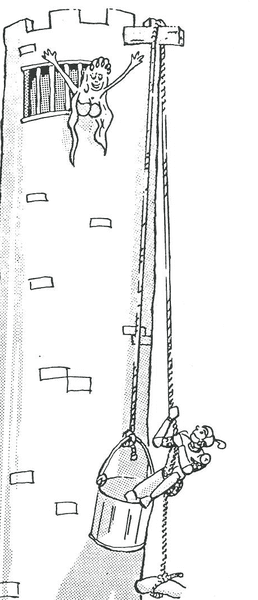
The prince learned of this and was determined to rescue the one he loved, so he started out for the tower where the unhappy princess sat imprisoned. When he arrived at the base of the tower the prince looked up and noticed that there was a wooden beam protruding from the top of the structure. He immediately contrived a method to use this, to reach his princess. He attached a sturdy bucket, he found nearby, to one end of a very long rope and to the other end he tied a stone. Then with a mighty heave he threw the stone across the top of the beam so that the rope was looped across the top of the beam. The prince had thus constructed a simple pulley. He then stepped into the bucket and proceeded to hoist himself up. (See the well-drawn diagram)
In due time the prince reached the top and was rewarded with a long embrace by the King's daughter. The prince, however, could not return the embrace, nor could he begin his work to release the princess, since letting go of the rope would cause the bucket to fall. So he began searching for a way to fix the rope to the tower wall. Luck seemed to be smiling on the young man because close by, he discovered a metal hook embedded in the stonewall. The prince tugged on the hook with one hand (the other hand holding the rope tightly), and finding it secure, he proceeded to tie the rope to the hook. But the instant he did that, the supporting beam broke and the bucket, together with the poor prince, came crashing to the ground. The King, who was very wicked, also happened to know his physics very well (no connection between the two), and had originally designed the beam to support the weight of the prince and the weight of the bucket, but no more How did the King know the prince would fall? Show using diagram and equations.
Once upon a time there was a terribly wicked King who had a daughter who was very beautiful. The daughter was in love with a handsome prince, and before long the prince and the princess had become inseparable. The King, however, was wicked and did not believe in happiness and so he had his daughter locked up in a prison at the top of a tall tower.
The prince learned of this and was determined to rescue the one he loved, so he started out for the tower where the unhappy princess sat imprisoned. When he arrived at the base of the tower the prince looked up and noticed that there was a wooden beam protruding from the top of the structure. He immediately contrived a method to use this, to reach his princess. He attached a sturdy bucket, he found nearby, to one end of a very long rope and to the other end he tied a stone. Then with a mighty heave he threw the stone across the top of the beam so that the rope was looped across the top of the beam. The prince had thus constructed a simple pulley. He then stepped into the bucket and proceeded to hoist himself up. (See the well-drawn diagram)
In due time the prince reached the top and was rewarded with a long embrace by the King's daughter. The prince, however, could not return the embrace, nor could he begin his work to release the princess, since letting go of the rope would cause the bucket to fall. So he began searching for a way to fix the rope to the tower wall. Luck seemed to be smiling on the young man because close by, he discovered a metal hook embedded in the stonewall. The prince tugged on the hook with one hand (the other hand holding the rope tightly), and finding it secure, he proceeded to tie the rope to the hook. But the instant he did that, the supporting beam broke and the bucket, together with the poor prince, came crashing to the ground. The King, who was very wicked, also happened to know his physics very well (no connection between the two), and had originally designed the beam to support the weight of the prince and the weight of the bucket, but no more How did the King know the prince would fall? Show using diagram and equations.