Thermal Expansion (liquid and solid) Question Help

AI Thread Summary
The discussion revolves around a user's confusion regarding thermal expansion, specifically how to apply the relationship between volume and linear expansion coefficients. The user mentions understanding that beta equals three times alpha and seeks clarification on using this in the volume expansion equation. A response emphasizes the importance of following forum guidelines by making a real attempt at solving the problem before seeking help. The user acknowledges this and indicates they have reposted their question in a separate thread for further assistance. Clear guidance on formulating the volume expansion equation for both the liquid and the container is suggested as a starting point.
kgm01
Messages
4
Reaction score
1
Summary: Help with volume and length expansion question
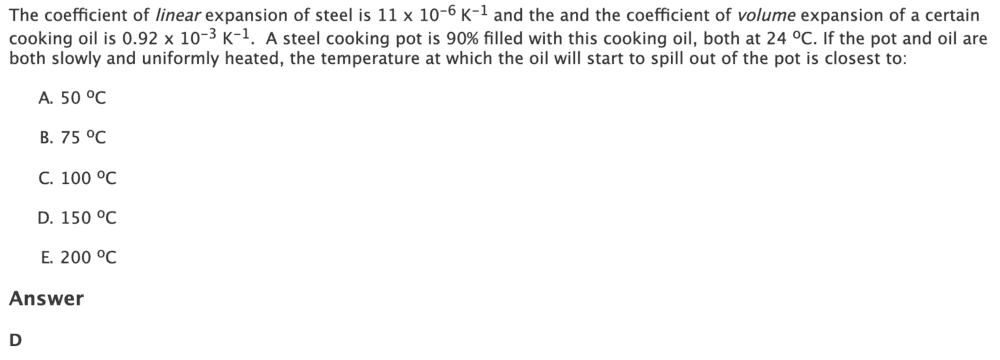
Screen Shot 2019-08-18 at 10.46.47 pm.png
Hi, I am struggling with this question. I understand that beta = 3 alpha so you use this to sub into the volume expansion equation. Is this correct? Can someone please provide a step by step instruction on how to do this question? Thank you !

 
Physics news on Phys.org
Hello kgm, ##\qquad## :welcome: ##\qquad## !

Not he way PF works -- see guidelines -- you have to post a real attempt

But an obvious first step is:
Write down the volume expansion equation for the oil and for the pot
 
Kindly see the attached pdf. My attempt to solve it, is in it. I'm wondering if my solution is right. My idea is this: At any point of time, the ball may be assumed to be at an incline which is at an angle of θ(kindly see both the pics in the pdf file). The value of θ will continuously change and so will the value of friction. I'm not able to figure out, why my solution is wrong, if it is wrong .
TL;DR Summary: I came across this question from a Sri Lankan A-level textbook. Question - An ice cube with a length of 10 cm is immersed in water at 0 °C. An observer observes the ice cube from the water, and it seems to be 7.75 cm long. If the refractive index of water is 4/3, find the height of the ice cube immersed in the water. I could not understand how the apparent height of the ice cube in the water depends on the height of the ice cube immersed in the water. Does anyone have an...
Back
Top