Coolcrab
- 11
- 0
If you look at liquid crystals in things like moodrings and LCthermometers then you will notice that they can change color when heated.
Now I have looked on the internet and found that it has to do with the The cholesteric (or chiral nematic) liquid crystal phase, where they align with each other in layers but are slightly tilted across layers. Example:
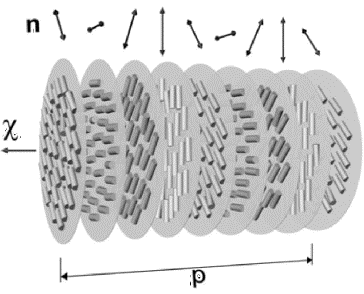
I also know that they reflect the light which has the wavelength of a full rotation of the crystals, this being called the "pitch". (see pic)
So if they rotate at such an angle that they make a full rotation in P = lambda Red, then it will look red.
But I do not know why. If I look at this picture, then it looks like a polariser that goes in all directions:
http://plc.cwru.edu/tutorial/enhanced/files/lc/phase/Graphics%5Cschem.BMP Which would cansel out all the light, and not reflect any.
So can anyone tell me what's going on here?
Now I have looked on the internet and found that it has to do with the The cholesteric (or chiral nematic) liquid crystal phase, where they align with each other in layers but are slightly tilted across layers. Example:
I also know that they reflect the light which has the wavelength of a full rotation of the crystals, this being called the "pitch". (see pic)
So if they rotate at such an angle that they make a full rotation in P = lambda Red, then it will look red.
But I do not know why. If I look at this picture, then it looks like a polariser that goes in all directions:
http://plc.cwru.edu/tutorial/enhanced/files/lc/phase/Graphics%5Cschem.BMP Which would cansel out all the light, and not reflect any.
So can anyone tell me what's going on here?
Last edited by a moderator: