How Do You Calculate Heat Transfer in a Thermodynamics Piston Problem?

Click For Summary
To calculate heat transfer in a thermodynamics piston problem, the first law of thermodynamics is essential, expressed as Δu = q + w. The work done by the piston can be calculated using the formula w = -P ⋅ ΔV, but it must be adjusted for mass when applying it per unit mass. Understanding the relationship between pressure, force, and distance is crucial, as the weight of the piston and the gas pressure must balance for the piston to move. Knowledge of basic physics concepts, such as forces and energy, is beneficial for grasping thermodynamics, but one can still learn effectively with a foundational understanding. Clarifying assumptions about pressure and using steam tables can aid in solving the problem accurately.
babaliaris
Messages
116
Reaction score
15
Moved from technical forums, so no template
I'm new to thermodynamics and after some reading I tried to solve the problem below but I have stuck (I think this problem assumes you know only the first law of thermodynamics)
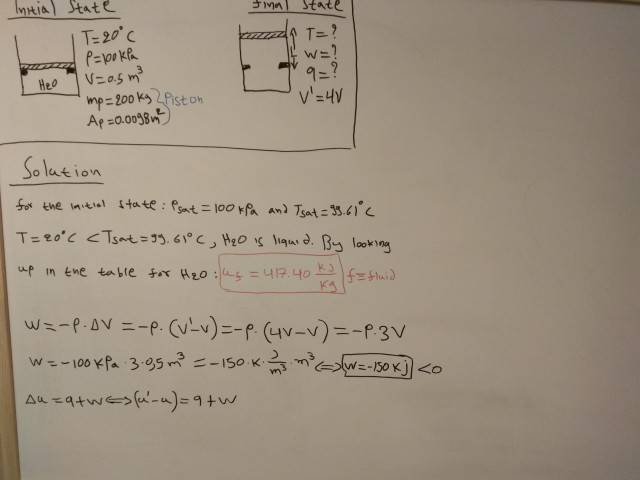
IMG-20190317-183746.jpg


You have a piston resting on some stops inside a container filled with water and you want to find out after heating the container the final Temperature(T), the Work(w) that has been done and the Heat(q) that was transferred. The final state has 4 times more volume than the initial state.

I found the work with pressure constant by using the formula
w = -P ⋅ ΔV

but I don't know how to find the heat. I wrote down the first law
Δu = q+w

Also notice that in the above formula all quantities are per mass for some reason so the work which I calculated before probably needs to be divided by the pistons mass or something before I use it in this formula?

but I only know the work and the initial internal energy, I don't know the final internal energy so I can't find Δu => I can't find q.

Is there something that I'm missing? I used tables to find the internal energy (u) in the initial state (Notice in the picture that u (in red) is kj/kg).
 

Attachments

  • IMG-20190317-183746.jpg
    IMG-20190317-183746.jpg
    22 KB · Views: 809
Physics news on Phys.org
How is the pressure constant? The piston starts off resting on stops, and unless it is barely resting there, that means P inside the gas is less than when the piston is being supported by the gas, after the expansion. You might try calculating the work by m*g*dh, where m = mass of piston, g = 9.8 m/s^2, and dh is distance piston moves, which you can get by using the area of the piston and volume of the cylinder to work out the diameter of the cylinder, then using this with the change in volume to calculate dh.
 
Christopher Grayce said:
How is the pressure constant? The piston starts off resting on stops, and unless it is barely resting there, that means P inside the gas is less than when the piston is being supported by the gas, after the expansion. You might try calculating the work by m*g*dh, where m = mass of piston, g = 9.8 m/s^2, and dh is distance piston moves, which you can get by using the area of the piston and volume of the cylinder to work out the diameter of the cylinder, then using this with the change in volume to calculate dh.

OK I did not know that. So I will use force times distance to calculate work (makes sense).
1) I don't really know how to calculate dh using what you said.
2) Why work = m⋅g⋅dh ? A force must push the piston to go up so weight should not be the only force.

Now something else. If I was to say from 1 to 10 what is my current knowledge of physics I would say about 3.
How much will this affect me from learning Thermodynamics?

Until know these are what I know from physics:
1) Movements
2) Newton's Laws.
3) Work
 
1. The notes you show in your post contain the area of the piston, which corresponds to the area of the cylinder. You know the initial and final volumes of the cylinder, so you use the formula for the volume of a cylinder (V = A*h) and the area of the piston to get the initial and final heights of the piston.

2. The only force pushing down on the piston is its weight, F = m*g, where m = mass of piston and g = acceleration due to gravity, 9.8 m/s^2. When the piston is pushed up the force from the gas pushing up will be approximately equal to the weight of the piston pushing down. (If it were less, the piston wouldn't move at all, and if it were significantly more the piston would move abruptly and chaotically, and normally we assume that doesn't happen in thermo, because that kind of change is difficult to analyze.) Work is force times distance, so F = m*g times the distance dh = h_final - h_initial the piston moves, so that's where I get m*g*dh.

3. I don't know. Thermodynamics depends somewhat on an understanding of mechanics (forces, energy), but not hugely. It depends a lot on what the focus of your thermodynamics is (e.g. engineering, chemistry, biology), and on how you're learning it (e.g. on your own or in a class). If you're learning it in a class, my advice would be to talk to the instructor. Even if his assumptions about how much physics you know doesn't match reality, he will have suggestions (certainly better than mine) about how to supplement what you already know efficiently.
 
  • Like
Likes babaliaris
Let's assume that there is vacuum outside the cylinder and piston. From a force balance on the piston, what water vapor pressure is required to just begin levitating the piston? From the saturated steam tables, what temperature does this correspond to? What is the mass of water within the cylinder? What is the initial specific internal energy of the water within the cylinder? What is the initial internal energy of the mass of water within the cylinder? What is the specific internal energy of the water when the piston just begins to levitate? What is the internal energy of the mass of water when the piston just begins to levitate? How much work has been done at this point? What is the change in internal energy up to the point that the piston just begins levitating? How much heat is transferred up to this point?
 
Is it possible that they mean that the pressure outside the cylinder is 100 kPa?
 
The book claims the answer is that all the magnitudes are the same because "the gravitational force on the penguin is the same". I'm having trouble understanding this. I thought the buoyant force was equal to the weight of the fluid displaced. Weight depends on mass which depends on density. Therefore, due to the differing densities the buoyant force will be different in each case? Is this incorrect?

Similar threads

  • · Replies 1 ·
Replies
1
Views
2K
  • · Replies 3 ·
Replies
3
Views
2K
Replies
25
Views
1K
  • · Replies 2 ·
Replies
2
Views
2K
Replies
10
Views
2K
Replies
49
Views
3K
  • · Replies 5 ·
Replies
5
Views
843
Replies
3
Views
2K
  • · Replies 3 ·
Replies
3
Views
2K
Replies
8
Views
2K