ThermodynamicsL Heat, Energy and Work Problem

Click For Summary

Homework Help Overview

The discussion revolves around a thermodynamics problem involving heat, energy, and work, specifically focusing on the processes of water being pumped, heated, and expanded through a turbine. The problem is divided into three parts, each addressing different thermodynamic processes and calculations related to water and steam phases.

Discussion Character

  • Exploratory, Conceptual clarification, Mathematical reasoning, Problem interpretation

Approaches and Questions Raised

  • Participants explore the nature of the processes described, questioning whether they are adiabatic and isentropic. There are discussions about the implications of canceling terms in energy equations and the relationship between pressure and internal energy. Some participants express confusion about the assumptions made regarding work and heat flow rates.

Discussion Status

Several participants have offered calculations and simplifications for the different parts of the problem, seeking verification of their methods and assumptions. There is an ongoing exploration of the relationships between enthalpy, work, and heat transfer, with no explicit consensus reached on the correctness of the approaches taken.

Contextual Notes

Participants note the absence of certain values, such as specific volumes, and question how this affects their calculations. There is also mention of the original problem being altered for personal understanding, which may influence the discussion's direction.

Tethys
Messages
7
Reaction score
0
Hello! I've been a long-time follower of the Physics Forums and have found it to be a great resource for a variety of physics and engineering topics, although I have not actually felt compelled to create an account on the boards until today. I have encountered a difficult thermodynamics problem in a homework assignment that I would like some input on. I have changed some of the numbers from the original problem because I would like to actually solve the given problem myself, but the concepts are the same.

Relevant equations

Equation1.png


Part One of the Problem

PalmRandom3002.jpg


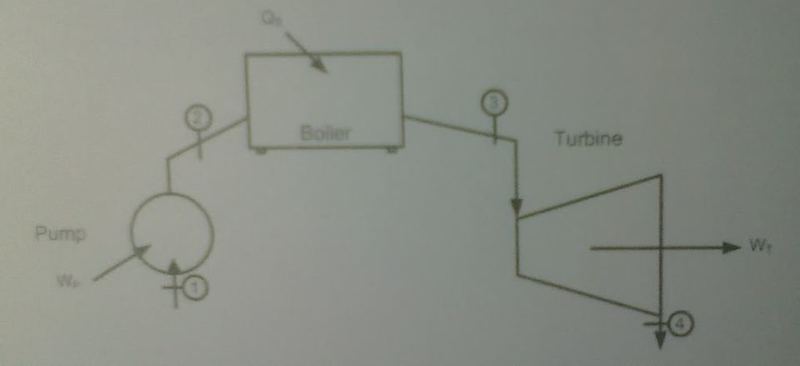
Water passes through a pump in a steady-state process in which there is no height change, no heat transfer, and a constant temperature across the device. The water initially has a pressure of 15 kPa and a temperature of 53.97 C, and it leaves the pump with an exit pressure of 5MPa. How much work is required to pressurize the water if the mass flow rate through the pump is 25 kg/s? Define the phase of the water at State 1 and State 2, and draw the process on a T-v diagram (v is specific volume).


Part Two of the Problem

The water is converted into steam in a constant-pressure process after exiting the high-pressure pump. How much heat is transferred to the water if the steam temperature is 500 C coming out of the bioler? What is the phase of the water at State 3? Draw the process on a T-v diagram.


Part Three of the Problem

Compute the turbine work output and draw the T-v diagram if the exit velocity from the turbine is 150 m/s and the steam expands through the turbine until it is saturated water at 15 kPa and 90% quality.


Much thanks in advance for the help and input,

-Tethys
 
Physics news on Phys.org
Bump! I could really use some help on this. Any input is appreciated.
 
Part 1

From the given information, it appears that this is an adiabatic process as well as an isentropic process.

H = U + pV ---> h = u + pv (expressed per unit mass)
U = KE + PE = .5mV^2 + mgh

Equation1.png


Qcv = 0
mi = me
KE is constant so (V^2)/2 can be canceled from both sides (?)
The potential energy term (gZ) can also be cancelled?

How does the summation in the above equation affect the ability to cancel equivalent terms?

From the given information:

P(1) = 15 kPa P(2) = 5 MPa
T(1) = 53.97 C = 327 K
Mass Flow (.m.) = 25 kg/s
Initial State = Liquid = Final State

From thermodynamic steam tables:

v(1) = 0.001014 m^3/kg
v(2) = 0.001014 m^3/kg
u(0) = 225.9 kJ/kg
u(2) = 225.1 kJ/kg

Why would an increase in pressure result in a decrease in internal energy?

W = -int(pdV) (V(1) - V(2))

Volumes aren't given, so can this be written per unit mass? Would this even help?
This problem has me stumped at the moment. I have an assessment coming up that covers this type of material, and I am having trouble getting a handle on how to solve problems of this type. If anyone can elucidate the methodology for solving the given problem I will be very grateful.

-Tethys
 
Last edited:
Part 1:

The given requation, when all equivalent terms are cancelled, and irrelivent terms removed simplifies to:

-w = h2 - h1

where all terms are per unit mass.

From steam tables,

h2 = 230.1 kJ/kg
h1 = 225.9 kJ/kg


So:

-w = 230.1 - 225.9 = 4.2 kJ/kg

And the work flow rate can be found using the mass flow rate:

.W. = w(.m.) = (-4.2 kJ/kg)(25 kg/s) = -105 kJ/s

From the wording of this problem, I initially assumed that it was asking for the total work term, but the fact that there are no mass terms given in the problem makes me think that the work flow is actually what it is asking for. Is this correct??

If somebody could verify the method and/or answer that would be great!
 
Last edited:


Part 2

Further simplification of the given equation gives the following relation for Part 2:

q + h2 = w + h3

h2 = 230.99 kJ/kg
h3 = 3434.7 kJ/kg


There is no work in this step, so:

q = h3 - h2 = 3434.7 - 230.99 = 3203.7 kJ/kg

The heat flow rate can be found using the mass flow rate:

q(.m.) = (3203.7 kJ/kg)(25 kg/s) = 80,092.75 kJ/s = .Q.

Is my assumption that this problem is asking for the Heat Flow Rate correct?
 
Last edited:


Part 3

This part is calculated in a similar fashion as the previous two, with the given relevant equation simplifying to:

-w = h4 - h3

h4 is calculated from the given quality (90%) and given pressure (15 kPa) rather than T and P from the steam tables.

-w = 2362 - 3434.7 = -1072.7 kJ/kg

w = 1072.7 kJ/kg


Verification of methodology and/or prospective answer would be appreciated!
 
Bump! It would be great if I could get some verification on how I worked this problem before I use the same methods to solve the original version (which has different temperature, pressure, and mass flow numbers).

I don't mean to complain, but I've had this problem up for four days now, and I haven't gotten any input so far. I've been a fan of the physics forums for a long time, and I am honestly a little surprised that nobody has offered any assistance on this.
 

Similar threads

  • · Replies 2 ·
Replies
2
Views
2K
Replies
9
Views
4K
  • · Replies 1 ·
Replies
1
Views
3K
  • · Replies 22 ·
Replies
22
Views
4K
  • · Replies 116 ·
4
Replies
116
Views
8K
  • · Replies 2 ·
Replies
2
Views
2K
  • · Replies 3 ·
Replies
3
Views
2K
  • · Replies 8 ·
Replies
8
Views
3K
Replies
4
Views
2K
  • · Replies 3 ·
Replies
3
Views
1K