jisbon
- 475
- 30
- Homework Statement
- A film has a refractive index of 1.45 and thickness of 100nm coated on the camera lens. Are there any wavelengths in the visible spectrum intensified in the reflected light if the refractive index of the lens is
(i) larger than film
(ii) smaller than film
- Relevant Equations
- -
Hi all, just wanted to check into check on my workings if it is correct :)
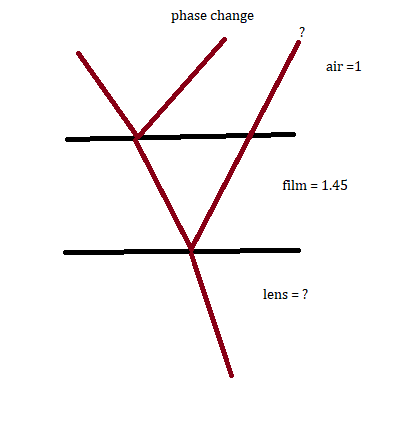
So if index of lens is more than film, both rays will have phase change, and hence for constructive interference:
##2nt=m\lambda ##
where n =1 and thickness = 100nm
When m=1 , wavelength is 200nm
m =2 wavelength is 100nm...
Hence can I conclude that there are no wavelengths in visible spectrum intensisifed in reflected light if index of lens is larger than film? (since visible is 400-700nm)
(ii)
On the other hand, if index is lower, they will have a phase difference:
##2nt=(m+0.5)\lambda ##
where n =1 and thickness = 100nm
When m=1 , wavelength is 133nm...
Hence can I conclude that there are no wavelengths in visible spectrum intensisifed in reflected light if index of lens is smaller than film too?
So if index of lens is more than film, both rays will have phase change, and hence for constructive interference:
##2nt=m\lambda ##
where n =1 and thickness = 100nm
When m=1 , wavelength is 200nm
m =2 wavelength is 100nm...
Hence can I conclude that there are no wavelengths in visible spectrum intensisifed in reflected light if index of lens is larger than film? (since visible is 400-700nm)
(ii)
On the other hand, if index is lower, they will have a phase difference:
##2nt=(m+0.5)\lambda ##
where n =1 and thickness = 100nm
When m=1 , wavelength is 133nm...
Hence can I conclude that there are no wavelengths in visible spectrum intensisifed in reflected light if index of lens is smaller than film too?
Last edited by a moderator: