Why Does Thin Film Oil Show Different Colors When Illuminated?

Click For Summary

Homework Help Overview

The discussion revolves around the phenomenon of thin film interference as observed in a thin film of oil floating on water. Participants explore the conditions under which different colors are reflected when illuminated by white light, focusing on the concepts of destructive and constructive interference.

Discussion Character

  • Conceptual clarification, Assumption checking, Exploratory

Approaches and Questions Raised

  • Participants discuss the reasons for the absence of reflected colors at certain points, questioning the role of phase changes in interference. They also explore how the thickness of the oil film relates to the observed colors and interference patterns.

Discussion Status

The conversation is active, with participants providing insights into the nature of phase changes and their effects on interference. Some guidance has been offered regarding the relationship between thickness and interference types, although multiple interpretations of the concepts are still being explored.

Contextual Notes

Participants reference specific wavelengths of light and the refractive indices of oil and water, indicating a focus on the physical properties influencing the interference patterns. There is an ongoing examination of the assumptions related to phase changes during reflection.

whitehorsey
Messages
188
Reaction score
0
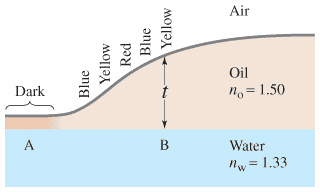
1. A thin film of oil (no = 1.50) with varying thickness floats on water (nw = 1.33). When it is illuminated from above by white light, the reflected colors are as shown in the figure. In air, the wavelength of yellow light is 580 nm.
a. Why are there no reflected colors at point A?
b. What is the oil's thickness t at point B?
oilfilm.png


3. a. Because it is a destructive interference? the reflected ray from air to oil (phase change) and oil to water (no phase change) so they cancel out?

b. Why is this one a constructive interference? I've read that because there is light it is always constructive but when its dark it is destructive is that true?
 
Physics news on Phys.org
whitehorsey said:
1. A thin film of oil (no = 1.50) with varying thickness floats on water (nw = 1.33). When it is illuminated from above by white light, the reflected colors are as shown in the figure. In air, the wavelength of yellow light is 580 nm.
a. Why are there no reflected colors at point A?
b. What is the oil's thickness t at point B?

View attachment 61552

3. a. Because it is a destructive interference? the reflected ray from air to oil (phase change) and oil to water (no phase change) so they cancel out?

The ray reflected from the oil-water interface travels across the oil layer and back, and its phase changes during that trip. By how much?

whitehorsey said:
b. Why is this one a constructive interference? I've read that because there is light it is always constructive but when its dark it is destructive is that true?

When two waves interfere the resultant intensity depends on the phase difference between them. How does the phase of a wave of wavelength λ change if it travels D distance?
The interference is destructive if the phase difference between two waves is odd number times pi. It is constructive in case it is integer number times 2pi.

ehild
 
whitehorsey said:
3. a. Because it is a destructive interference? the reflected ray from air to oil (phase change) and oil to water (no phase change) so they cancel out?
Yes. Though for full marks you'd need to articulate why a "phase change" and why "no phase change".

when its dark it is destructive is that true?
Yes, that explains why the thinnest region is black. Moving to an adjacent slightly less thin region, seen as blue, we can say it remains a region of destructive interference for most wavelengths, but the blue colour indicates that blue is starting to show constructive interference.
 
ehild said:
The ray reflected from the oil-water interface travels across the oil layer and back, and its phase changes during that trip. By how much?

It changes by 180 degrees. So that would cause the rays to cancel out.


NascentOxygen said:
Yes. Though for full marks you'd need to articulate why a "phase change" and why "no phase change".

Yes, that explains why the thinnest region is black. Moving to an adjacent slightly less thin region, seen as blue, we can say it remains a region of destructive interference for most wavelengths, but the blue colour indicates that blue is starting to show constructive interference.

Ah okay. But how does the thickness also tell you whether it is constructive or destructive?
 

Similar threads

  • · Replies 1 ·
Replies
1
Views
2K
  • · Replies 3 ·
Replies
3
Views
4K
  • · Replies 1 ·
Replies
1
Views
2K
  • · Replies 6 ·
Replies
6
Views
3K
  • · Replies 2 ·
Replies
2
Views
2K
  • · Replies 1 ·
Replies
1
Views
951
Replies
7
Views
6K
Replies
2
Views
4K
  • · Replies 6 ·
Replies
6
Views
4K
Replies
1
Views
3K