Third Invariant expressed with Cayley-Hamilton Theorem

Join the discussion
Ask a follow-up here, or get your own question answered by working scientists, mathematicians and engineers — people, not an autocomplete.
Real named experts · corrections over time · the nuance an AI answer skips
2 replies · 2K views
FluidStu
Messages
25
Reaction score
3
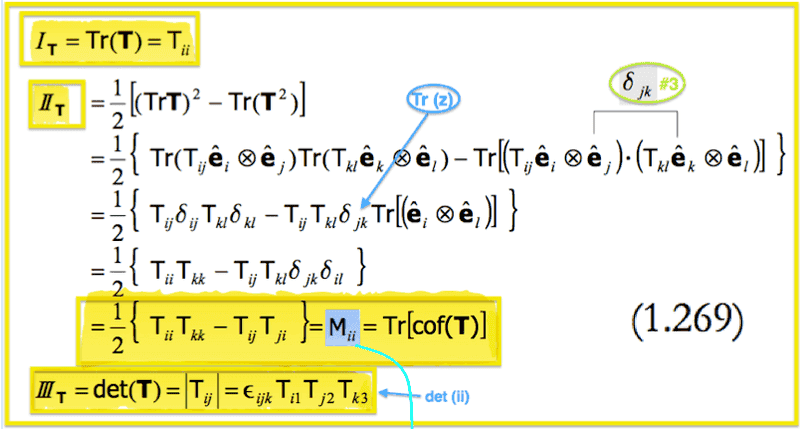
The Cayley-Hamilton Theorem can be used to express the third invariant of the characteristic polynomial obtained from the non-trivial solution of the Eigenvector/Eigenvalue problem. I follow the proof (in Chaves – Notes on Continuum Mechanics) down to the following equation, then get stuck at "Replacing the values of IT and IIT with those in 1.269. Could someone please explain? Thanks


upload_2016-4-11_9-14-6.png
upload_2016-4-11_9-17-24.png
upload_2016-4-11_9-17-35.png

with 1.269 being:
upload_2016-4-11_9-14-51.png
 
on Phys.org
We need to show that the RHS of the equations in the first two boxes are equal. To minimise the latex coding I'll write ##A## for ##Tr(T)## and ##B## for ##Tr(T^2)##. Then subtract the RHS of the second from the RHS of the first and multiply the result by 2 to get:
$$2II_TA-2I_TB-A^3+3AB=2II_TA-2AB-A^3+3AB=A\left(2II_T-2B-A^2+3B\right)=A\left(2II_T+B-A^2\right)=2A\left(II_T-0.5(A^2-B)\right)
=2A\left(II_T-II_T\right)=0$$
So twice the difference is zero.
So the two RHSs are equal.
 
  • Like
Likes   Reactions: FluidStu
Great! Thanks Andrew.