guohua
- 1
- 0
- TL;DR
- For the exploration of relative reference frames and the absolute reference frame, a thought experiment is presented.
The early physics community generally held the view that heavier objects fall faster, until Galileo refuted this idea through a classic logical thought experiment: if a lighter object and a heavier object are bound together as a composite body, would the falling speed of this composite increase or decrease?
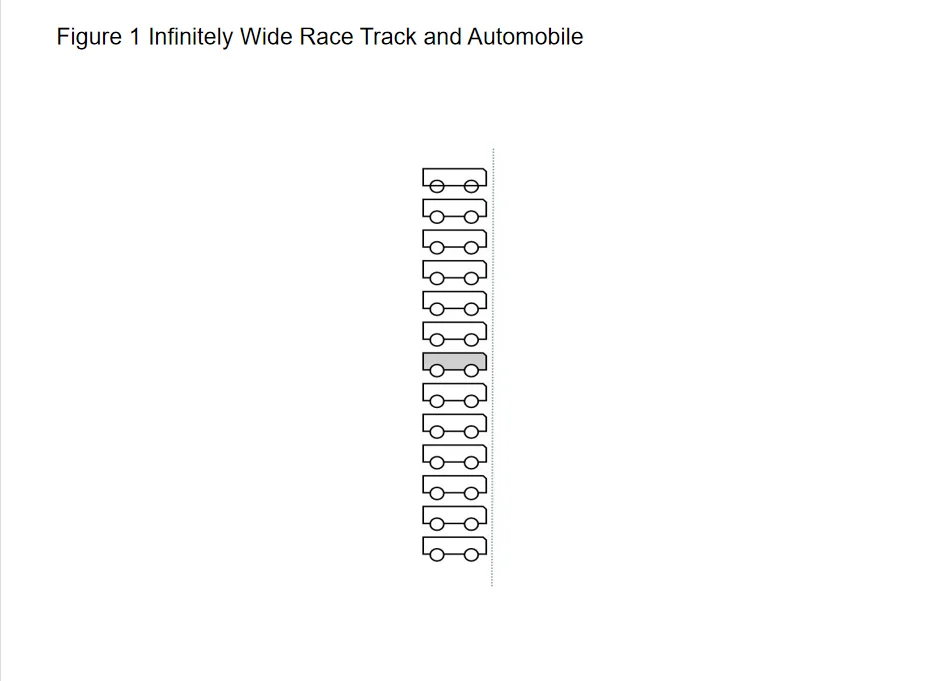
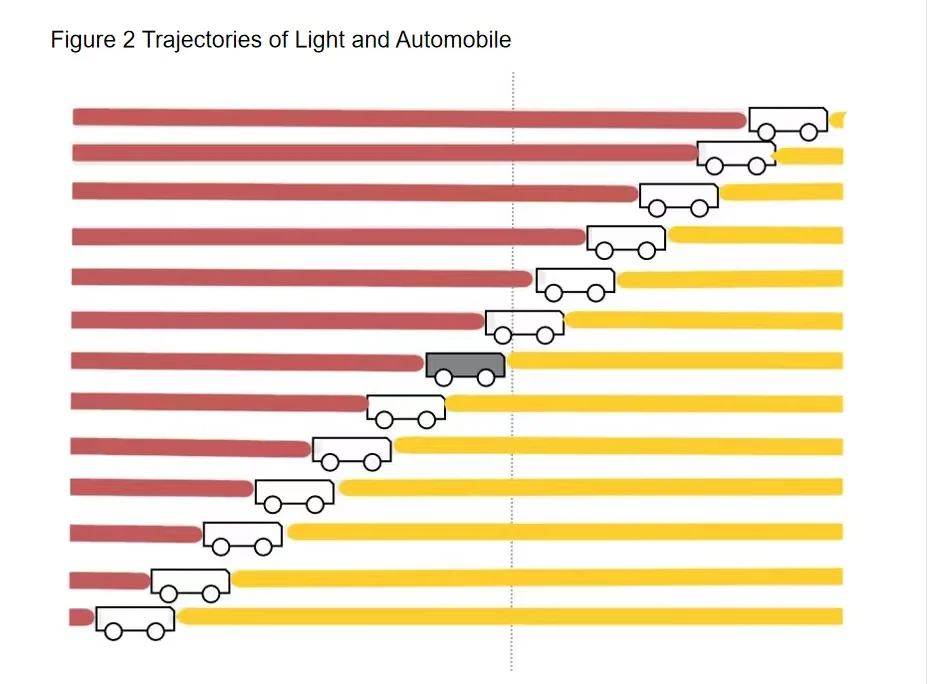
This paper constructs a thought experiment model based on reference frames: an infinitely wide straight track is assumed, with an infinite number of motor vehicles arranged at the starting line. One vehicle is selected as the reference observation carrier and kept stationary relative to the track. Vehicles on both sides of this stationary reference vehicle move at constant speeds in opposite directions, one moving forward and the other backward, and the speed difference between any two adjacent vehicles is infinitesimal. All vehicles turn on their on-board light sources simultaneously. Observation directly above the track reveals that there exists a vehicle with identical optical path lengths for its red light and yellow light. Repeating this experiment on three mutually orthogonal planes enables the establishment of a fundamental reference coordinate system.
1 Is the speed of light determined by intrinsic physical properties? Is the speed of light affected by observers? For two mutually opposite velocities free from external interference, does there exist an external-perturbation-independent zero velocity?
2 In Figure 2, high-speed moving objects exhibit directional dependence relative to the speed of light in vacuum; no shift of interference fringes is detected in experiments. Is there a theoretical contradiction between the two phenomena?
3 Observers can determine the motion state of target objects. Similarly, the motion state of the Earth can also be observed from external reference frames. If an information communication link is established between the observer and the Earth, the Earth is able to confirm its own absolute motion state.
4 Do the existing physical laws still hold in high-speed reference frames? Are there any undetected hidden variables in the universe?
The current theory of relative reference frames is established on the basis of various physical experiments. This paper adopts an alternative approach, drawing on Galileo’s logical deduction to investigate issues related to reference frames from a novel perspective.
This paper constructs a thought experiment model based on reference frames: an infinitely wide straight track is assumed, with an infinite number of motor vehicles arranged at the starting line. One vehicle is selected as the reference observation carrier and kept stationary relative to the track. Vehicles on both sides of this stationary reference vehicle move at constant speeds in opposite directions, one moving forward and the other backward, and the speed difference between any two adjacent vehicles is infinitesimal. All vehicles turn on their on-board light sources simultaneously. Observation directly above the track reveals that there exists a vehicle with identical optical path lengths for its red light and yellow light. Repeating this experiment on three mutually orthogonal planes enables the establishment of a fundamental reference coordinate system.
1 Is the speed of light determined by intrinsic physical properties? Is the speed of light affected by observers? For two mutually opposite velocities free from external interference, does there exist an external-perturbation-independent zero velocity?
2 In Figure 2, high-speed moving objects exhibit directional dependence relative to the speed of light in vacuum; no shift of interference fringes is detected in experiments. Is there a theoretical contradiction between the two phenomena?
3 Observers can determine the motion state of target objects. Similarly, the motion state of the Earth can also be observed from external reference frames. If an information communication link is established between the observer and the Earth, the Earth is able to confirm its own absolute motion state.
4 Do the existing physical laws still hold in high-speed reference frames? Are there any undetected hidden variables in the universe?
The current theory of relative reference frames is established on the basis of various physical experiments. This paper adopts an alternative approach, drawing on Galileo’s logical deduction to investigate issues related to reference frames from a novel perspective.