Thrust Bearings and Smooth Journal Bearings reaction moment?

Click For Summary

Discussion Overview

The discussion revolves around the presence of reaction moments in thrust bearings and smooth journal bearings, as referenced in R. C. Hibbeler's textbook on Mechanics of Materials. Participants explore the implications of these bearings in mechanical systems, questioning whether they can tolerate significant moments and how this relates to their design and application.

Discussion Character

  • Debate/contested
  • Technical explanation
  • Exploratory

Main Points Raised

  • One participant notes that Hibbeler's textbook does not mention reaction moments for thrust and journal bearings, suggesting that these bearings may not be designed to handle significant moments.
  • Another participant speculates that the absence of reaction moments in Hibbeler's analysis could be due to the design of bearings that typically eliminate moments through multiple bearings and reduced overhangs.
  • A third participant references a source indicating that normal radial single ball bearings are not designed for moment loads, and highlights a specific product line designed to handle such loads.
  • Some participants discuss the concept of self-aligning bearings and their potential inability to resist moments, while questioning how this applies when multiple bearings are used in conjunction.
  • One participant suggests that a shaft under moderate speed can be treated like a simple beam, with standard analysis methods applicable, while also noting that higher speeds complicate stability and analysis.

Areas of Agreement / Disagreement

Participants express differing views on whether thrust and journal bearings can have reaction moments, with some suggesting they typically do not, while others question this assumption. The discussion remains unresolved, with multiple competing perspectives on the topic.

Contextual Notes

Participants highlight potential limitations in understanding the behavior of bearings under various loading conditions, including the influence of bearing configuration and the effects of speed on shaft stability.

AnotherParadox
Messages
35
Reaction score
3
Ok, so this is an undergraduate level question probably but consider this

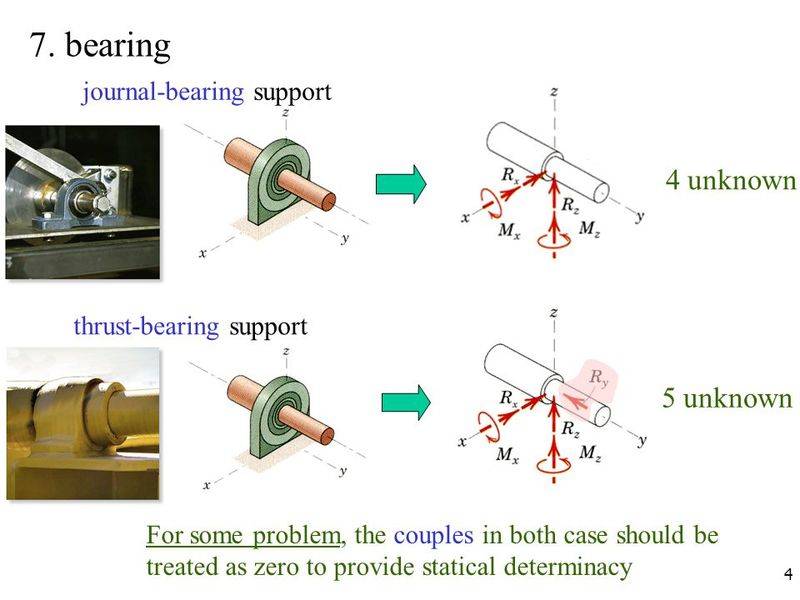
R. C. Hibbeler's Textbook on Mechanics of Materials says this about thrust bearings and smooth journal Bearings :

ab4fe9f56f8a18eeda226a13343a3b76.png


In other words, it says nothing about reaction moments. Now this chart has other 2D connection types that include a counter or reaction moment such as a fixed support that has 3 unknowns in 2D (M, Fx, Fy) or 3 reaction forces. So it's safe to say already that Hibbeler does not consider journal and thrust bearings to have reaction moments.

But to double check that he's saying this I looked at the first problem set
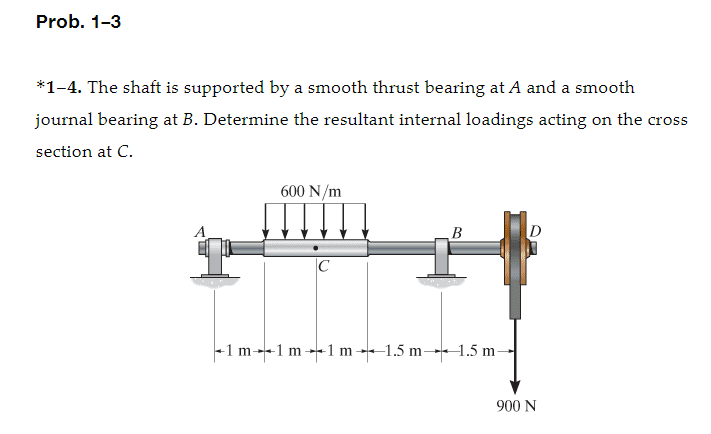
02487ac280ada418cc8e66c180297260.png


Now you are probably wondering how to solve this while consider the reaction moments at A and B, but before you strain yourself on that idea just take a look at a solution manual and you'll see it doesn't consider them at all. It leads to answers of 233 N for the resultant internal loading at point C and 433 N*m for the bending moment.

A quick search and general intuition would tell you there are probably reaction moments at both A and B or on both thrust bearings and smooth journal bearings.

The rod a is long cylinder in-closed by a 'bracket' with a cylindrical hole in it. If you slide a cylinder in a cylindrical hole it's only going to turn about its axis. Turning perpendicular isn't going to work thus a counter moment. As shown below (results for searching thrust bearing reaction forces)
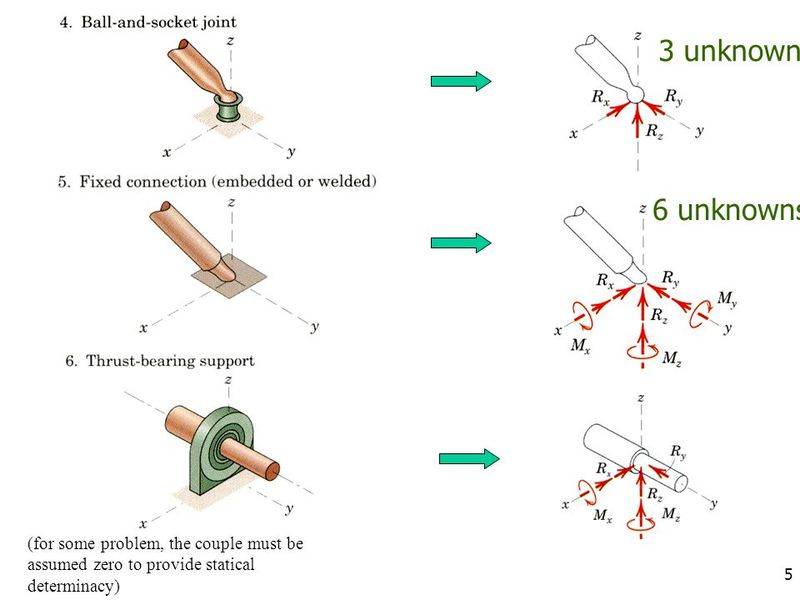
3+unknowns+6+unknowns..jpg


And again
7.+bearing+4+unknown+5+unknown+journal-bearing+support.jpg


In most results you see a reaction moment in the X and Z axis, yet this is and my own intuition is inconsistent with Hibbeler's textbook.

Are there different types of bearings that do or don't have reaction moments in the X and Z axes? Is Hibbeler wrong, is my intuition and these searches wrong? Is everyone wrong? Are they both right? Is this simple a common different 'flavor' of material?

What am I missing here? This shouldn't be so difficult, at least not unless I'm missing something major.
 
Last edited:
Engineering news on Phys.org
I think the bearings you mention (journal and thrust) aren't normally designed to tolerate significant moments. Moments would tend to twist the bearing out of it's housing. They should be eliminated by having multiple bearings along the shaft and reducing pulley overhangs etc. I'm speculating that might be why they weren't considered by Hibbeler?

Edited to add..

Reaction moments.png


Some of these bearings and bearing mountings are self aligning and would provide no resistance to a moment...

ggb-exalign-pb-pedestal-bearing-1_0.jpg
 
Last edited:
  • Like
Likes   Reactions: AnotherParadox
Google found..

http://www.carterbearings.co.uk/new...-for-moment-loads-with-thin-section-bearings/
Normal radial single ball bearings aren’t designed for these moment loads so Carter Manufacturing Limited stocks a Silverthin™ product line specifically to satisfy these engineering constraints.

When engineers are choosing a bearing for their specific application, it is common to combine a series of bearings working together in order to handle the variety of loads within the system. Typically, bearing loads are thought of only in terms of radial or axial but with only a single bearing, any radial load applied at any distance from the center of the bearing ball path will create a moment load. Silverthin™ Thin-Section Bearings offer a bearing with a unique raceway geometry specifically to handle this moment load.
 
CWatters said:
Some of these bearings and bearing mountings are self aligning and would provide no resistance to a moment...

On first thought, this would only be true if it were the only bearing on the rod. If you put two bearing mountings that are self aligning on the same rod (such as on the example problem) then self aligning wouldn't be able to happen since the two mountings are fixed and pointing at each other by the rigid rod connecting them.

But then on second thought I suppose it wouldn't be providing resistance to the moment itself, rather channeling it from the other bearings in the series reaction force (in x or y) ...much like a fulcrum.. so no need for the reaction moment.

Correct me if wrong
 
Last edited:
Not sure I follow your first paragraph but the second seems correct.
 
  • Like
Likes   Reactions: AnotherParadox
AnotherParadox said:
But then on second thought I suppose it wouldn't be providing resistance to the moment itself, rather channeling it from the other bearings in the series reaction force (in x or y) ...much like a fulcrum.. so no need for the reaction moment...

A shaft running at moderate speed and in a stable condition can usually be treated like a simple beam and load distribution , shear force , bending moment and deflection can all be worked out using standard analysis methods .

The bearings provide points of fixation . The type and degree of fixation depends on the bearing configuration .

Calculations for stress can be a little more difficult . We can discuss that problem later if you wish .

At higher speeds shaft stability becomes a problem and more complicated analysis methods are needed
 

Similar threads

  • · Replies 3 ·
Replies
3
Views
3K
Replies
1
Views
3K
  • · Replies 8 ·
Replies
8
Views
7K
  • · Replies 3 ·
Replies
3
Views
2K
  • · Replies 4 ·
Replies
4
Views
2K
  • · Replies 4 ·
Replies
4
Views
7K
  • · Replies 4 ·
Replies
4
Views
3K
Replies
1
Views
2K
  • · Replies 23 ·
Replies
23
Views
37K
Replies
6
Views
3K