Hill
- 867
- 658
- TL;DR
- Replacing a field eigenstate by the field operator
This question is not crucial, but I'd like to understand better the equation (14.35) in this derivation:
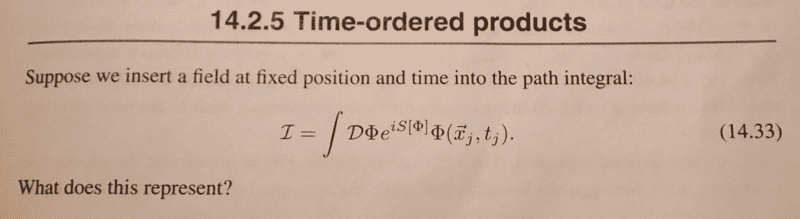
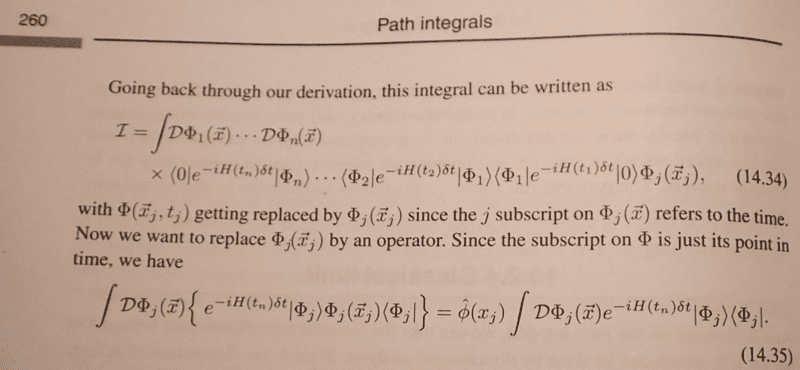
Here ##\Phi## is an eigenvalue of ##\hat \phi##, i.e., ##\hat \phi (\vec x ) |\Phi \rangle = \Phi (\vec x) |\Phi \rangle##.
First, I think that there is a typo in (14.35): the Hamiltonian should be evaluated at time ##t_{j+1}## rather than ##t_n##. Is it right?
But the question is, why the exponential is included in (14.35)? Wouldn't it be correct just to write, $$\int \mathcal D \Phi_j(\vec x) \, |\Phi_j \rangle \Phi_j (\vec x_j) \langle \Phi_j| = \hat \phi (x_j) \int \mathcal D \Phi_j(\vec x) \, |\Phi_j \rangle \langle \Phi_j|$$?
Here ##\Phi## is an eigenvalue of ##\hat \phi##, i.e., ##\hat \phi (\vec x ) |\Phi \rangle = \Phi (\vec x) |\Phi \rangle##.
First, I think that there is a typo in (14.35): the Hamiltonian should be evaluated at time ##t_{j+1}## rather than ##t_n##. Is it right?
But the question is, why the exponential is included in (14.35)? Wouldn't it be correct just to write, $$\int \mathcal D \Phi_j(\vec x) \, |\Phi_j \rangle \Phi_j (\vec x_j) \langle \Phi_j| = \hat \phi (x_j) \int \mathcal D \Phi_j(\vec x) \, |\Phi_j \rangle \langle \Phi_j|$$?
Last edited: