To find the forces on a composite object

  • Thread starter Thread starter gnits
  • Start date Start date
  • Tags Tags
    Composite Forces
Click For Summary
SUMMARY

The discussion focuses on calculating the forces acting on a composite object, specifically a cylinder and a plank, under static friction conditions. The correct coefficient of friction at point C is determined to be u = 8/49, while the analysis also reveals that the rod may slip before the cylinder, requiring u to be at least 1/3 to prevent slipping. Key calculations include normal forces S = 8W/15 and R = 23W/15, with trigonometric values cos(2ɵ) = 4/5 and sin(2ɵ) = 3/5. The participants emphasize the importance of considering all points of contact and the correct application of static friction principles.

PREREQUISITES
  • Understanding of static friction and its limits
  • Knowledge of free-body diagrams and equilibrium analysis
  • Familiarity with trigonometric functions in physics
  • Ability to perform algebraic manipulations in force equations
NEXT STEPS
  • Study the principles of static friction and limiting friction in detail
  • Learn how to construct and analyze free-body diagrams for composite systems
  • Explore the effects of multiple points of contact on frictional forces
  • Investigate the relationship between normal force and frictional force in various scenarios
USEFUL FOR

Physics students, mechanical engineers, and anyone involved in analyzing forces in composite systems will benefit from this discussion.

gnits
Messages
137
Reaction score
46
Homework Statement
To find the forces on a composite object
Relevant Equations
moments
Could I please ask for help with the following:
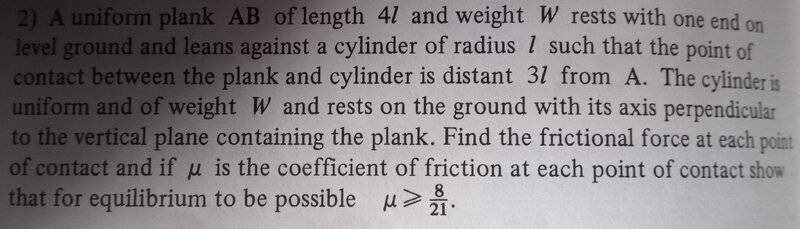
c.jpg


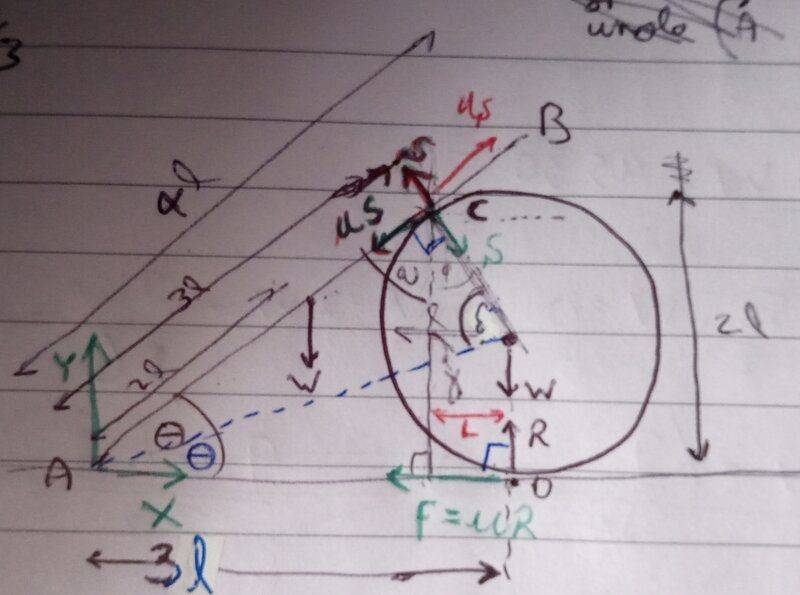
Here's a diagram:

b.jpg


(in what follows, for clarity, I write L to represent the lower case L of the diagram).

My diagram wrongly shows u (the coefficient of friction) to be the same at both points of contact. Since this image was taken I have realized that, it does not affect the following where I refer the coefficient of fruition at C as v.

For the first part of the question the answer in the book is "8W/45 at all points of contact".

I have done that part and agree with the book answer. I obtain F = uR = vS = 8W/45

Intermediate results which I derived and used on the way are that: S = 8w/15 and that R = 23w/15. Also cos(2ɵ)=4/5 and sin(2ɵ)=3/5

For the last part (in this part the coefficient of friction at both points of contact are the same = u) I reasoned that I would balance the horizontal forces acting on the cylinder, like so:

uR + uS*cos(2ɵ) - S*sin(2ɵ)=0

substituting in for S, R, cos(2ɵ) and sin(2ɵ) from above formulae leads to u = 8/49

not 8/21.

Have I made an arithmetic error or have I erroneously applied the wrong physics?

Thanks for any help,
Mitch.
 
Last edited:
Physics news on Phys.org
Your diagram is a little hard to read. It would be clearer if you drew separate free-body diagrams for the plank and the sphere. I agree with your answers for the normal forces S and R.

You should not assume that a static friction force ##f_s## is always related to the normal force ##N## as ##f_s = \mu N##. The correct relation is ##f_s \leq \mu N##.
 
  • Like
Likes Lnewqban and Steve4Physics
Hi @gnits. I’d like to add a few thoughts...

As @TSny has indicated, the coefficients of friction are not used for the first part of the question. The system is not about to slip. So the coefficient(s) of friction should not appear in the working.
______________

For example, imagine you (weight say 600N) are standing on horizontal ice.

Your friend X applies a horizontal 10N force on you. You do not slide. ##F_{friction}## between you and the ice is therefore 10N as you are still in equilibrium.

X increases the applied force to 20N. You still do not move. ##F_{friction}## has therefore increased to 20N.

X increases the force to 30N. You are now just about to start sliding. (E.g. force of 30.00001N would make you slide). ##F_{friction}## is now 30N and this is the limiting frictional force. The coefficient of static friction is 30/600 = 0,05 and is defined only for this limiting case.
______________

For the second part of the question, note that there are 3 points of contact (point A as well as the 2 contact points on the cylinder).

[I guess that’s why the answer to the first part refers to ‘all’ points of contact. But I think you have considered only 2 – because you used the word ‘both’. So you may still need to find the frictional force at point A.]

There are are various ways sliding could start:
- sliding at point A only;
- sliding at point B only;
- sliding at point O only (I think your diagram shows point ‘O’ at the bottom of the cylinder)’
as well the possibilities of simultaneous sliding at 2 or 3 points of contact.

So I guess you are meant to identify which mode of siding is going to occur first and use that to find μ.
 
Thanks for you detailed answer. I'll get back to it later and let you know how I got on.
 
Well, I'm a little closer to the answer:

Firstly, yes, as Steve4Physics says, A is also a point of contact. And by resolving horizontally on the system as a whole I also get that X = 8w/45. So that completes the first part of the question.

I still believe that my analysis of the cylinder alone, balancing the horizontal forces, which leads to u = 8/49 seems correct. So this would say that, for no slipping at point of contact between cylinder and ground we require u >= 8/49 = 0.163 (to 3 decimal places).

But, taking Steve4Physics' advice made me realize that the rod may slip before the cylinder does. So I balanced the horizontal forces on the rod as follows:

X - S * sin(2ɵ) + u*S * cos(2ɵ) = 0, this leads to u = 1/3. which is greater than 8/49 and so slipping would occur here first, i.e. to not-slip here would require u >= 1/3 = 0.333 (to 3 decimal places) , but this is slightly different to books answer of u >= 8/21 = 0.381 (to 3 decimal places).

I tried balancing vertically for rod only, get same result of u = 1/3.

Would anybody be able to show me where I am reasoning wrongly?
 
If you know the static friction force f and the normal force N at a point of contact, what can you say about the possible values of u at that point of contact?

As a numerical example, suppose f = 2.0 Newtons and N = 8.0 Newtons. What is the range of possible values for u?

Since you know the friction force and the normal force at each of the three contact points in this problem, you can do this type of analysis at each of the points and compare results.
 
Big thanks to both of you for your help. I needed each piece of advice. I get it and agree with the book's answer. Thanks again.
 
  • Like
Likes TSny

Similar threads

  • · Replies 2 ·
Replies
2
Views
2K
Replies
11
Views
2K
  • · Replies 2 ·
Replies
2
Views
2K
  • · Replies 2 ·
Replies
2
Views
2K
  • · Replies 18 ·
Replies
18
Views
2K
  • · Replies 6 ·
Replies
6
Views
2K
  • · Replies 13 ·
Replies
13
Views
2K
Replies
5
Views
2K
  • · Replies 21 ·
Replies
21
Views
1K