To prove that three forces are in equilibrium

Click For Summary
SUMMARY

The discussion centers on proving that three forces acting at the circumcenter O of triangle PQR are in equilibrium. The forces, represented as kQR, kRP, and kPQ, act in the directions of the midpoints D, E, and F of the triangle's sides. The participants concluded that the forces maintain proportional relationships to the sides of the triangle, allowing them to form a closed triangle, thus confirming their equilibrium. The key insight is that the forces are perpendicular to the sides they intersect, ensuring their lengths and orientations are consistent with the triangle's geometry.

PREREQUISITES
  • Understanding of triangle geometry, specifically circumcenters and midpoints.
  • Familiarity with vector notation and force representation.
  • Knowledge of the properties of isosceles triangles and their circumcenters.
  • Ability to apply the concept of proportionality in geometric contexts.
NEXT STEPS
  • Study the properties of circumcenters in triangles, focusing on their geometric implications.
  • Learn about vector addition and equilibrium in physics, particularly in the context of forces.
  • Explore the concept of similar triangles and how they relate to force vectors.
  • Investigate the conditions under which three forces can be in equilibrium in a two-dimensional space.
USEFUL FOR

Mathematicians, physics students, and educators interested in the principles of force equilibrium and triangle geometry will benefit from this discussion.

gnits
Messages
137
Reaction score
46
Homework Statement
To prove that three forces are in equilibrium
Relevant Equations
Equating of forces
Could I please ask for help regarding the following question:

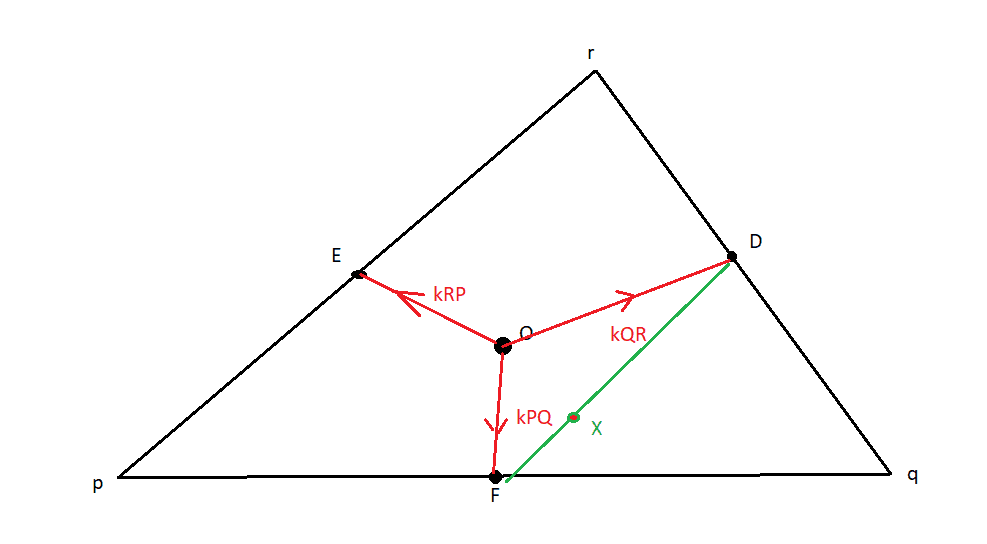
D, E and F are the midpoints of the sides QR, RP and PQ respectively of triangle PQR whose circumcenter is O. Forces of magnitude kQR, kRP and kPQ act at O in directions ##\overrightarrow{OD}##, ##\overrightarrow{OE}## and ##\overrightarrow{OF}## respectively.

Prove that the forces are in equilibrium.


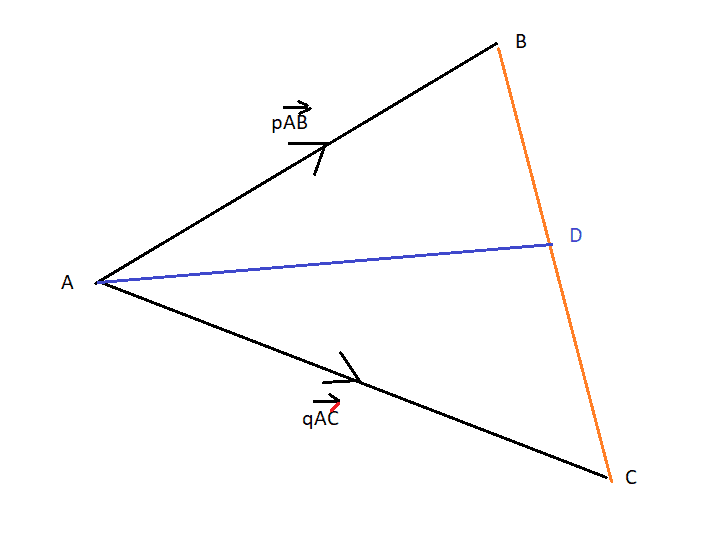
I am allowed to make use of the following fact, (although I am free to answer the question any other way):
theorem.png

With both forces going away from A we have:

##p\overrightarrow{AB}## + ##q\overrightarrow{AC}## = ##(p+q)\overrightarrow{AD}##

where

##BD:DC = q:p##

Here's a diagram for the problem (the green stuff is referenced in my solution below where I attempt to apply the above fact).
solution..png


I was hoping to show that the kPQ and kQR forces combined to give a force which was opposite (so ##\overrightarrow{OX}## would be opposite to ##\overrightarrow{OE}## ) and of equal size to the kRP force by using the above fact. Well straight off I see that this would give a force of magnitude k(QR + PQ) which I would need to be equal to kRP, and I can't see how that can be so.

Thanks for any help,
Mitch.
 
Physics news on Phys.org
Can you show that the three forces form a closed triangle if you move them around parallel to themselves? Sure.
 
kuruman said:
Can you show that the three forces form a closed triangle if you move them around parallel to themselves? Sure.
Thanks for your hint. I think it has enabled me to see it: I see that the three forces have lengths which are in the same proportion to each other as the original triangle,. Now, because O is the circumcentre then it must be the case that each of the forces is perpendicular to the side of the original triangle that it intersects (e.g. OD is perpendicular to rq etc). So the lines are of the right length and relative orientation to each other to form a closed triangle which is similar to the original. (Now, I doubt myself, D is the midpoint of rq, doesn't mean that OD is perpendicular to rq though). Ok, it does because O, being the circumcentre, is equidistant from r and q).
 
Last edited:
Not quite.
gnits said:
Now, because O is the circumcentre then it must be the case that each of the forces is perpendicular to the side of the original triangle that it intersects (e.g. OD is perpendicular to rq etc).
I don't think that this true. The problem says that OD intersects rq at its midpoint. This doesn't necessarily make OD perpendicular to rq. It would be perpendicular if rq were the base of an isosceles triangle, pr=pq. We are not told that this is the case here. Hint: You can construct a triangle uniquely if you are given (a) one side and the two angles that it is part of, (b) two sides and the angle between them, (c) all three sides.
 
Last edited:
O as the circumcentre must be equidistant from all the vertices. Thus ORQ is an isosceles triangle and OD is perpendicular to QR. D,O,P are not necessarily collinear. O is not the centroid. (It might help to redraw the diagram more accurately.)
 
  • Like
Likes   Reactions: hutchphd
To @gnits:
Let me provide a most generous second hint, but before you proceed reading this post, please reread the hint in post #4, paying special attention to case (c).

Most generous second hint: Line segments ##RP##, ##PQ## and ##QR## form a triangle if put together. Can lengths ##kRP##, ##kPQ## and ##kQR## (where ##k## is a constant) also form a triangle if put together? Why or why not?
 
Thanks to everyone for their help, kuruman's was particularly of help to me, I am most grateful. These have helped me to see my way to the answer. Thanks again, Mitch.
 
  • Like
Likes   Reactions: kuruman

Similar threads

  • · Replies 5 ·
Replies
5
Views
2K
Replies
17
Views
3K
  • · Replies 2 ·
Replies
2
Views
2K
  • · Replies 13 ·
Replies
13
Views
3K
  • · Replies 7 ·
Replies
7
Views
2K
  • · Replies 7 ·
Replies
7
Views
5K
  • · Replies 2 ·
Replies
2
Views
2K
  • · Replies 1 ·
Replies
1
Views
2K
  • · Replies 5 ·
Replies
5
Views
4K
Replies
5
Views
2K