Torque around a point from lever linkage

Click For Summary
SUMMARY

This discussion focuses on calculating torque around point D in a lever linkage system involving multiple connected links. The primary equation used is T = F*r*sin(theta), where F is the force applied at point A, and r is the distance from point D. The user attempts to derive the output force F_b at point B using equilibrium equations and vector analysis. The final expression for torque around point D is confirmed as T = F_b*lambda*sin(omega), where F_b is derived from the relationship F_b = [ F*(alpha/2)*sin(theta) ] / [ (alpha/2)*sin(phi) ].

PREREQUISITES
  • Understanding of torque and its calculation using T = F*r*sin(theta)
  • Knowledge of equilibrium equations in static systems
  • Familiarity with vector analysis in mechanical systems
  • Experience with CAD software for modeling mechanical linkages
NEXT STEPS
  • Research equilibrium equations for static structures in mechanical engineering
  • Learn about vector resolution techniques in force analysis
  • Explore CAD software options for simulating mechanical linkages
  • Study advanced torque calculations in multi-link systems
USEFUL FOR

Mechanical engineers, physics students, and anyone involved in modeling and analyzing lever systems and torque in mechanical linkages.

BatsDude
Messages
14
Reaction score
0
Hi all. Brushing up on some of my force and torque stuff so I can do some modelling in software.

Homework Statement


I have a system as shown in the picture. A force F acts at point A, which is the end point of the lever AB. Connected to the lever is a link BC, and connected to BC at point C is another link CD, which is anchored to the ground.
I'm trying to resolve this into a torque around the point D. I know the lengths, and all the angles involved, I'm just confused about how the force travels through the linkage.
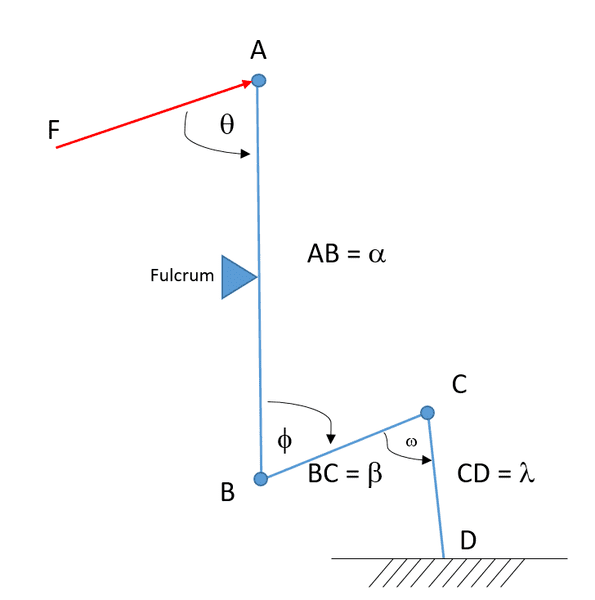
SWs7w.png


Homework Equations


T = F*r*sin(theta) is the equation for torque from a force acting at an angle

The Attempt at a Solution


My attempt was to try and equate the forces through the lever first.
Let F_b be the output force of the lever at point B, resulting from F acting at point A.
F*(alpha/2)*sin(theta) = F_b*(alpha/2) *sin(phi). Solve for F_b.
From here, I would assume that this force F_b is acting on member CD at an angle of omega and at a lever length of lambda. From this I can calculate the torque around D.

However, I'm not at all sure if this is correct.
 
Physics news on Phys.org
Draw the vectors representing the forces directly on the diagram . You should be able to see a way of solving this and similar problems very easily .

Just for interest - since you mention software modelling - you can use a modern cad system as a visual calculator for linkage problems .
 
Hi Nidum,
Thanks for your reply. I've drawn the force vectors that I think are happening, as seen below. Is that correct? The main issue I'm having is actually determining the value of F_b and whether or not it interacts along BC or if it acts at an angle on BC.
fjgS2Px.png
 
Anyone able to help?
 
BatsDude said:
determining the value of F_b and whether or not it interacts along BC or if it acts at an angle on BC.
Let the tension in BC be T (your Fb).
What equilibrium equations can you write for the point B?
What equilibrium equations can you write for the point C?
 
So would the torque around D just boil down to = F_b*lambda*sin(omega)?

Where F_b is = [ F*(alpha/2)*sin(theta) ] / [ (alpha/2)*sin(phi) ]
 
BatsDude said:
So would the torque around D just boil down to = F_b*lambda*sin(omega)?

Where F_b is = [ F*(alpha/2)*sin(theta) ] / [ (alpha/2)*sin(phi) ]
Yes.
 
  • Like
Likes   Reactions: BatsDude
Thank you for your help!
 

Similar threads

  • · Replies 22 ·
Replies
22
Views
3K
  • · Replies 9 ·
Replies
9
Views
2K
  • · Replies 2 ·
Replies
2
Views
1K
  • · Replies 5 ·
Replies
5
Views
3K
  • · Replies 42 ·
2
Replies
42
Views
4K
  • · Replies 12 ·
Replies
12
Views
2K
  • · Replies 6 ·
Replies
6
Views
2K
  • · Replies 9 ·
Replies
9
Views
2K
Replies
30
Views
4K
Replies
4
Views
2K