Torque equilibrium and angular momentum conservation problems

Join the discussion
Registration is free. Start your own thread to ask a follow-up.
5 replies · 2K views · last reply
riseofphoenix
Messages
294
Reaction score
2
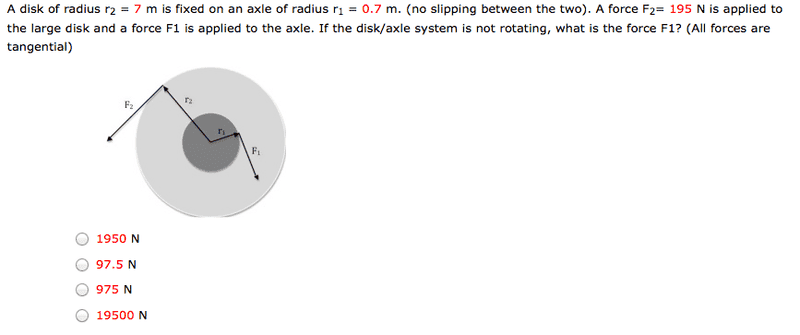
Number 11)

Physics problem: a disk of radius r2 = 7 m on an axle of radius r1 = 0.7 m, with tangential forces F2 = 195 N and F1 applied, and four multiple-choice answers from 1950 N to 19500 N.


This is what I did:

Ʃτ = F2r2 + F1r1 = 0
(195)(7) + F1(0.7) = 0
F1(0.7) = -(195)(7)
F1 = -1365/0.7
F1 = -1950 N
F1 = 1950 N

Is that answer right?

Number 12)
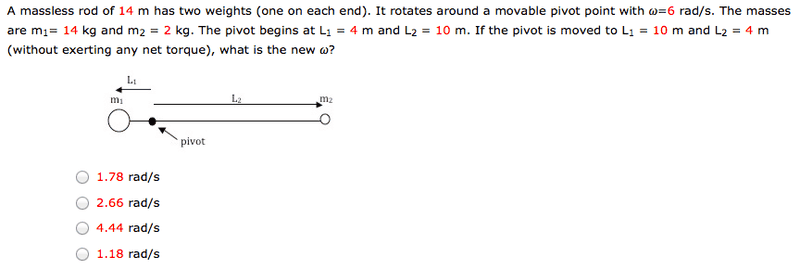
Diagram of a massless rod with a pivot near the left end, a mass m1 on the left end and m2 on the right end, with lengths L1 and L2 labeled, followed by four multiple-choice answers 1.78, 2.66, 4.44 and 1.18 rad/s.


This is what I did:

Since this is a massless rod and the location of the axis is through the end, I = ML2

Linitial = Lfinal (Conservation of Angular Momentum)
(I1ω1 + I2ω2)initial = (I1ω1 + I2ω2)final
[ M1L12ω1 ] + [ M2L22ω2 ] = [ M1L12ω1 ] + [ M2L22ω2 ]
[ (14 kg)(4)2(6) ] + [ (2 kg)(10)2(6) ] = [(14 kg)(10)2(ω2) ] + [ (2 kg)(4)2(ω2) ]
1344 + 1200 = 1400(ω2) + 32(ω2)
2544 = 1432(ω2)
2544/1432= ω2
1.776 = ω2
1.78 rad/s = ω2

Is that right?

Number 13)

Multiple-choice question: a hoop and a solid disk with the same radius, mass and angular speed, same braking torque; which takes longer to stop. Radio button selected next to 'the hoop'.


I think this one is right. I googled it...

Number 14)

Multiple-choice question about Doppler shift: fire truck at 24 m/s, cyclist at 9 m/s, siren 1550 Hz when stopped; options 1547 Hz, 1487 Hz, 1447 Hz, 1587 Hz.


fobserver = fsource [ (v + vobserver)/(v + vsource) ]
fobserver = 1550 [ (340 + 9 m/s)/(340 + 24 m/s) ]
fobserver = 1550(349/364)
fobserver = 1550(0.958791209)
fobserver = 1486 Hz

Is that right?
 
Last edited:
Physics news on Phys.org
riseofphoenix said:
Number 11)

Diagram of a disk on an axle with forces F2 (195 N, large outer disk, radius r2) and F1 (small inner axle, radius r1), followed by four multiple-choice answers: 1950 N, 97.5 N, 975 N, 19500 N.


This is what I did:

Ʃτ = F2r2 + F1r1 = 0
(195)(7) + F1(0.7) = 0
F1(0.7) = -(195)(7)
F1 = -1365/0.7
F1 = -1950 N
F1 = 1950 N

Is that answer right?
You're familiar enough with this site, that you should know by now that you shouldn't be posting 4 questions in one thread.

Your solution to problem appears to be correct.
 
riseofphoenix said:
Number 12)
Diagram of a massless rod with a pivot point, a mass m1 on the left at distance L1 and a mass m2 on the right at distance L2, followed by four multiple-choice answers: 1.78, 2.66, 4.44 and 1.18 rad/s.


This is what I did:

Since this is a long uniform rod and the location of the axis is through the end, I = (1/3)ML2

Linitial = Lfinal (Conservation of Angular Momentum)
(I1ω1 + I2ω2)initial = (I1ω1 + I2ω2)final
[ (1/3)M1L12ω1 ] + [ (1/3)M2L22ω2 ] = [ (1/3)M1L12ω1 ] + [ (1/3)M2L22ω2 ]
[ (1/3)(14 kg)(4)2(6) ] + [ (1/3)(2 kg)(10)2(6) ] = [ (1/3)(14 kg)(10)2(ω2) ] + [ (1/3)(2 kg)(4)2(ω2) ]
448 + 400 = 466.67(ω2) + 10.67(ω2)
848 = 477.34(ω2)
848/477.34 = ω2
1.776 = ω2
1.78 rad/s = ω2

Is that right?
I suspect that the answer is correct, but you used the wrong moments of inertia throughout.

Why do you have the 1/3 in all of them (moments of inertia) ? These are mass-less rods.
 
SammyS said:
I suspect that the answer is correct, but you used the wrong moments of inertia throughout.

Why do you have the 1/3 in all of them (moments of inertia) ? These are mass-less rods.
Wait but...what should they be then?
I've been looking online for "moment of inertia for massless rod" and I can't find anything other than (1/3)ML2

So it would just be ML2?
 
Last edited:
And sorry about posting 4 questions all in one post! I just needed someone to verify my work real quick

Is it ok if I ask you to check one very last thing for me? I promise it'll be quick
 
riseofphoenix said:
Wait but...what should they be then?
I've been looking online for "moment of inertia for massless rod" and I can't find anything other than (1/3)ML2

So it would just be ML2?
What is the mass of a massless rod?

The only objects with mass in problem 12 are the two weights.