Torque on two pillars (introductory physics problem)

14 replies · 3K views · last reply
Camden
Messages
15
Reaction score
2
Homework Statement
A bridge section of mass 2400kg is supported at each end of its 24.0m length by pillars. A car of mass 960kg is parked 5.00m from one end of the bridge.
Relevant Equations
F=ma
T=Fsin(theta)r
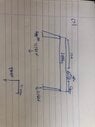
One image is attached is the question and the other is my attempt. I believe the pillars would have a downward force of 11760N applied to each pillar since they are spaced an equal distance apart. Now the tricky bit is when Torque comes into play. I believe I need to find the distance the car sits from the centre of the bridges mass. I am unsure how to do that though.
 
Attachments
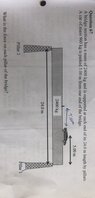
  • Hand-rotated photo of a printed physics question with a side-view diagram of a bridge deck of 2400 kg on pillars 1 and 2, 24.0 m apart, with a car 5.00 m from one end and a handwritten 7,000 N arrow.
    IMG_1600.jpg
    21.7 KB · Views: 179
  • Handwritten free-body diagram of a horizontal beam supported at both ends by pillars, with a car on it 12 m from the left end, the beam labelled 240 kg and the car 1960 N, upward reactions 11760 N at each pillar.
    IMG_1601.jpg
    25.6 KB · Views: 197
Camden said:
I believe the pillars would have a downward force of 11760N applied to each pillar since they are spaced an equal distance apart.
My neck hurts, perhaps because the pictures are rotated ?

Your belief is not justified. If the car is on top of one of the pillars, would its weight be distributed equally over the two ?

##\ ##
 
BvU said:
My neck hurts, perhaps because the pictures are rotated ?

Your belief is not justified. If the car is on top of one of the pillars, would its weight be distributed equally over the two ?

##\ ##
I believe the pillar the car is almost directly underneath will experience more weight from the car.
 
Much better. Any useful formula for the fraction (perhaps derived from an applicable condition for equilibrium of the horizontal section that rests on the pillars) ?

## \ ##
 
Camden said:
I believe the pillar the car is almost directly underneath will experience more weight from the car.
The car is above the pillars, not underneath them.
But yes, the pillar nearer the car will experience the greater load.
Use moment balance to find out how much.
 
haruspex said:
The car is above the pillars, not underneath them.
But yes, the pillar nearer the car will experience the greater load.
Use moment balance to find out how much.
Are there any other phrases that mean the same as Moment balance? I have not been taught that particular word before.
 
BvU said:
Much better. Any useful formula for the fraction (perhaps derived from an applicable condition for equilibrium of the horizontal section that rests on the pillars) ?

## \ ##
So I believe the net Torque should be zero. I am unsure which formula I should be deriving from.
 
Camden said:
Are there any other phrases that mean the same as Moment balance? I have not been taught that particular word before.
Moment is another word for torque, and balance means the net value is zero.
 
Camden said:
So I believe the net Torque should be zero. I am unsure which formula I should be deriving from.
You quoted T=Fsin(theta)r. Do you understand what F, r and θ are in that equation?
 
haruspex said:
You quoted T=Fsin(theta)r. Do you understand what F, r and θ are in that equation?
Yes I do,
F= Force applied
r= Distance force is being applied from
theta= angle at which the force is being applied
So is my first step 0= Fsin(theta)r ?
 
Camden said:
Yes I do,
F= Force applied
r= Distance force is being applied from
theta= angle at which the force is being applied
So is my first step 0= Fsin(theta)r ?
Yes, but you need to choose the body you are applying it to and the axis about which you are taking moments.
And to clarify, theta is the angle between the line of action of the force and the line along which you are measuring r.