Total current needs to go through the inductor L1, How ?

  • Thread starter Thread starter Etech_Soffy
  • Start date Start date
  • Tags Tags
    Current Inductor
Click For Summary

Discussion Overview

The discussion revolves around the conditions necessary for ensuring that the total current from a source flows exclusively through an inductor (L1) in an electrical circuit involving capacitors and resistors. Participants explore the implications of circuit configuration, impedance, and resonance in the context of an LRC network.

Discussion Character

  • Exploratory, Technical explanation, Debate/contested, Homework-related, Mathematical reasoning

Main Points Raised

  • Some participants question the terminology used, specifically referring to the circuit as a "clamp" and suggest it resembles a current source driving an LRC network.
  • There is a discussion about the nature of the circuit, with some asserting it is a standard series resonant LCR circuit, while others argue about the classification based on where the resistor is placed.
  • One participant notes that to achieve all current flowing through L1, the resistor must be disconnected, indicating a need for infinite impedance in the network.
  • Another participant proposes that the impedance Z should be an inductor (L2) and discusses the conditions under which the impedance between points a and b becomes infinite.
  • Some participants express confusion regarding the original question and the implications of achieving infinite impedance using ideal elements at a specific frequency.
  • There are mentions of the mathematical representation of the circuit's impedance and the conditions for resonance, with some participants suggesting that an LC tank circuit without losses could theoretically achieve infinite impedance at resonance.
  • Several participants attempt to clarify the requirements for the circuit, including the need for specific component values to ensure the desired current flow.

Areas of Agreement / Disagreement

Participants exhibit a mix of agreement and disagreement regarding the classification of the circuit and the conditions necessary for achieving the desired current flow through L1. There is no consensus on the exact approach or terminology, and multiple competing views remain on the implications of resonance and impedance.

Contextual Notes

Some participants express uncertainty about the original question's clarity and the implications of the circuit's configuration. There are unresolved mathematical steps and assumptions regarding the behavior of the circuit at different frequencies.

Etech_Soffy
Messages
3
Reaction score
0
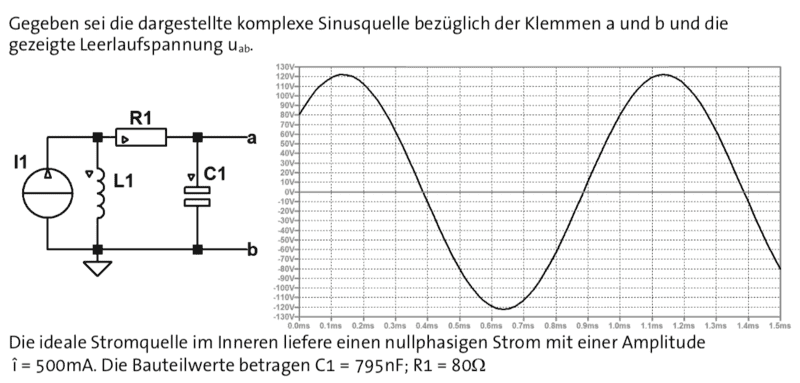
Summary:: So the question is, what do I need to do on clamp 'ab', so that the total current only goes through the Inductor L1.
I know the must be a second inductor parallel to the capacitor C1, but i don't know why.
Can someone please explain.
I also included the german question under the picture.

1641676023781.png

1641676058364.png
 
Physics news on Phys.org
Welcome to PF.

Why are you calling that a "clamp" circuit? It looks like a current source (sinusoidal?) driving an LRC network...
 
  • Like
Likes   Reactions: Klystron
berkeman said:
Welcome to PF.

Why are you calling that a "clamp" circuit? It looks like a current source (sinusoidal?) driving an LRC network...
Yes it is, sorry my english is not the best when it comes to electrical engeneering. I don't know the correct terms/ names for it.
 
This is a standard series resonant LCR circuit. You'll find lots of links on the web about it's analysis.

I don't think I understand your real question in English. Sorry I don't read German and can't use google translate on an image.

There will always be some current in the C1 branch, except at one or two specific frequencies. The first is 0, i.e. DC, when there is nothing else connected between a and b. DC current can't flow through a capacitor. The second may be at a frequency where the shunt impedance between nodes a and b is infinite, that is the only way to get zero current. So I'm guessing the question is find the impedance Z to connect between a,b that makes the parallel combination of Z and C1 infinite at a specific frequency. You can solve this using the complex representation of impedance (phasors).

Is this a homework question? What have you tried in writing equations for this problem? What is the impedance of a parallel combination of Z (an unknown impedance) and C1.
 
Etech_Soffy said:
Yes it is, sorry my english is not the best when it comes to electrical engeneering. I don't know the correct terms/ names for it.
No worries. Your English is a lot better than my German (although I still remember how to count to 10 in German -- I'm an Army brat and lived in Germany from 2-4 y/o). :smile:
DaveE said:
This is a standard series resonant LCR circuit.
Not really a series LCR circuit the way it's being driven, right?

Etech_Soffy said:
Summary:: So the question is, what do I need to do on clamp 'ab', so that the total current only goes through the Inductor L1.
Unless you disconnect the reisister, you will not be able to get all of the current source's current to flow just through the inductor...
 
Yes you a right. I am looking for Z and i already know it has to be an inductor. And my question is, why the impedance between a and b is infinite when putting in an iductor.
No it is not a homework, it is was in the examination last year.
So Z has to be L2 (i think) (complex): Z(all) = R1 + C1 || Z = R1 + 1/ ( 1/jwC1 + jwL2 )
 
Etech_Soffy said:
No it is not a homework, it is was in the examination last year.
We treat all schoolwork-type questions the same at PF, so I will move this to the Homework Help forums. :smile:

Etech_Soffy said:
So Z has to be L2 (i think) (complex): Z(all) = R1 + C1 || Z = R1 + 1/ ( 1/jwC1 + jwL2 )
If you want the input impedance seen at a-b, that will be ##Z_C // (Z_R + Z_L)## since the impedance of the ideal current source is infinite.
 
berkeman said:
Not really a series LCR circuit the way it's being driven, right?
Series vs. parallel is really determined by where the resistor is (i.e. losses in the resonant tank). If the current that flows through the capacitor and the inductor HAS TO flow through the resistor, it's a series circuit. Another way to think about this (my favorite) is to ask what resistor value gives you no losses (Q=∞). If it's zero, it's series ; if it's ∞, it's parallel. The infinite impedance current source has no effect on the natural response of this circuit. OTOH, if you attach a bunch of other stuff (mostly impedances) onto the circuit, these definitions can become confusing and meaningless.
 
Yeah, upon further review I think you are right. When I said that I was thinking from the perspective of the current source drive. But apparently that is irrelevant to the OP's question, who seems to be asking about the input impedance at a-b.
 
  • #10
berkeman said:
If you want the input impedance seen at a-b, that will be ZC//(ZR+ZL) since the impedance of the ideal current source is infinite.
Yes, but since you want infinite impedance in the network to the right of L1, you can ignore the series R. The only way to have infinite impedance is to get that from the load and the capacitor. So if ZL||ZC=∞, then (ZL||ZC)+R=∞
 
  • #11
Etech_Soffy said:
So Z has to be L2 (i think) (complex): Z(all) = R1 + C1 || Z = R1 + 1/ ( 1/jwC1 + jwL2 )
##Z1||Z2=\frac{1}{\frac{1}{Z1}+\frac{1}{Z2}}##
Fix that and keep going. Your headed in the right direction. How would you get 0 current in that branch of the network?
 
  • #12
DaveE said:
The only way to have infinite impedance is to get that from the load and the capacitor
Yeah, I didn't understand when the OP said that. I guess he wants infinite input impedance using ideal elements at a single frequency, but I'm too confused to be much help going forward. Thanks for helping him @DaveE
 
  • #13
DaveE said:
I don't think I understand your real question in English. Sorry I don't read German and can't use google translate on an image.
I can ... Capture2Text
"
The illustrated complex sine source with regard to terminals a and b and the illustrated open circuit voltage Uab are given.
The ideal internal current source delivers a zero-phase current with an amplitude T = 500mA. The component values are C1 = 795nF; R1 = 80 ohm.
b) <M10> * What measures at gate a-b can be used to ensure that the entire current of the ideal current source (in the steady state) flows through coil L1?
If necessary, calculate the required component value. (4 points)
"
 
  • #14
Baluncore said:
I can ... Capture2Text
"
The illustrated complex sine source with regard to terminals a and b and the illustrated open circuit voltage Uab are given.
The ideal internal current source delivers a zero-phase current with an amplitude T = 500mA. The component values are C1 = 795nF; R1 = 80 ohm.
b) <M10> * What measures at gate a-b can be used to ensure that the entire current of the ideal current source (in the steady state) flows through coil L1?
If necessary, calculate the required component value. (4 points)
"
That makes no sense whatsoever, IMO. Did you use HillbillyTranslate.com for that? I've had bad luck with that website in the past... :wink:
 
  • #15
The only way that all of the current from the source goes only through the inductor is if the current is DC.
 
  • #16
What would happen if an inductor was connected to port ab, that was resonant with C1 at Fo = 1 kHz ?
 
  • #17
berkeman said:
The only way that all of the current from the source goes only through the inductor is if the current is DC.
No (in theory), because an LC tank with no losses has infinite impedance at the resonant frequency. The trick is to get the load current to cancel the capacitor current.
 
  • #18
Baluncore said:
I can ... Capture2Text
"
The illustrated complex sine source with regard to terminals a and b and the illustrated open circuit voltage Uab are given.
The ideal internal current source delivers a zero-phase current with an amplitude T = 500mA. The component values are C1 = 795nF; R1 = 80 ohm.
b) <M10> * What measures at gate a-b can be used to ensure that the entire current of the ideal current source (in the steady state) flows through coil L1?
If necessary, calculate the required component value. (4 points)
"
Every specification but the frequency?

Anyway "Capture2Text", thanks, I'll have to check that out.
 
  • #19
DaveE said:
Every specification but the frequency?
The sinusoidal plot is part of the data set.
It does not pass through zero at time zero, so the student must look at the first and third zero crossings to see that the period is 1 msec = 1 kHz.
 

Similar threads

  • · Replies 4 ·
Replies
4
Views
2K
  • · Replies 10 ·
Replies
10
Views
1K
Replies
9
Views
3K
Replies
5
Views
2K
  • · Replies 6 ·
Replies
6
Views
2K
  • · Replies 108 ·
4
Replies
108
Views
36K
  • · Replies 3 ·
Replies
3
Views
3K
  • · Replies 3 ·
Replies
3
Views
2K
  • · Replies 13 ·
Replies
13
Views
5K
  • · Replies 1 ·
Replies
1
Views
12K