Math Amateur
Gold Member
MHB
- 3,920
- 48
I am reading "Multidimensional Real Analysis I: Differentiation" by J. J. Duistermaat and J. A. C. Kolk ...
I am focused on Chapter 2: Differentiation ... ...
I need help with an aspect of Example 2.2.5 ... ...
Duistermaat and Kolk's Example 2.2.5 read as follows:
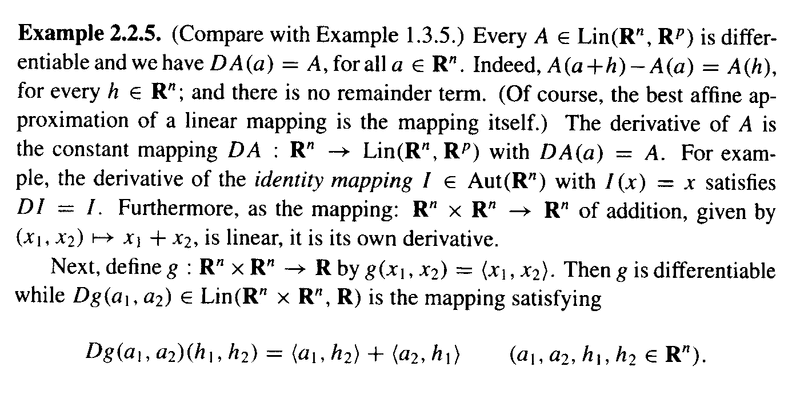
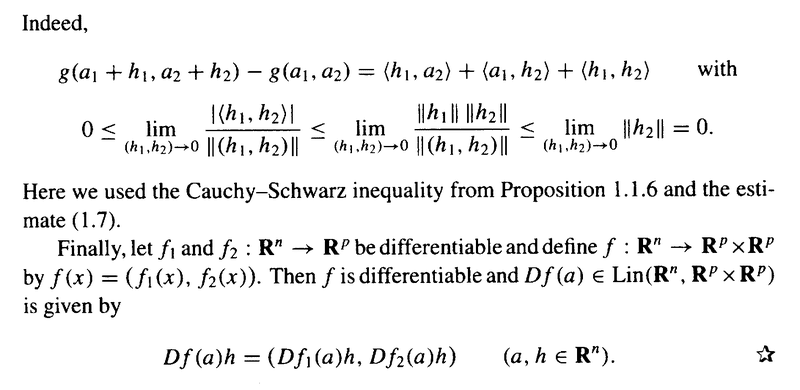 In the above text by D&K we read the following:
" ... ... Indeed ##A(a+h) - A(a) = A(h)##, for every ##h \in \mathbb{R}^n##; and there is no remainder term. ... ... "Now I can see that
##A(a + h) = A(a) + A(h)## ... ... (1) from the definition of ##A## ...
and in (2.10) we have ...
##A(a +h) - A(a) = DA(a)h + \epsilon_a(h)## ... ... (2)
So ... from (1) and (2) we get
##A(h) = DA(a)h + \epsilon_a(h)##
... BUT ... why, in D&K's terms is "there no remainder term" ...
... in other words ... why is ##\epsilon_a(h) = 0## ...
Hope someone can help ...
Peter
==========================================================================================***NOTE***
The above post refers to equation (2.10) which occurs in Definition 2.2.2 ... so I am providing Definition 2.2.2 and the accompanying text ... as follows:
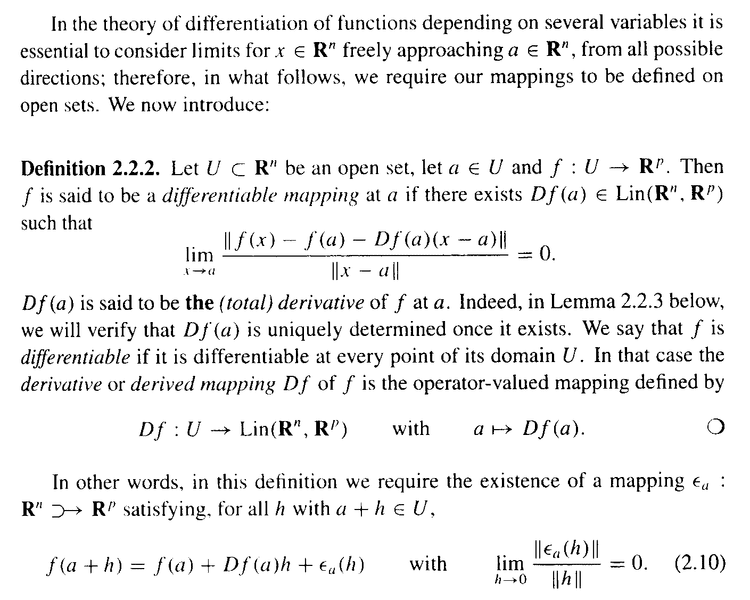
 I hope that helps readers understand the context and notation of the above post ...
Peter
I am focused on Chapter 2: Differentiation ... ...
I need help with an aspect of Example 2.2.5 ... ...
Duistermaat and Kolk's Example 2.2.5 read as follows:
" ... ... Indeed ##A(a+h) - A(a) = A(h)##, for every ##h \in \mathbb{R}^n##; and there is no remainder term. ... ... "Now I can see that
##A(a + h) = A(a) + A(h)## ... ... (1) from the definition of ##A## ...
and in (2.10) we have ...
##A(a +h) - A(a) = DA(a)h + \epsilon_a(h)## ... ... (2)
So ... from (1) and (2) we get
##A(h) = DA(a)h + \epsilon_a(h)##
... BUT ... why, in D&K's terms is "there no remainder term" ...
... in other words ... why is ##\epsilon_a(h) = 0## ...
Hope someone can help ...
Peter
==========================================================================================***NOTE***
The above post refers to equation (2.10) which occurs in Definition 2.2.2 ... so I am providing Definition 2.2.2 and the accompanying text ... as follows:
Peter
Attachments


Last edited: