Transformer open/short circuit test

Click For Summary

Discussion Overview

The discussion revolves around the concepts of impedance (Z) and resistance (R) in AC circuits, particularly in the context of transformer open and short circuit tests. Participants seek clarification on the differences between calculating impedance and resistance using various formulas and the implications of reactive components in AC circuits.

Discussion Character

  • Technical explanation
  • Conceptual clarification
  • Debate/contested

Main Points Raised

  • Some participants express confusion regarding the calculation of impedance (Z) and resistance (R), particularly why Z = V/I applies in AC circuits while R does not.
  • One participant suggests that the confusion may stem from applying Ohm's law for DC circuits to AC circuits.
  • Another participant clarifies that Z equals R only when there is no reactive component in the circuit.
  • There is mention of the power triangle, indicating the relationship between real power, reactive power, and apparent power in AC circuits.
  • One participant confirms their understanding of converting between complex numbers and polar notation, suggesting familiarity with the concepts discussed.

Areas of Agreement / Disagreement

Participants express varying levels of understanding regarding the relationship between Z and R, with some confusion remaining about the application of different formulas in AC versus DC contexts. The discussion does not reach a consensus on the underlying issues causing the confusion.

Contextual Notes

Limitations include potential misunderstandings of AC circuit principles, the application of DC equations to AC scenarios, and the need for clarity on reactive components and their effects on impedance calculations.

Luchekv
Messages
65
Reaction score
1
Hi guys,
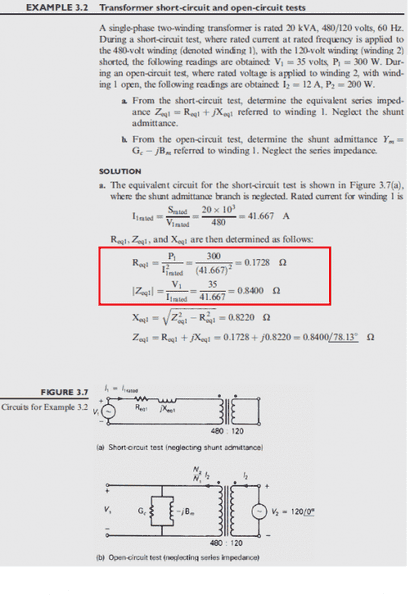
The problem isn't with the question itself its more to do with the fact about how they got Z and R. Just need some clarification.
confused.png

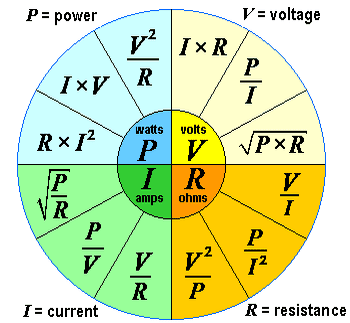
In every other AC power question. I have always worked out impedance with whatever parameters I had be it P/I^2 or V/I. I'm confused as to what the difference here is? Now I'm being thrown off and don't know what I'm calculating in other questions :S
Both of those formulas work out 'R' as can be seen here..so why are they getting two different numbers?
sds.png


Thank you in advance guys
 
Physics news on Phys.org
you have posted ohms law for DC not AC.

is that your confusion?

you know to replace R in your circular crib sheet with

Z = R + (Xl - Xc)j

?
 
I'm confused as to why Z = V/I and not R...but P/I^2 does
 
Luchekv said:
I'm confused as to why Z = V/I and not R...

You confused why Z does not equal R?

Z = V/I is ohms law for AC circuits

Z equals R when there is no reactive component.

Z is the total opposition to current flow defined as I wrote previously.are you happy with complex numbers (both using j notation and polar notation, and swapping between the two)?

Do you know the power triangle
http://sub.allaboutcircuits.com/images/02218.png
 
Last edited:
  • Like
Likes   Reactions: Luchekv
Thats perfect, thank you! and yes I'm good with converting between the two :)
 
Just a note, if you draw a power triangle. You'll notice that the 'real' Power is real (Re) and reactive power (Q) is Imaginary (Im), whereas apparent power (S) is a vector of both.

Considering that resistors only have the real component and no imaginary part, this is why you can apply the DC power equation to the AC circuit for this resistor.
 
  • Like
Likes   Reactions: Luchekv

Similar threads

  • · Replies 7 ·
Replies
7
Views
3K
  • · Replies 5 ·
Replies
5
Views
3K
  • · Replies 4 ·
Replies
4
Views
2K
  • · Replies 20 ·
Replies
20
Views
5K
  • · Replies 2 ·
Replies
2
Views
6K
Replies
19
Views
3K
  • · Replies 2 ·
Replies
2
Views
2K
  • · Replies 5 ·
Replies
5
Views
2K
  • · Replies 1 ·
Replies
1
Views
5K
  • · Replies 1 ·
Replies
1
Views
2K