Transistor Approximations: NPN BC548 vs. 2N3904, PNP BC559 vs. 2N3906

  • Thread starter Thread starter nomizzz
  • Start date Start date
  • Tags Tags
    Npn Transistor
Click For Summary
SUMMARY

The discussion focuses on substituting NPN BC548 and PNP BC559 transistors with 2N3904 and 2N3906 respectively for a Transistor Logic to RS-232 project. The participants confirm that the 2N3904 and 2N3906 transistors are suitable replacements, emphasizing the importance of understanding RS-232 signaling, which requires voltage levels between +5V to +15V for logical "0" and -5V to -15V for logical "1". The use of a MAX232 chip is recommended for level conversion to ensure compatibility with RS-232 voltage requirements.

PREREQUISITES
  • Understanding of transistor types: NPN and PNP
  • Familiarity with RS-232 signaling standards
  • Basic knowledge of circuit design and breadboarding
  • Experience with soldering electronic components
NEXT STEPS
  • Research the specifications and characteristics of 2N3904 and 2N3906 transistors
  • Learn about RS-232 signaling and voltage requirements
  • Explore the use of the MAX232 chip for level conversion
  • Study circuit design principles for transistor logic applications
USEFUL FOR

Electrical engineering students, hobbyists building RS-232 interfaces, and anyone interested in transistor logic circuit design.

nomizzz
Messages
2
Reaction score
0
Hello everybody,

I'm currently taking Electrical Engineering as senior physics major at Fordham University and have decided to take on a little side project to gain a better understanding.

What I'm attempting to create is my own Transistor Logic -> RS-232 (Rs-232 refers to the serial (com1) port on computers). I found a perfect simple circuit schematic which I've attached below, and I've purchased the breadboard, soldering iron and all the exact resistors, capacitors and diodes required. My problem is I couldn't find the two transistors, NPN BC548 and PNP BC559 at any of my nearby Radio Shacks.

After comparing the spec sheets online and doing a little bit of googling, I found that PNP transistor 2N3906's characteristics and specs seem to fit pretty well with BC559 and BC548 fits fairly well with 2N3904's. Unfortunately, we've only just got into transistors in EE right now and I have no equations to simplify them and determine if the voltage will be operable or even destructive for the computer that will be receiving the signal and sending it back.

Below is a fairly comprehensive diagram for the circuit that I retrieved from a website. My alterations, as I said, will be subbing in the 2N3906 for the BC559 and the 2N3904 for the BC548. What will this mean for my final voltages?
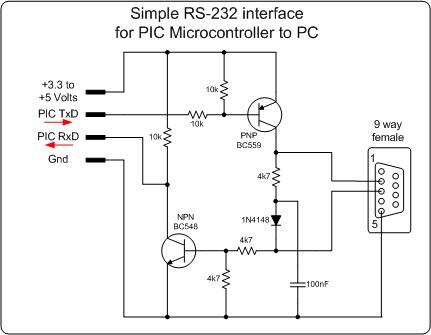


Xbox_360_lite-on_rs232_simple.jpg
 
Engineering news on Phys.org
It's really arbitrary for DC analysis. Beta of general purpose transistors is anywhere from 100 to 250. They are both silicon transistors with about 0.7v drop.
 
You should use the recommended voltages unless you know what is on the other end. The PNP collector output is received by some comparator or transistor with a threshold which you do not know.
 
nomizzz said:
Hello everybody,

I'm currently taking Electrical Engineering as senior physics major at Fordham University and have decided to take on a little side project to gain a better understanding.

What I'm attempting to create is my own Transistor Logic -> RS-232 (Rs-232 refers to the serial (com1) port on computers). I found a perfect simple circuit schematic which I've attached below, and I've purchased the breadboard, soldering iron and all the exact resistors, capacitors and diodes required. My problem is I couldn't find the two transistors, NPN BC548 and PNP BC559 at any of my nearby Radio Shacks.

After comparing the spec sheets online and doing a little bit of googling, I found that PNP transistor 2N3906's characteristics and specs seem to fit pretty well with BC559 and BC548 fits fairly well with 2N3904's. Unfortunately, we've only just got into transistors in EE right now and I have no equations to simplify them and determine if the voltage will be operable or even destructive for the computer that will be receiving the signal and sending it back.

Below is a fairly comprehensive diagram for the circuit that I retrieved from a website. My alterations, as I said, will be subbing in the 2N3906 for the BC559 and the 2N3904 for the BC548. What will this mean for my final voltages?


Xbox_360_lite-on_rs232_simple.jpg

Two things. First, the 3904 and 3906 jellybean trnsistors will work fine for this application. Second, you are not understanding how the RS-232 signalling works. It requires +/- voltages to work. A logical "0" is a voltage between 5V and 15V, and a logical "1" is a voltage between -5V and -15V.

That's why most uC circuits will use a MAX232 chip or similar, for the level conversion from TTL or CMOS logic levels to RS232 voltage levels. You can find more information about RS-232 signalling at Maxim's website:

http://www.maxim-ic.com/

.
 
A big thanks to all for the quick and helpful replies.

I'm going to breadboard the circuit design and check to make sure the the voltage fall within the appropriate ranges that berkeman suggested. If that clears, I'm going to begin soldering the pieces on to circuit board I bought and solder the finished product to my input device.

I'll post an update when I'm done.
 

Similar threads

  • · Replies 1 ·
Replies
1
Views
1K
  • · Replies 6 ·
Replies
6
Views
7K
  • · Replies 2 ·
Replies
2
Views
13K