Transmission line Secondary Coefficients

Join the discussion
Registration is free. Ask a follow-up in this thread, or start your own.
7 replies · 4K views
David J
Gold Member
Messages
140
Reaction score
15

Homework Statement


A transmission line has the primary coefficients as given below.

##R=2\Omega/m##
##L=8 nH/m##
##G=0.5 mS/m##
##C=0.23 pF/m##

Determine the lines secondary coefficients ##Z0##. ##\alpha## and ##\beta## at a frequency of ##1 GHz##

Homework Equations


[/B]
In my notes I am given

##\alpha=\frac{R}{2}\sqrt\frac{C}{L} +\frac{G}{2}\sqrt\frac{L}{C}## and ##\beta=\omega\sqrt{LC}##

The Attempt at a Solution


[/B]
##\alpha=\frac{2}{2}\sqrt\frac{0.23 X 10^-12}{8 X 10^-9} +\frac{0.5 X 10^-3}{2}\sqrt\frac{8 X 10^-9}{0.23 X10^-12}##

##\alpha=1 X \sqrt{2.875 X 10^-5} + (2.4 X 10^-4)\sqrt{34,782.6}##

##\alpha=\sqrt{2.875 X 10^-5} + (2.4 X 10^-4)\sqrt{34,782.6}##

##\alpha=(5.362 X 10^-3) +0.044760 = 0.050121902## nepers per meter

I think this is correct. I am unsure how to input the single multiplication sign `X` in LaTeX form. I think my " to the power of`s" are correct for ##R, L, G## and ##C## but I am unsure about the final result in nepers per meter

For the second part I got the following:-

##\beta=\omega\sqrt{LC}##

##(2\pi)(1 X 10^9) \sqrt{(8 X 10^-9)(0.23 X 10^-21)}##

So I have ##6,283,185,307\sqrt{1.84 X 10^-21}##

So ##6,283,185,307(4.289522 X 10^-11)=0.269518623## radians

So ##\beta= 0.269518623## radians

This second answer I am not so sure as I have some very large numbers but I have followed the examples in my notes.

Any comments on the two attempts above would be appreciated.

Thanks
 
Physics news on Phys.org
The values look okay. ##\beta## should be radians per meter. You'll want to round to the appropriate number of significant figures to match your "givens".

For multiplication in LaTeX you can use \times or \cdot : ##a \cdot b = a \times b##.
 
Thanks a lot for your help with this
 
gneill said:
The values look okay. ##\beta## should be radians per meter. You'll want to round to the appropriate number of significant figures to match your "givens".

For multiplication in LaTeX you can use \times or \cdot : ##a \cdot b = a \times b##.
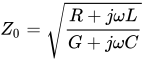
l Following onto this question i got all the same workings however we needed to find Zo aswell. Using
0f7a2214412eaf12fa94bf33a612ab95c0c24c2b
with the values above I got Zo=179.427+j26.5060 Ω or in polar Zo=181.375 /_+8.403° Ω (sorry don't currently have software to do the polar expression so used /_ to signify the angle).Does this sound correct for this answer?
 
Connorm1 said:
l Following onto this question i got all the same workings however we needed to find Zo aswell. Using
0f7a2214412eaf12fa94bf33a612ab95c0c24c2b
with the values above I got Zo=179.427+j26.5060 Ω or in polar Zo=181.375 /_+8.403° Ω (sorry don't currently have software to do the polar expression so used /_ to signify the angle).Does this sound correct for this answer?

https://www.wolframalpha.com/input/?i=√((2+(16π)i)/(0.0005+i(0.00046π))) Here's my workings using wolframalpha
 
gneill said:
Looks good.

Thanks @gneill! Only bit i was struggling on! But I hoped it'll be as simple as use the equation and plug in values. Helpful as always :)
 
In my opinion, the correct formula it is as follows:
α+jβ=sqrt[(R+jꞷL)x(G+jꞷC)]
The formula α=1/2xRxSQRT(C/L)+1/2xGxSQRT(L/C) it is good in the case in which
we can neglect R with respect to ꞷ*L and G with respect to ꞷ*C.
The difference is not more than 1-2%, indeed.
a=0.051409 and b=0.272549