Tricky circular area math problem from the GRE

Click For Summary

Homework Help Overview

The discussion revolves around a problem from the GRE practice exam involving the areas of circles and their intersections. Participants are trying to understand the relationships between the areas defined as x, y, and z, and how they relate to a specific quantity A derived from these areas.

Discussion Character

  • Exploratory, Conceptual clarification, Mathematical reasoning, Assumption checking

Approaches and Questions Raised

  • Participants express uncertainty about how to approach the problem and question the validity of guessing answers. Some attempt to derive relationships between the areas based on given values, while others explore the implications of the intersections of the circles.

Discussion Status

The discussion is active with various interpretations being explored. Some participants suggest that the problem may not require extensive algebra, while others are attempting to clarify the relationships between the areas. There is no explicit consensus on the best approach or interpretation of the problem.

Contextual Notes

Some participants question whether the thread fits within the homework category, indicating a potential ambiguity regarding the nature of the problem as it relates to formal coursework.

mgier001
Messages
12
Reaction score
0
Hey guys, I was wondering if anyone could help me out with this problem from the GRE practice exam:
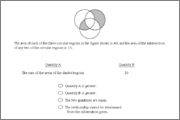
image.jpg


I honestly don't know how to go about solving it. I'm guessing that the answer is either B or D, however I know that in this GRE exam you can never guess... My friends think the answer is B but I have not been able to come up with any logical reasoning behind any of the answer choices.
This problem is tricky so if anyone can help me through it I would greatly appreciate it.
Thanks,
-Matt
 
Physics news on Phys.org
Is this thread misposted? I'm not sure if this problem would fall under a homework/coursework category since it technically is not homework or coursework... :\
 
mgier001 said:
Hey guys, I was wondering if anyone could help me out with this problem from the GRE practice exam:

image.jpg


I honestly don't know how to go about solving it. I'm guessing that the answer is either B or D, however I know that in this GRE exam you can never guess... My friends think the answer is B but I have not been able to come up with any logical reasoning behind any of the answer choices.
This problem is tricky so if anyone can help me through it I would greatly appreciate it.
Thanks,
-Matt
The area of each circle is ##x##. The intersection of two circles has area ##y##. The intersection of all three has area ##z##. Quantity A is given by ##y+(x-2y-z)##. What does this tell you?

mgier001 said:
Is this thread misposted? I'm not sure if this problem would fall under a homework/coursework category since it technically is not homework or coursework... :\
Technically, I think this goes under homework.
 
  • Like
Likes   Reactions: 1 person
Mandelbroth said:
The area of each circle is ##x##. The intersection of two circles has area ##y##. The intersection of all three has area ##z##. Quantity A is given by ##y+(x-2y-z)##. What does this tell you?


Technically, I think this goes under homework.


Well the area of each circle x=40, and intersection y=15. However, z is not given. I would guess z to be 7.5, but I don't want to simply guess an answer.

Solving with 7.5 yields: 15+(40-(2x15)-7.5) = 17.5
 
mgier001 said:
Well the area of each circle x=40, and intersection y=15. However, z is not given. I would guess z to be 7.5, but I don't want to simply guess an answer.

Solving with 7.5 yields: 15+(40-(2x15)-7.5) = 17.5
All you need to know is that ##z## is nonnegative. Other than that, it doesn't really matter what ##z## is. Try it. Algebra is fun. :-p
 
Mandelbroth said:
All you need to know is that ##z## is nonnegative. Other than that, it doesn't really matter what ##z## is. Try it. Algebra is fun. :-p

Do you mind explaining the equation? I would have subtracted 3y and added 2z.
x-3y+2z
 
we have 7 regions
3A
3B
1C
each circle is made up of 1A+2B+C
so 40=a+2b+c
each intersection of two circles is made up of B+C
so 15=b+c
our shaded region is made up of A+B
so 25=a+b
 
  • Like
Likes   Reactions: 1 person
Doing all that algebra is wasting valuable test-taking time. Take the smaller shaded region, and instead shade in one of the other two regions that have the same shape. Look at the overall shaded region that results.

p.s. Mod's note: moving this to homework area.
 
Put the small shaded area in the circle that has the large shaded area , it leaves you with the intersection of two circles which is 15.

So the shaded area is 40-15 = 25.

Not sure if it's suppose to be more complicated , but the statement that all the intersections of two circles are identical intuitively suggest that each of the three small areas surrounding the triple intersection are of the same size.Do you think you had to prove that?
 
  • Like
Likes   Reactions: smslca
  • #10
Mandelbroth said:
The area of each circle is ##x##. The intersection of two circles has area ##y##. The intersection of all three has area ##z##. Quantity A is given by ##y+(x-2y-z)##. What does this tell you?
I can't see where you get y+(x-2y-z) from. Using your labelling:

the larger shaded area = x - 2y + z

and the smaller shaded area = y - z

so Quantity A = (x - 2y + z) + (y - z) = x - y

As a couple of of the posters have already stated, it is intuitively obvious that it is x - y if you "move" the smaller shaded area into the other circle.
 
  • #11
I agree with Red Belly, no algebra is needed. This is a logic question, no maths involved.
 
  • #12
oay said:
I can't see where you get y+(x-2y-z) from. Using your labelling:

the larger shaded area = x - 2y + z

and the smaller shaded area = y - z

so Quantity A = (x - 2y + z) + (y - z) = x - y

As a couple of of the posters have already stated, it is intuitively obvious that it is x - y if you "move" the smaller shaded area into the other circle.
I misinterpreted their meaning of intersection of 2 circles as "the intersection of 2 and only 2 circles." I apologize.

Regardless, B is correct.
 

Similar threads

  • · Replies 3 ·
Replies
3
Views
2K
  • · Replies 3 ·
Replies
3
Views
1K
  • · Replies 10 ·
Replies
10
Views
5K
  • · Replies 5 ·
Replies
5
Views
3K
  • · Replies 4 ·
Replies
4
Views
4K
  • · Replies 6 ·
Replies
6
Views
3K
  • · Replies 14 ·
Replies
14
Views
3K
Replies
6
Views
3K
Replies
1
Views
2K
  • · Replies 2 ·
Replies
2
Views
2K