Trouble Understanding How to Apply Kirchhoff's Laws

  • Thread starter Thread starter gibberingmouther
  • Start date Start date
  • Tags Tags
    Apply Laws
Click For Summary
SUMMARY

This discussion focuses on the application of Kirchhoff's Laws in circuit analysis, particularly in determining current and voltage drops across resistors in a given circuit. The user struggles with identifying parallel and series connections among resistors, specifically noting that R34 is in parallel with R1, while R2 is not in parallel with R34. The user seeks clarification on using the formula E = IR and emphasizes the importance of practicing circuit problems to improve understanding and performance in physics coursework.

PREREQUISITES
  • Understanding of Kirchhoff's Laws
  • Knowledge of series and parallel resistor configurations
  • Familiarity with Ohm's Law (E = IR)
  • Basic circuit analysis techniques
NEXT STEPS
  • Practice solving circuit problems using Kirchhoff's Laws
  • Learn to identify series and parallel resistor combinations in circuits
  • Explore advanced circuit analysis techniques, such as mesh and nodal analysis
  • Review resources on voltage drop calculations across resistors
USEFUL FOR

Students in physics courses, particularly those studying electrical circuits, as well as educators and tutors looking to enhance their teaching methods in circuit analysis.

gibberingmouther
Messages
120
Reaction score
15
Homework Statement
Finding currents through resistors
Relevant Equations
R(eq. parallel) = (1/R1 + 1/R2 + …)^-1 and R(eq. series) = (R1 + R2 + …) and E=IR
I'm taking a break from music for a few days because I do that sometimes, and it's like a rule for me, and I usually listen to music when doing my physics homework. I'm realizing I have a little more trouble without that boost I get. But it could also be that what I'm trying to do is hard. I think I really need to work on circuit solving if I want to get a B in this class.

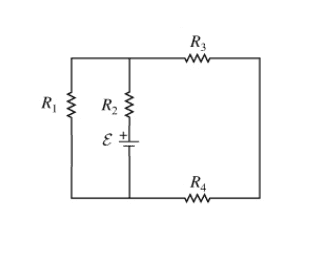
The specific circuit I was having trouble with is:
241054

I don't think I need to include the specific values, but the battery voltage and the resistance values for each resistor are given.

I tried breaking the circuit up into loops, but that doesn't seem to work very well. The problem asks what the currents going through each resistor are. I don't know how to find those values or the voltage drops.

I guess I can find the voltage drops if I can find the currents - because they would just be the currents times the given resistances, right? R34 is in parallel with R2 and R234 is in parallel with R1. So V34 = V2 and V234 = V1? Is V134 = V2?

Is I3 = I4 = I(eq.) for the entire circuit?

If somebody could help me understand how to apply E = IR along with the rules for parallel and series circuits that would help immensely.
 
Physics news on Phys.org
There are serveral methods to solve this problem. Perhaps it is better to know which method your professor expects you to use. Is it mentioned in the problem statement?

Also, it will be easier to work it out with the given component values instead of using variable names.
 
gibberingmouther said:
The specific circuit I was having trouble with is:
View attachment 241054
I don't think I need to include the specific values, but the battery voltage and the resistance values for each resistor are given.

I tried breaking the circuit up into loops, but that doesn't seem to work very well. The problem asks what the currents going through each resistor are. I don't know how to find those values or the voltage drops.

I guess I can find the voltage drops if I can find the currents - because they would just be the currents times the given resistances, right? R34 is in parallel with R2 and R234 is in parallel with R1. So V34 = V2 and V234 = V1? Is V134 = V2?

No, R34 (the series equivalent of R3 and R4 ) is not parallel with (Edit:)R2. Two resistors are connected in parallel if they have two pairs of terminals in common, but one terminal of R2 is connected to the positive terminal of the source.
But R1 is parallel with R34.
241064


The red dot is common for all the tree resistors, but the blue one is common for R1 and R34 only.

gibberingmouther said:
Is I3 = I4 = I(eq.) for the entire circuit?
No
 
Last edited:
ehild, you said that R34 is not in parallel with R1 but R1 is in parallel with R34? Is that what you meant to say? My understanding was that if two resistors are in parallel, then they are in parallel to each other. Did you mean to say R2 is in parallel with R34?
 
gibberingmouther said:
ehild, you said that R34 is not in parallel with R1 but R1 is in parallel with R34? Is that what you meant to say? My understanding was that if two resistors are in parallel, then they are in parallel to each other. Did you mean to say R2 is in parallel with R34?
Sorry, I meant R34 is not parallel with R2.
 
  • Like
Likes   Reactions: gibberingmouther
I had trouble for awhile, but I think I get it now thanks to an electronics site I found and the hints on Pearson. I just need to do some practice problems so I'm less likely to make mistakes when I take the final exam, because solving these circuits sometimes involves a lot of steps and algebra.

Figuring out how to do this is so far the hardest thing I've done in my two physics courses, even though the rules you're supposed to use seem so simple. I've had an easier time with complicated formulas that use calculus than with solving circuits.
 

Similar threads

  • · Replies 8 ·
Replies
8
Views
2K
  • · Replies 3 ·
Replies
3
Views
2K
Replies
3
Views
2K
  • · Replies 8 ·
Replies
8
Views
2K
  • · Replies 10 ·
Replies
10
Views
3K
  • · Replies 18 ·
Replies
18
Views
3K
Replies
2
Views
6K
  • · Replies 16 ·
Replies
16
Views
2K
Replies
4
Views
2K
  • · Replies 4 ·
Replies
4
Views
2K