Trouble with calculating acceleration from velocitity using calculus

Click For Summary

Homework Help Overview

The discussion revolves around calculating acceleration from velocity using calculus, specifically focusing on the relationship expressed by the equation a = v dv/ds. Participants are exploring the steps involved in applying calculus to derive acceleration from a given velocity function.

Discussion Character

  • Conceptual clarification, Mathematical reasoning

Approaches and Questions Raised

  • The original poster attempts to understand the transition from the equation a = v dv/ds to a specific form of acceleration. Some participants discuss the application of the chain rule in differentiation and how it relates to the problem at hand.

Discussion Status

Participants are actively engaging with the mathematical concepts involved, with some providing explanations about the chain rule and differentiation. The original poster expresses a clearer understanding after receiving input from others, indicating a productive exchange of ideas.

Contextual Notes

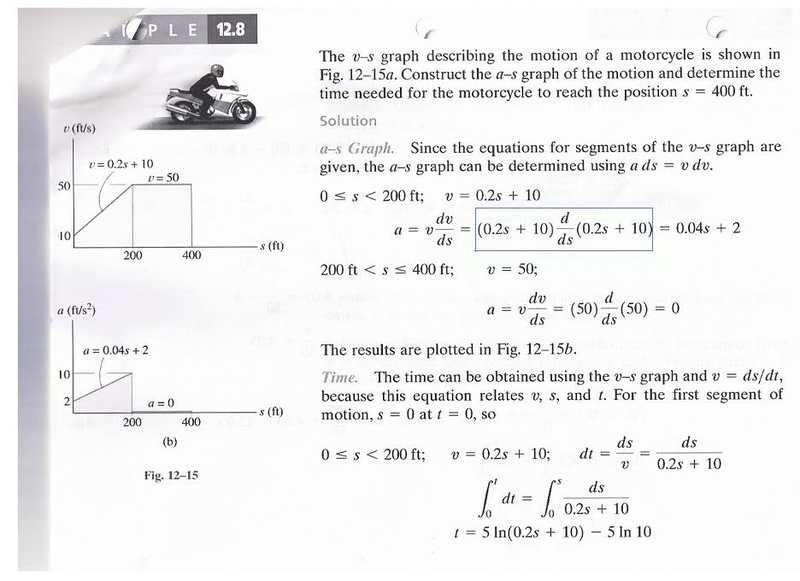
The original poster is working with a specific velocity function presented graphically, which influences the discussion on how to differentiate it to find acceleration. There is an emphasis on understanding the calculus principles rather than simply obtaining a solution.

James22
Messages
8
Reaction score
0
I don't understand what is happening after the a=v dv/ds statement. If someone could explain the steps using calculus to end up with a=0.04s + 2 I would really appreciate it. I am trying to figure it out by reading over my old calculus notes, but I can't make a connection between the two.
Homework Statement


oidk41.jpg


Homework Equations


a=v dv/ds

The Attempt at a Solution


I am just trying to follow along at this point. I don't understand what is happening after the a=v dv/ds statement. If someone could explain the steps using calculus to end up with a=0.04s + 2 I would really appreciate it.
 
Last edited:
Physics news on Phys.org
The steps make use of a property of differentiation called the chain rule. It basically says that the derivative of a function with respect to one variable (e.g. x) can be expressed as the product of the derivative of that function with respect to another variable (e.g. y) times the derivative of y with respect to x (provided y also depends on x). That statement may have been difficult to parse, so here it is in equation form:

If f is a function of y, f(y), and y is also a function of x, y(x), then:

\frac{df}{dx} = \frac{df}{dy}\frac{dy}{dx}​

This is the chain rule for differentiation. In your example, the chain rule has been applied to the derivative of velocity with respect to time. Velocity is a function of time, v(t), but position is also a function of time s(t). therefore, using the chain rule, we can write:

a(t) = \frac{dv}{dt} = \frac{dv}{ds}\frac{ds}{dt}​

Now, in this last step, ds/dt, which is the rate of change of position with time, is just velocity (v = ds/dt by definition). So, substituting v for ds/dt, the expression becomes:

a(t) = \frac{dv}{dt} = \frac{dv}{ds}v​
 
Last edited:
Rewriting it in this way is useful because you already know the velocity as a function of position v(s) (rather than time). It is given to you in graphical format. So, the remaining steps are:

v(s) = 0.2s + 10​

To differentiate the velocity with respect to position, basic calculus rules were used. The derivative of a sum of two functions is the sum of the derivatives of those two functions. Also, remember the power rule for differentiation of functions that can be expressed as powers of the independent variable. If:

f(s) = As^n​

then:

\frac{df}{ds} = nAs^{n-1}​

For this reason, the derivative of a constant function is zero, because n=0 in that case. Intuitively, a constant function doesn't change, so its rate of change is zero. In our particular example, we can apply these rules as follows:

v(s) = 0.2s^1 + 10

\frac{dv}{ds} = \frac{d}{ds}(0.2s^1 + 10) = \frac{d}{ds}(0.2s^1) + \frac{d}{ds}(10) = 0.2s^0 + 0 = 0.2​

Therefore:

v\frac{dv}{ds} = (0.2s + 10)(0.2) = 0.04s + 2​
 
Thank you Cepheid, I understand now.
 

Similar threads

Replies
3
Views
2K
  • · Replies 4 ·
Replies
4
Views
1K
  • · Replies 1 ·
Replies
1
Views
2K
  • · Replies 5 ·
Replies
5
Views
1K
  • · Replies 6 ·
Replies
6
Views
2K
Replies
8
Views
2K
Replies
6
Views
2K
  • · Replies 5 ·
Replies
5
Views
2K